How did Elephant Walk (1954), a film which is barely remembered today, wind up as Paramount's most
expensive to date, with a final cost of $3 million? Blame it on a costly production to begin with, mixed with a location
shoot half a world away and a famous star suffering a mental breakdown in the middle of filming, forcing the studio
to replace her. The location was Ceylon (now Sri Lanka), the star was Vivien Leigh, and her replacement was
Elizabeth Taylor.
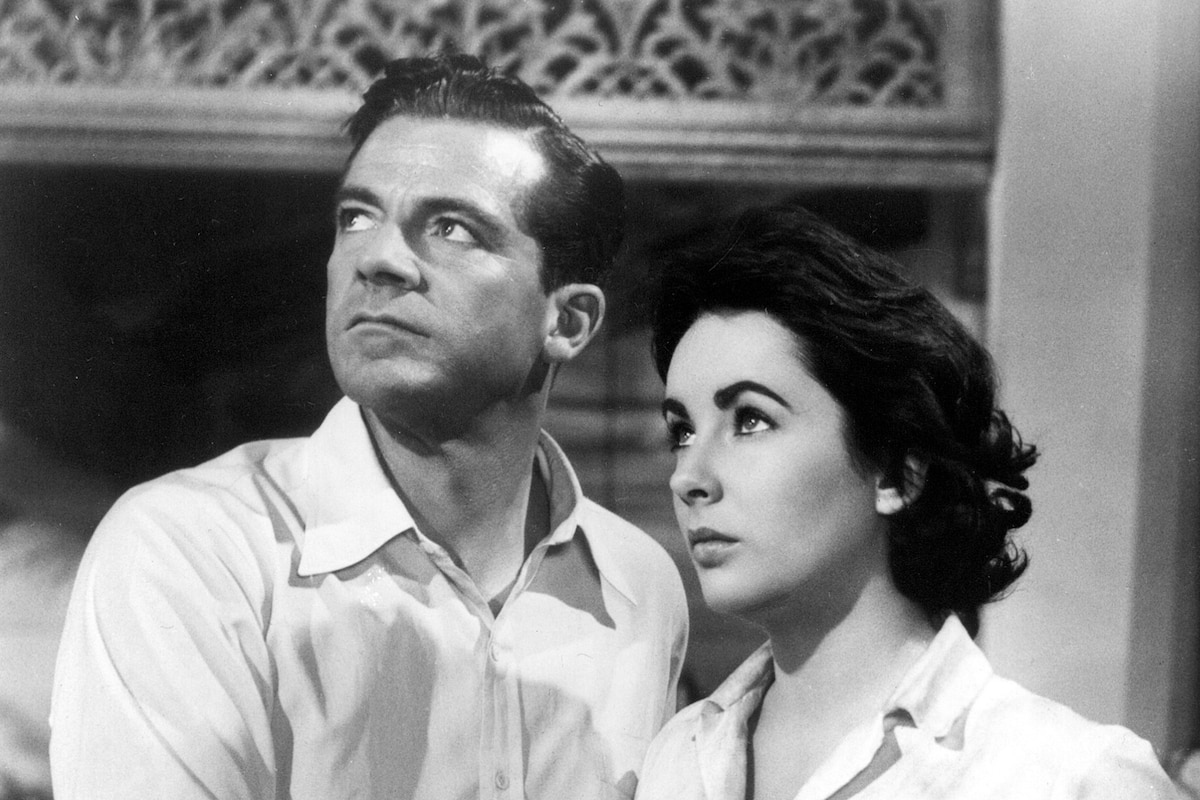
The plot of Elephant Walk is somewhat similar to Rebecca (1940), with Elizabeth Taylor as the new
bride whom Peter Finch brings home to his ancestral tea plantation in the Ceylon jungle. He doesn't pay her any
attention, however, preferring to slack around with his buddies (indoor bicycle polo, anyone?), and naturally Taylor
starts to fall for the plantation foreman, played by Dana Andrews. The film's title comes from the fact that the
plantation was built smack in the middle of the elephants' ancient jungle pathway. A violent climax features the
massive beasts stampeding the property as they reclaim their right of way.
Producer Irving Asher originally wanted Laurence Olivier and Vivien Leigh to star in this picture, but Olivier disliked
the script, turned it down, and encouraged his wife Vivien to do the same. When she signed on despite his
objections, Olivier recommended Peter Finch to play the husband. Finch was Olivier's protégé, still unknown in
Hollywood, but ultimately he got the part.
Once on location, he also embarked on a passionate affair with his mentor's wife. That would pose the least of the
problems for producer Asher, however, as Leigh's mental state quickly deteriorated. A manic-depressive, she started
hallucinating, addressing Finch as "Larry," and showing bizarre confusion about where she was. She even mixed up
lines of Blanche Dubois's dialogue from A Streetcar Named Desire with her lines for this film. Olivier was
called to the location to see what he could do but his visit was in vain. (Their marriage was already troubled and
would end in divorce six years later.) Finally, after about three weeks, Leigh was flown back to Hollywood to
recuperate, but it was already clear that she would have to be replaced. Paramount was losing a lot of money
because of the delays and had to press on. (On the flight back, Leigh had a particularly bad mental attack, screaming
and trying to open the plane door, and had to be sedated.)
Leigh's wildly shifting moods had already prompted director William Dieterle to shoot her scenes twice, including
versions in which Leigh was far enough in the background that the shot could still be used if she was replaced.
(Indeed, some of these shots remain in the picture.) He also framed some shots with her back to the camera for the
same reason and shot some scenes without her at all, so that the footage could be used as background for process
shots.
Dieterle's intuition proved correct. Asher got Paramount to replace Leigh with MGM star Elizabeth Taylor, even
though at age 21 she was almost twenty years younger than Leigh. MGM took extreme advantage of the situation
charging Paramount an astronomical $150,000 for the loanout.
Taylor had recently given birth to her first child, and Edith Head's costumes had to be refitted for the bustier actress; a
few had to be remade altogether. Taylor idolized Leigh. According to biographer Donald Spoto, she said of her:
"Vivien Leigh was my heroine. She was innocence on the verge of decadence, always there to be saved."
Of Taylor's performance here, Spoto wrote: "Elizabeth made a virtue of necessity, turning her underwritten character
into a small miracle of slightly subdued sexual hysteria and shining, in glorious Technicolor, against the most
unlikely projected backgrounds."
It's a little hard to believe that Finch's character would ignore his wife as played by the stunning Elizabeth Taylor,
which Asher later acknowledged: "[I was] faced with an almost impossible situation," he said, "because in the
original story there was a shrew who really created problems for her tea-planter husband. He would rather stay
downstairs and play childish games with the boys, like riding around on bicycles, than face the scorpion Vivien
waiting for him to go up to bed with her....Vivien was absolutely perfectly cast. She just had to stand there and tacitly
demand his presence. The camera did the rest. But Elizabeth, extremely young then, and simply magnificent to look
at, coming down in a negligee, trying to get Peter to come up with her, just didn't ring true. There isn't a man on
earth who wouldn't have raced up those stairs!"
The impressive elephant stampede took some time to pull off. The elephants were so well-trained, Finch observed,
"they could step on a matchbox without breaking it." True enough, they had been trained never to touch anything,
and now they were being asked to destroy a house. It took several hours to get them to do it, and they were helped
by the fact that all the structures and furniture had been partially sawn apart in advance so they would crumble
easily.
Producer: Irving Asher
Director: William Dieterle
Screenplay: John Lee Mahin, Robert Standish (novel)
Cinematography: Loyal Griggs
Film Editing: George Tomasini
Art Direction: J. McMillan Johnson, Hal Pereira
Music: Franz Waxman
Cast: Elizabeth Taylor (Ruth Wiley), Dana Andrews (Dick Carver), Peter Finch (John Wiley), Abraham Sofaer
(Appuhamy), Abner Biberman (Dr. Pereira), Noel Drayton (Planter Atkinson).
C-103m. Closed captioning.
by Jeremy Arnold
SOURCES:
Alexander Walker, Elizabeth: The Life of Elizabeth Taylor
Donald Spoto, A Passion For Life: The Biography of Elizabeth Taylor
Elaine Dundy, Finch, Bloody Finch
Trader Faulkner, Peter Finch
Elephant Walk
by Jeremy Arnold | April 13, 2007
SIGN UP FOR OUR NEWSLETTERS

CONNECT WITH TCM