Decision Against Time (1956), released in its native Britain as Man in the Sky, was one of the last movies to come out of the famed Ealing Studios. The company was in decline and its most recent distribution arrangement, with The Rank Organisation, had just ended. A new deal was struck for six Ealing pictures to be distributed by MGM, of which Decision Against Time was the first. (A seventh and final Ealing film, The Siege of Pinchgut, was distributed by Associated British-Pathe in 1959.)
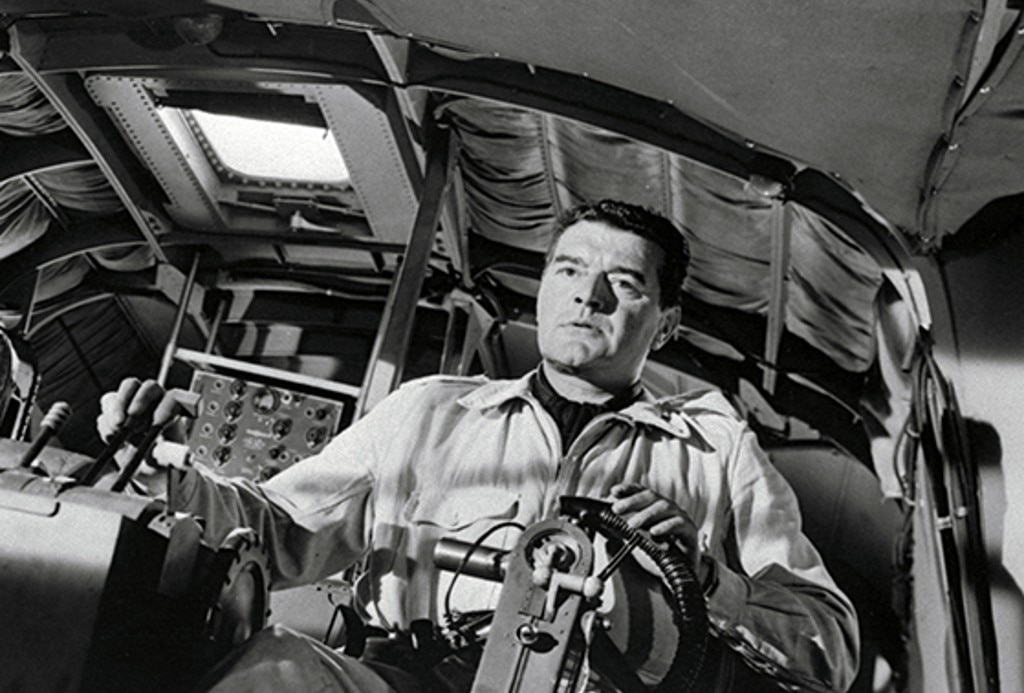
Ealing was known most for its comedies, of course, but Decision Against Time is a drama. Jack Hawkins plays a test pilot whose plane becomes crippled and may not be able to land safely. If the plane is lost, an entire company will go out of business. Meanwhile, Hawkins is having domestic problems with his wife (Elizabeth Sellars).
As directed by Ealing stalwart Charles Crichton, whose most famous movies are The Lavender Hill Mob (1951) and A Fish Called Wanda (1988), Decision Against Time made an impression with its aerial photography and moderately suspenseful storyline, but did not register as anything exceptional. As Variety declared: "[It] has its moments of suspense but lacks development of this quality that might have made this British import a truly gripping melodrama." The critic added perceptively: "Hawkins has good support from players in usual matter-of-fact roles which characterize so many British films but don't appeal particularly to American audiences."
In his autobiography, Hawkins later wrote that
Decision Against Time contained one of his favorite scenes from his entire career: "In the first scene we shot I had to land an aircraft that had developed a serious fault in mid-air and then, in the most humdrum way, climb into my car, stop to pick up some laundry, make my way home...and start to run a bath. My wife, beautifully played by Elizabeth Sellars, asks me how the day has gone, and I said 'all right' in an offhand manner. Unknown to me she had witnessed the near-disaster, and she rounds on me, accusing me of being prepared to sacrifice her and our children simply for my job.
"I then had a six-minute speech, which was really the justification why a man does a job - any job - which was brilliantly written by Bill Rose, one of the finest screenwriters, and a man who wrote perfectly for me. This speech attracted a lot of attention, and for an actor no feeling exceeds the satisfaction when people come up afterwards and say that the character you played was splendid, and you were the right person to play it."
Film historian William Everson also wrote about the scene in a thoughtful little essay. "Rather like a low-key Ceiling Zero [1936]," he wrote, "deliberately downplaying the tension on the ground, Man in the Sky gives Hawkins a role different from yet at the same time emotionally parallel to the one he had played in The Long Arm [1956]. It's not in essence a typical Ealing story, [but] there are some surprises, especially the heated climactic exchange between Hawkins and his wife, ...a reminder of the pre-war and wartime Ealing films in which Ealing recognized the (now-outdated) position of the husband/father as undisputed master of the household, at least in British society of that period. The film is strongest in its opening and closing reels; if the middle section seems slacker it is only because by then the plot has revealed that it is not going to be complex or spectacular but basically simple... But it is thoroughly satisfying in a way typical of Ealing."
Look for Donald Pleasence in a small role.
Producer: Michael Balcon, Seth Holt
Director: Charles Crichton
Screenplay: John Eldridge, William Rose
Cinematography: Douglas Slocombe
Film Editing: Peter Tanner
Art Direction: Jim Morahan
Music: Gerard Schurmann
Cast: Jack Hawkins (John Mitchell), Elizabeth Sellars (Mary Mitchell), Jeremy Bodkin (Nicholas Mitchell), Gerard Lohan (Philip Mitchell), Walter Fitzgerald (Reginald Conway), John Stratton (Peter Hook).
BW-87m.
by Jeremy Arnold
Decision Against Time
by Jeremy Arnold | April 10, 2007
SIGN UP FOR OUR NEWSLETTERS

CONNECT WITH TCM