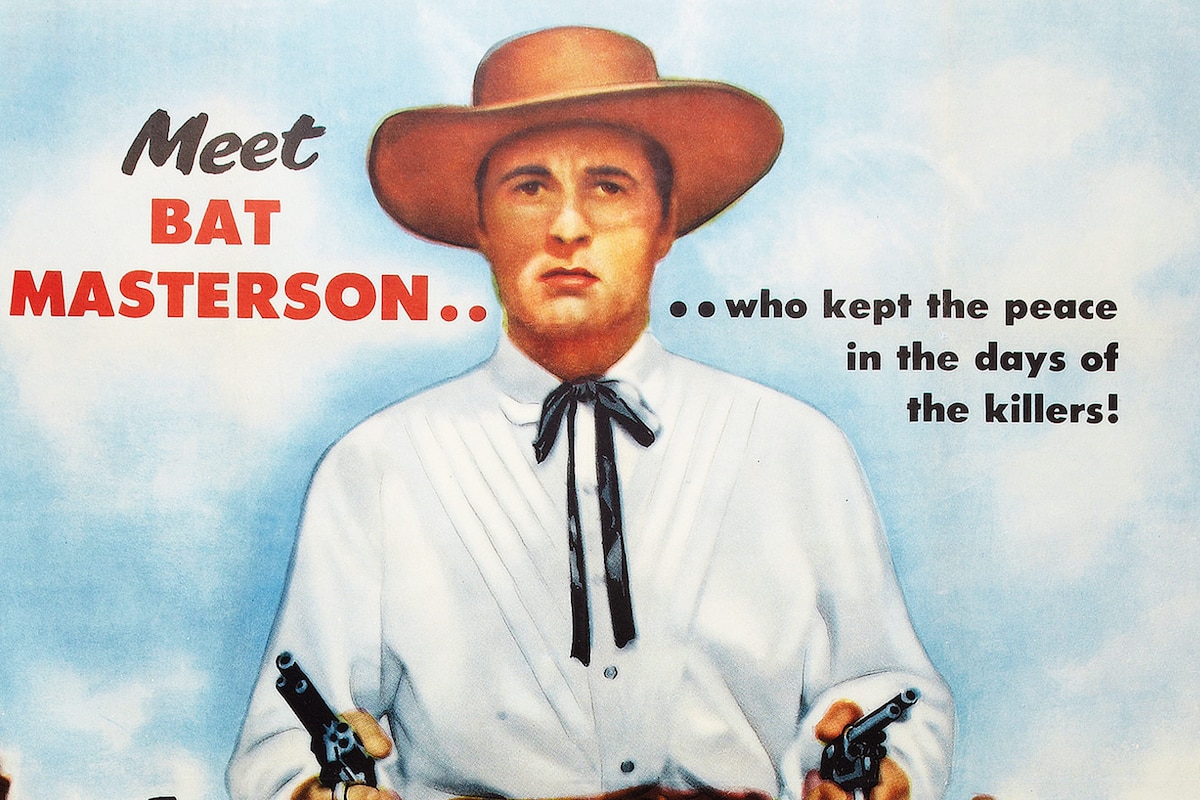
Audiences who attended the Columbia Pictures release of Masterson of Kansas (1954) got not one but three legends of the Wild West for their money: Bat Masterson, Doc Holliday and Wyatt Earp. The story involves Dodge City Sheriff Masterson's efforts to prove that a group of cattlemen are framing an acquaintance of his, Merrick, for murder because Merrick negotiated a treaty that gave land rights to a Kiowa tribe. He enlists the aid of Earp and Holliday in bringing the true murderer to justice, thereby preventing an Indian war.
In real life, Masterson (born in Illinois in 1855), was initially a deputy marshal under Earp in Dodge City. In 1877 he campaigned for and won the post of county sheriff, where he enforced a curfew and gun restrictions on the often lawless town. In 1879, he was appointed U.S. deputy marshal but lost his bid for re-election primarily because of accusations by a newspaper editor that he was crooked. After that, he made a living as a gambler in such Western boom towns as Leadville, Deadwood, and Tombstone (where he came to know Holliday, a friend of Earp's). Eventually he went East to New York, where he was for a time U.S. deputy marshal (appointed by his friend President Teddy Roosevelt) and editor for the New York Morning Telegraph. His three-times-a-week column was one of the paper's most popular. He lost his law enforcement job when Roosevelt left office but stayed on in New York, continuing his newspaper work. On October 25, 1921, in the middle of writing his column, he died at his desk of a sudden heart attack.
The Western legend has been portrayed on screen a number of times by, among others, Joel McCrea and Randolph Scott. Gene Barry played Masterson in a long-running TV series. Here the role is taken on by George Montgomery, a former boxer who, while never a top-rank star, made a string of popular action-packed Westerns in the 1950s. During this time, he was married to singer Dinah Shore, a successful recording and television star. In later life, he turned his self-taught talents to sculpture and created busts of such Western film legends as John Wayne, Gene Autry, Randolph Scott and Clint Eastwood.
Masterson of Kansas was directed by William Castle, better known for his horror movies and the over-the-top gimmicks and marketing devices he used to draw audiences. Among the pictures he directed were such early 60s schlock-horror classics as The Tingler (1959), which used a vibrating device attached to theater seats for shock effect; Thirteen Ghosts (1960), released in "Illusion-O," requiring viewers to use special glasses to see the ghosts; and the late Joan Crawford vehicles Strait-Jacket (1964) and I Saw What You Did (1965). As a producer, he gained a measure of respectability when he produced Rosemary's Baby (1968) for director Roman Polanski and even appeared in a cameo. He also served as associate producer and uncredited second unit director on Orson Welles' film noir The Lady from Shanghai (1947). John Goodman played a character based on Castle in the affectionate spoof of the B-movie industry Matinee (1993).
The chief of the Kiowa in this picture is played by Jay Silverheels, famous as the faithful Indian companion Tonto in the long-running Lone Ranger TV series and subsequent spin-off films. The Canadian-born son of a Mohawk chief, Silverheels entered the movie business in 1937 and worked steadily through 1974, although always typecast as the stereotypical Indian character. In later years, he became a spokesperson for improving the portrayals of Indians. He died in 1980.
Director: William Castle
Producer: Sam Katzman
Screenplay: Douglas Heyes
Cinematography: Henry Freulich
Editing: Henry Batista
Art Direction: Paul Palmentola
Original Music: Mischa Bakaleinikoff (uncredited)
Cast: George Montgomery (Bat Masterson), Nancy Gates (Amy Merrick), James Griffith (Doc Holliday), Bruce Cowling (Wyatt Earp), Jay Silverheels (Yellow Hawk).
C-73m.
by Rob Nixon
Masterson of Kansas
by Rob Nixon | March 12, 2007
SIGN UP FOR OUR NEWSLETTERS

CONNECT WITH TCM