Oscar Wilde wrote his most famous play as a satire of marriage, Victorian morality, class-consciousness and the conventions of romantic comedy. Some critics have interpreted the leading male characters' double lives as a subtle reflection of Wilde's secret homosexual life while also a married man with two children. Algernon's address on Half Moon Street is the same as Wilde's, and, like Wilde, he wears a green carnation in his lapel.
Wilde originally wrote the play in four acts, with the third act dealing with the arrival of a lawyer out to collect bad debts Jack had run up as Ernest in London. When the producer asked him to shorten the play, Wilde cut the lawyer and combined acts three and four.
The play was a tremendous hit when it opened in London in 1895. It closed after only 83 performances, however, because of Wilde's prosecution for gross indecency when his libel suit against the Marques of Queensberry led to revelations of his homosexual relations. The play was not revived until 1900, after Wilde's death, when it became one of his most popular works.
Nonetheless, the play was a hit in every country in which it was performed, even when translated into other languages. The title's pun on the name "Ernest" and the quality of "being earnest" only translates into German and Dutch. In other countries it was called everything from Bunbury to Who Is Ernest? and The Importance of Being Named Ernest. In France, the pun was preserved by naming the leading man "Constant," while he was called "Franco" in Italy, "Szilard" (steadfast) in Hungary and "Filip" in Czech, a language in which "having Philip" means being smart.
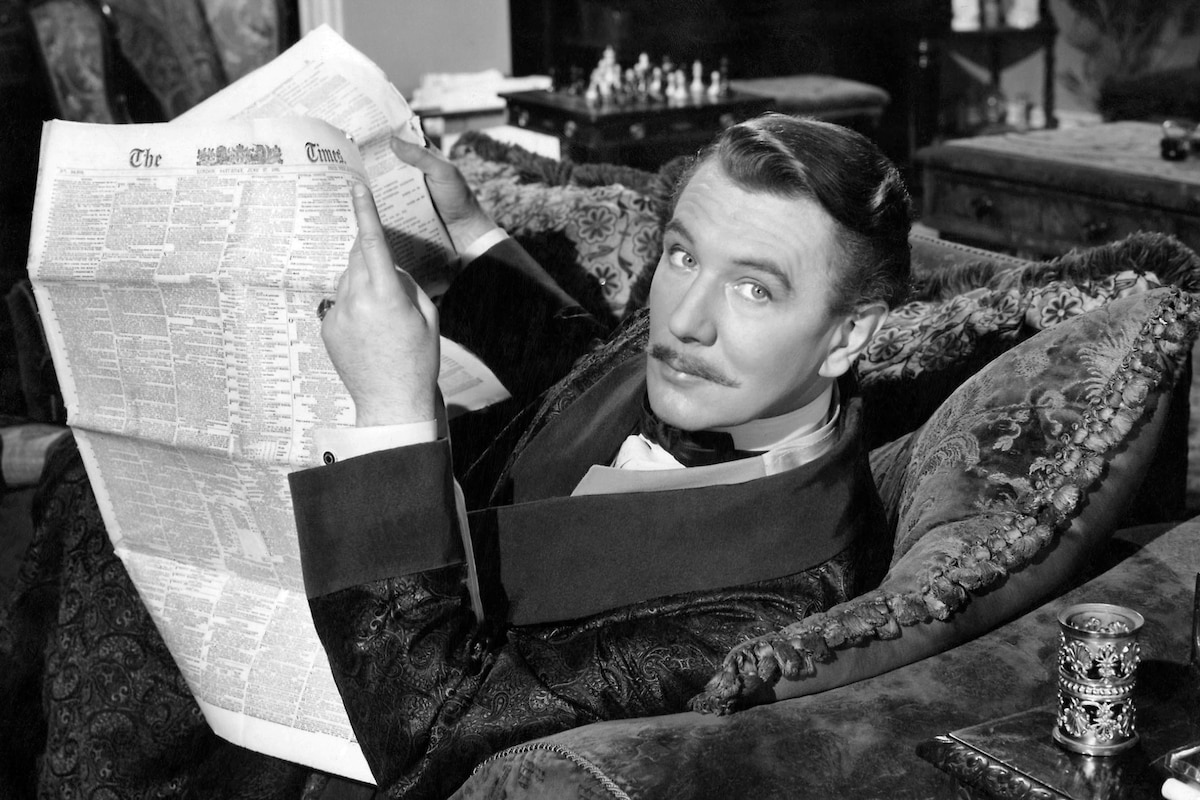
Although the play was a staple of the British and American stage, this was the first English-language film version. It was made at the urging of actor Michael Denison, who played Algernon, just after the script passed into the public domain.
Denison was under contract to the Associated British Picture Corporation, which first announced plans to make the film. It was J. Arthur Rank, however, who registered the title first. As a condition to settle any dispute with the other studio, he agreed to cast Denison as Algernon.
Asquith wrote the screenplay himself, simply making a few minor changes in Wilde's original. He declined to accept screen credit for it, triggering a battle with the British screenwriters' union.
Two of the film's actors were already noted stage interpreters of their roles, Michael Redgrave, who had performed Ernest to great acclaim in London and on Broadway, and Edith Evans, who played Lady Bracknell.
Asquith originally offered the role of Jack to John Gielgud, another of the most famous stage interpreters of the role. Gielgud declined because he did not like film acting.
Dorothy Tutin made her film debut as Cecily. Redgrave had suggested her for the role after seeing her work on stage, where she had debuted as a leading lady at 18.
by Frank Miller
The Big Idea
by Frank Miller | March 02, 2007
SIGN UP FOR OUR NEWSLETTERS

CONNECT WITH TCM