Before filming began on Red River, consideration was given to shooting in color, but Hawks found the color processes at that time to be too garish and decided on black-and-white as being more conducive to a feeling of the period.
Hawks and his crew scouted more than 15,000 miles of territory in Texas, Arizona, New Mexico, Oklahoma and Mexico before settling on a location. Red River was shot on a vast cattle ranch near Elgin, Arizona from June through November 1946. Other locations included the Whetstone Mountains in Arizona and the San Pedro River, standing in for the Red River.
The San Pedro River was in a location where it seldom rained which was ironically named the Rain Valley. Hawks had five dams built on the river to make the waters rise to the appropriate level.
Despite the reputed lack of rain, there were frequent unexpected downpours on location. Wayne convinced Hawks to shoot in all weather, and the script was rewritten to accommodate a fierce storm.
Shots of the great cattle drive required 25,000 gallons of water to settle the dust kicked up by the cattle.
To coordinate the massive movement of actors, crew and cattle, the company depended on short-wave radios and walkie-talkies for communications.
Two sets of costumes were required to cover wear and tear, to a total of $150,000 for the cowboys' wardrobe (Joanne Dru's costumes alone cost more than $20,000). Each actor had two pairs of boots at $150 a pair.
Delays were caused by weather and illness. Wayne was bedridden with a severe cold, Dru caught the flu, and Hawks had to be hospitalized after being bitten by a centipede. On the first day of shooting, Clift burned himself on the thigh with a blank cartridge practicing quick draws.
Originally budgeted at around half a million, the film eventually cost at least twice that to make.
Hawks said he often thought of Western master John Ford when shooting, particularly in a burial scene when ominous clouds started to gather. He told Wayne to keep talking, say anything, and they would fix the sound later. In the final cut, the scene is played with a big cloud dramatically passing over, and Hawks said he told Ford, "Hey, I've got one almost as good as you can do-you better go and see it."
Clift had learned to ride horses while at military prep school, but it was a different kind of riding than he was required to do in this role. He asked experienced Western actor Noah Beery, Jr. for help and worked hard to become convincing on screen. Beery later said, "The thing he enjoyed most was becoming a hell of a good cowboy and horseman." Hawks always had high praise for how hard Clift worked on the picture.
The slightly built, 5' 10" Clift was nervous about standing up to the 6' 5" Wayne but gained confidence when Hawks told him to play his scenes like David against Goliath. He also urged the young actor to underplay in his scenes with Wayne, particularly the scene in which his character challenges Dunson for the first time. Wayne was also not sure Clift could be convincing as a rugged cowboy, but after that first confrontation scene he told Hawks his doubts were gone and "he's going to be okay."
Despite Wayne's acceptance of Clift in the part, the two did not become friendly. Clift hated the way the story had been changed to allow Wayne's character to live at the end, and Wayne told Life magazine, "Clift is an arrogant little bastard." The younger actor did occasionally take part in the nightly poker games Wayne and Hawks organized but also said, "They tried to draw me into their circle but I couldn't go along with them. The machismo thing repelled me because it seemed so forced and unnecessary."
Wayne responded to Clift's underplaying by working harder at his difficult role. In the scene where Clift's character tells him he's taking over the drive and moving the herd to Abilene, Wayne turned his back on him and said in a low voice, "I'm gonna kill you, Matt." The action was counter to Hawks' direction to have Wayne cringe. But the actor refused to appear cowardly and played it his way, to Hawks' ultimate satisfaction. The improvised moment left Clift dumbfounded and was used in the final cut.
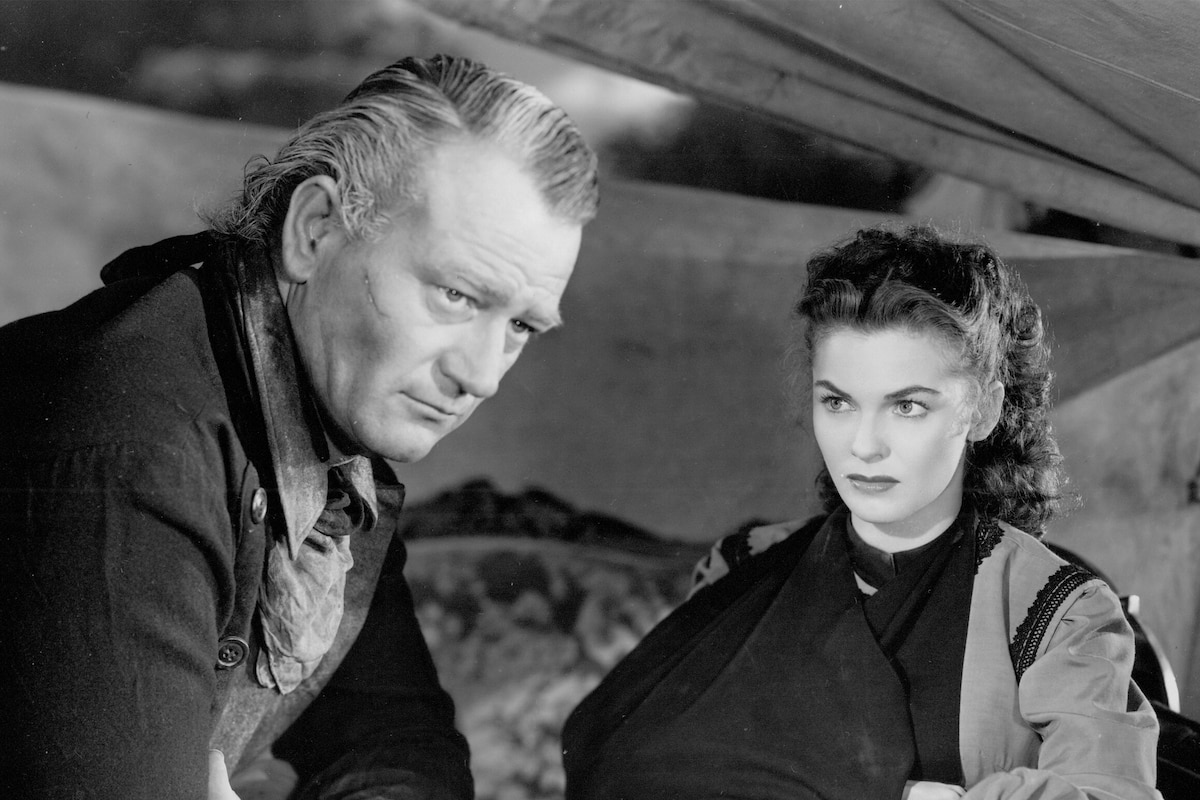
Hawks and Wayne also differed on how Wayne would play the aged Dunson. Hawks thought that beyond the added gray hair and wrinkles, Wayne should move and talk differently and suggested he consult Walter Brennan on techniques for appearing old. Wayne found the shuffling and tottering that Brennan suggested to be detrimental to his character and image and played it his own way, "standin' tall." But Wayne did interject some subtle movements to convey his advanced years, such as reaching out for Clift's assistance in rising to his feet from a crouch. "Oh, yeah, Hawks and I had a few fights along the way," Wayne said, "but he accepted me as an expert, which I was, and we did not have any more trouble, and I was always happy to work for Hawks."
Hawks had great respect for Wayne, even though many people didn't consider him a great actor. "He's a damn good actor. He does everything, and he makes you believe it," Hawks later commented.
Hawks insisted Walter Brennan play his role mostly without his false teeth for the running gag about his character losing his teeth in a poker game. At first Brennan balked, but then remembered he had earned a Best Supporting Actor Oscar® playing mostly without his teeth under Hawks' direction in Come and Get It (1936) so he consented.
Writer Borden Chase, who did not get along well with Hawks, claimed the director fancied Joanne Dru and was so upset by her attention to John Ireland that he cut Ireland's role in the picture considerably. Hawks later called Chase "an idiot," a heavy drinker and philanderer who didn't know what he was talking about, adding that the real reason he cut Ireland's scenes was because the actor was always getting drunk, stoned on marijuana, and losing his hat and gun. Dru and Ireland were married a year after this film's release.
Chase also objected to what he considered the historically inaccurate use of six-shooters. Hawks insisted on using them, however, so he didn't have to stop a scene to reload guns.
Hawks shot the beginning of the cattle drive in close-ups of each of the principal cowhands because he felt tight shots would be needed to help the audience keep all the characters straight in their minds. To that end, he also gave them all different kinds of hats, including a derby. Montgomery Clift used Hawks' own hat, which was given to him by Gary Cooper. Cooper had imparted a weather-beaten look to the hat by watering it every night. "Spiders built nests in it," Hawks said. "It looked great."
Hawks claimed the problem with the one scene that invites criticism of Red River, the ending, was not the scene itself but the way Joanne Dru played it.
To get the impressive shot of Wayne surveying his vast herd, the camera was placed on a motorized turntable so it always moved at the same speed. The shot began with Wayne at a fencepost and panned across the cattle until it came to another fencepost. The camera was then stopped while the available cattle were moved into the next segment of the shot, then started again. This was repeated until the camera moves back to Wayne, giving the impression that he was looking out at many times more cattle than they actually had on location.
In the shot of Walter Brennan's character driving the chuck wagon across the river, the actor did the stunt himself.
The release of Red River was held up due to a copyright infringement lawsuit from Howard Hughes, who claimed the climax of Red River was taken from his production of The Outlaw (1943), which Hawks had begun directing but quit. As Hawks told the story, Hughes was suing over the use of the line "Draw your gun," a ludicrous charge. The real dispute, however, was over a scene featuring Dunson's unsuccessful attempt to draw Garth into a gunfight, a scene which was similar to one involving Pat Garret and Billy the Kid in Hughes's The Outlaw. Reportedly Wayne, who had a good relationship with Hughes, interceded and eventually got permission to release the film with the scene intact.
by Rob Nixon
Behind the Camera
by Rob Nixon | March 02, 2007
SIGN UP FOR OUR NEWSLETTERS

CONNECT WITH TCM