Although he had never directed a Western before, Howard Hawks bought Borden Chase's story, "The Chisholm Trail," about the first cattle drive on that historic route. The story was serialized in the Saturday Evening Post in late 1946 and early 1947 after principal photography had been completed for the location shoots on Red River.
The biggest controversy surrounding Red River and the one criticism usually leveled at it involves the ending. In Chase's original story, Dunson is killed in the fight with Matt and taken back to Texas so he can be buried on the other side of the Red River in the cattle empire he created. Chase bitterly opposed changing the story to allow Wayne's character to live and be reconciled with Clift's character and he always resented Hawks' decision to do that.
Hawks never had a warm regard for Chase either. "I wouldn't say he was the greatest judge of how [to write a story]," Hawks later said, adding that Chase "never had another good picture," an unfair judgment considering Chase's screenplays for several outstanding Anthony Mann Westerns of the 1950s (Winchester '73 [1950], Bend of the River [1952] and The Far Country [1954]).
According to Hawks, Charles Schnee was hired to help him rewrite the story over Chase's objections and the two writers never worked together on the script.
John Wayne was offered $150,000 and ten percent of the profits to play the role of Tom Dunson.
Hawks originally wanted Gary Cooper for the role of Dunson, but the actor declined, saying the character was too ruthless for his taste and might have a negative impact on his likable hero image.
Hawks also wanted another big name in the cast, albeit in a small but important role. But Cary Grant turned down the part of Cherry Valance that eventually went to John Ireland.
After Hawks saw Montgomery Clift on Broadway in Lillian Hellman's play The Searching Wind, the 26-year-old actor, who had resisted "going Hollywood" for a few years, became the first and only choice for the role of Matt Garth. He was offered a flat $60,000 for the work. But Clift had to be talked into doing the role, mostly because of his concern about the climactic fight scene with the bigger and tougher Wayne. It was a doubt amplified in his mind by several friends who told him he was crazy to play against type. Clift finally agreed to do it at Hawks' urging but refused to sign more than a one-picture deal.
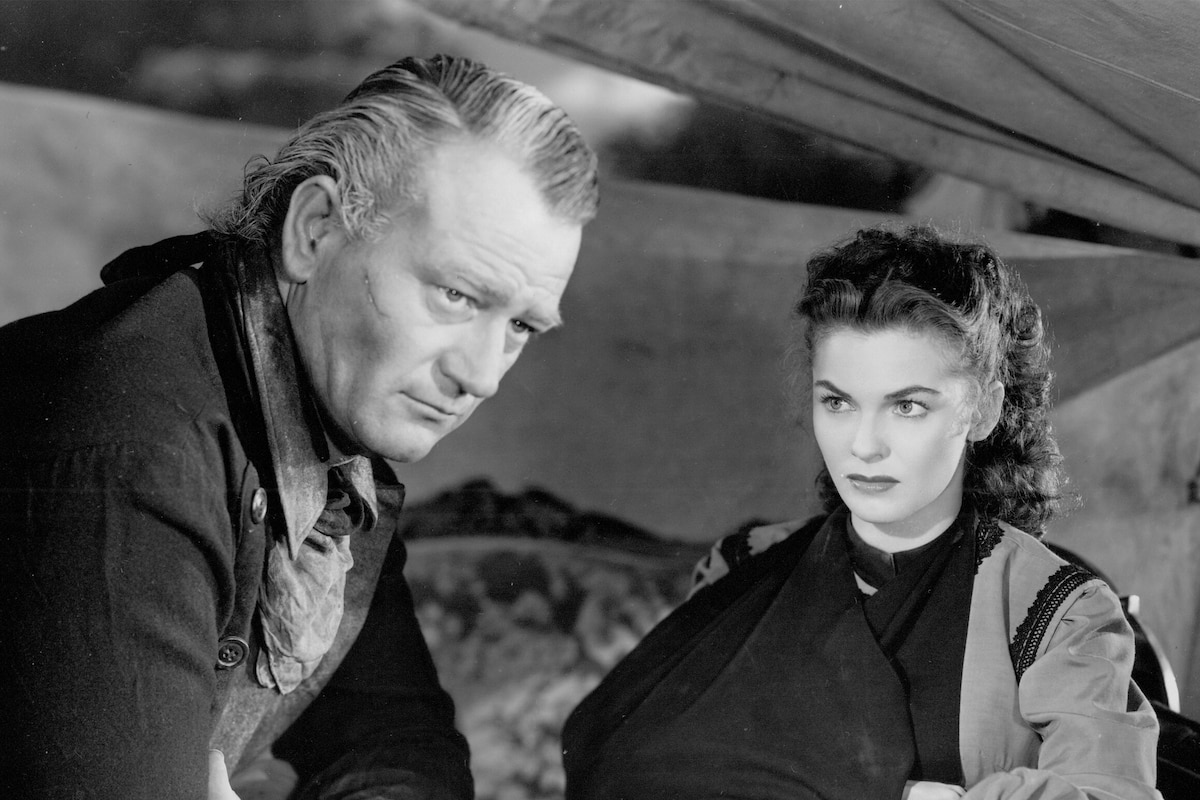
The role of Tess Millay was originally intended for Hawks discovery Margaret Sheridan, but she became pregnant before shooting began and did not get to make her film debut until the Hawks-produced The Thing from Another World (1951). The part went to Joanne Dru, who had only one previous picture to her credit.
An old hand at Westerns, Wayne attended a production meeting with Hawks and executive producer Charles K. Feldman and expressed his concerns with their approach to Red River. The first thing he suggested was that they get United Artists to up the $1.5 million dollars by more than 50 percent since their intentions were clearly to make a blockbuster.
Wayne said he gave the producers extensive advice about the possible location and logistical problems associated with making Westerns and insisted Hawks hire real cowhands and trained stunt professionals instead of the amateurs he had lined up. The director ended up signing 70 real cowboys for the job. He also contracted to have dozens of horses represent the hundreds required by the story and about a thousand head of cattle at $10 per day each stand in for Dunson's herd of 10,000. Wayne said once it was clear Hawks was taking his advice seriously and the budget would be increased, he agreed to do the picture.
by Rob Nixon
The Big Idea
by Rob Nixon | March 02, 2007
SIGN UP FOR OUR NEWSLETTERS

CONNECT WITH TCM