During World War II military service, Garson Kanin decided to try his hand at playwriting. The result was Born Yesterday, which he submitted to Broadway producer Max Gordon. Gordon agreed to produce the show with Kanin directing.
Despite Gordon's complaints that she was unreliable, Kanin cast film star Jean Arthur to return to Broadway after a 15-year absence as Billie Dawn. Kanin had worked with her on The More the Merrier, a hit comedy in which he had contributed to the script without credit.
Paul Douglas was cast as junk tycoon Harry Brock. He would go on to star in films, partly on the strength of his performances in Kanin's play.
Jean Arthur started creating problems with her first rehearsal, insisting on re-writing her lines and fighting the character's more brazen behavior early in the play. Gordon suggested they start looking for a replacement, but Kanin was convinced Arthur would adjust to the demands of the part.
When Born Yesterday began preview performances in New Haven and Boston, the show got only mixed reviews, with the best notices going to Douglas. During the run, Arthur became ill, and her doctor informed Gordon and Kanin that she would not be able to return to the show until it moved to Philadelphia. Finally, Kanin agreed to start looking at possible replacements.
Rumors circulated that Kanin's wife, Ruth Gordon, would take over the role, but she announced that she was giving up acting to concentrate on writing.
Max Gordon was particularly excited about the possibility of casting June Havoc as Billie Dawn, but she was already committed to another show.
Eventually, friends suggested he look at Judy Holliday, a young actress who had gotten strong positive reviews for the comedy Kiss Them for Me. Only Born Yesterday's costume designer, Mainbocher [Main Rousseau Bocher], had seen the show, and he urged them to give Holliday a chance. Her audition delighted Gordon and Kanin.
At this point Arthur's doctors informed Kanin that Arthur's condition had gotten so bad she would have to quit the show. Kanin, who seriously doubted Arthur was that ill, was more than a little relieved.
Gordon postponed the sold-out Philadelphia run for three days so that Holliday could learn the role. She worked practically around the clock to learn the lines and staging. At the final run-through, she broke down in tears every time she left the stage. But when she played her first performance in Philadelphia, the play came together as never before.
When Born Yesterday opened on Broadway on February 4, 1946, it made Holliday a star. The production ran for 1,642 performances. She would play the role on Broadway for over three years.
With the play's impressive Broadway success, Hollywood staged a bidding war for the screen rights. Kanin had had bad dealings with Columbia Pictures head Harry Cohn earlier in his career and instructed his agent to offer the script to everyone except him, stating he wouldn't sell him the rights for a million dollars. Two months later, Columbia purchased the rights for exactly that amount, the highest ever paid for film rights at that time.
Studio head Harry Cohn's first choice to play Billie was his reigning female star, Rita Hayworth. At the time, however, she was heavily involved in an international romance with Aly Kahn. When she wed him and temporarily retired from the screen, Cohn put the project on hold.
George Cukor was waiting for independent producer David O. Selznick to raise the funds for a film version of F. Scott Fitzgerald's Tender Is the Night - slated to star Selznick's wife, Jennifer Jones -when Cohn offered him the chance to direct Born Yesterday. With little chance of the financially strapped Selznick getting the production money raised, Cukor accepted Cohn's offer. Tender Is the Night would not be filmed until 1962. Although Jones played the female lead, it was directed by Henry King and produced by Henry T. Weinstein.
With Hayworth out of the picture, Kanin suggested giving Holliday a shot at the film, but Cohn wasn't about to risk his already hefty investment on an unknown he described as "That fat Jewish broad." Among the actresses he considered for the role were Lucille Ball, Barbara Stanwyck, Gloria Grahame, Marie Wilson, Evelyn Keyes, Barbara Hale and Jean Porter, a film actress who had toured in the show. One agent tried unsuccessfully to pitch his new, up-and-coming client, but having rejected the unknown Holliday, Cohn wasn't about to take a chance on the then-unknown Marilyn Monroe.
Originally, Kanin declined any involvement in the film version of Born Yesterday, mainly because Cohn expected him to write the adaptation for free. Cukor offered the adaptation to Philip and Julius Epstein, who had co-written Casablanca (1942), but their version made so many changes in the original, Cukor refused to use it.
Albert Mannheimer then took over, but he made too many changes for Cukor, too. The director then asked Kanin to take over, which he did without credit or payment (Cohn refused to put any more money into the screenplay). In addition to restoring lines and scenes cut from Mannheimer's version, Kanin decided to illustrate Billie's description of her trip to various sites in the nation's capital, opening up the play by allowing Cukor to shoot location scenes at the Supreme Court, the Washington Monument, the National Archives, the Library of Congress, the National Gallery and the Treasury Department.
Production delays and Cohn's refusal to even consider Holliday to play Billie Dawn so alienated Douglas that he passed on the film version (others have claimed that he felt Brock's role had been diminished in the screenplay in order to build up Billie's character). Instead, Cohn cast Broderick Crawford, who had just won an Oscar® for playing a crooked politician in All the King's Men (1949).
Initially, William Holden passed on the role of Paul Verrall, claiming that it would be overshadowed by the other leading roles. Finally, Kanin convinced him that the three roles had been written as equals, but Douglas and Holliday had so overpowered the original Broadway Paul (Gary Merrill), it had made people think of it as a secondary role. When he offered to build the role up for the screen, Holden finally agreed to do the film.
Hollywood's Production Code Administration forbade any overt reference to the fact that Billie Dawn and Harry Brock lived together, so Kanin and Cukor had to come up with shots of Billie sneaking into Brock's Washington apartment through the back door to make it seem that she had her own place elsewhere.
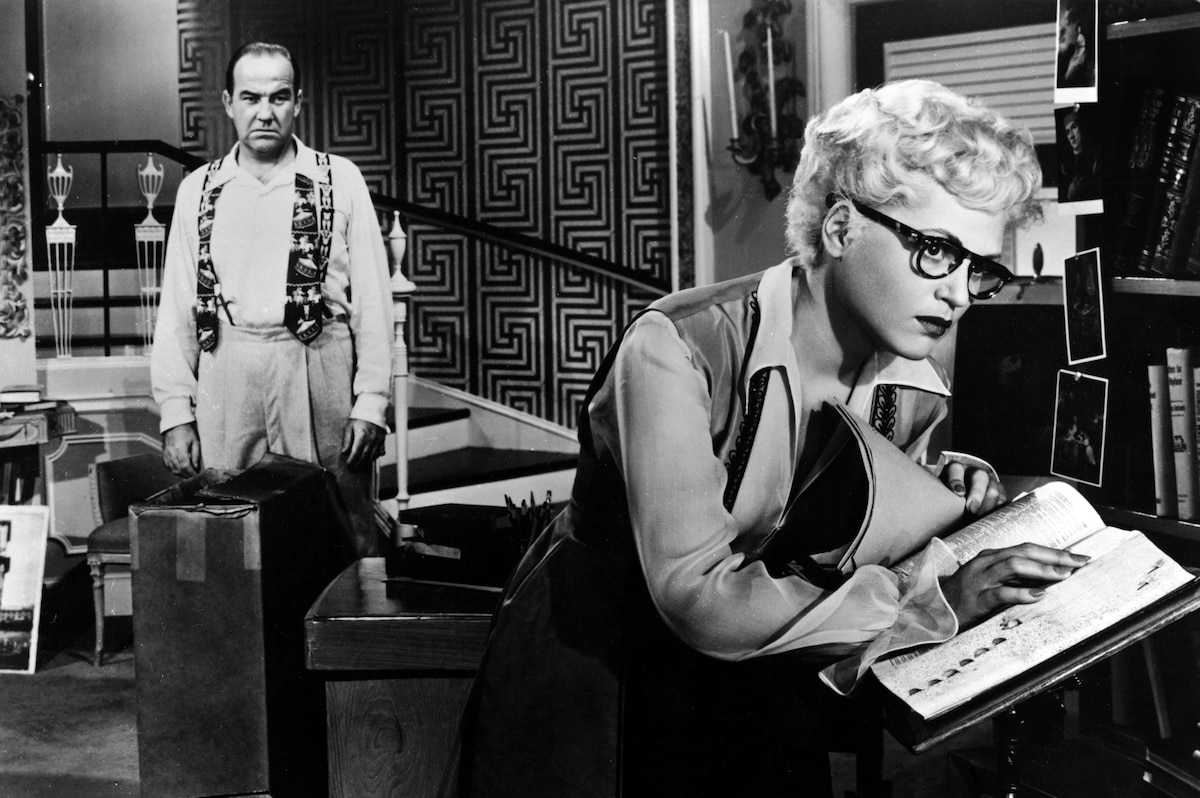
With little hope of starring in Born Yesterday, Holliday accepted a meaty supporting role in Adam's Rib (1949), written by Kanin and Ruth Gordon and directed by Cukor. The writers and director enlisted that film's star actress, Katharine Hepburn, in a campaign to win Holliday the lead in Born Yesterday. The three turned her performance in Adam's Rib into a screen test for the other film. In particular, one long scene in which Holliday's character recounts how and why she shot her husband was written as a near monologue for the character. Holliday shot her close-up of the speech in one take. Then Hepburn refused to shoot more than a few brief reaction shots, thus forcing Cukor to focus the entire scene on Holliday (Cukor would later state that that was the only way to film the scene anyway). That scene convinced Cohn to test Holliday. After three tests (she borrowed a gown from Hepburn for one of them), he finally cast her. Hepburn would later explain her generosity to Kanin: "It was the kind of thing you do because people have done it for you." (Garson Kanin, Tracy and Hepburn: An Intimate Memoir)
One thing that brought Cohn around was press reports during the shooting of Born Yesterday that Holliday was stealing the film from her more experienced co-stars. The items concerned Cukor, who didn't believe it was really possible to steal a film. When he confronted MGM's head of publicity about the stories, he discovered they had all been planted by Hepburn as part of her campaign to help Holliday win the lead in Born Yesterday.
At Holliday's first official meeting with Cohn after she had been cast in Born Yesterday, he looked her up and down then muttered, just loud enough for her to hear, "Well, I've worked with fat asses before." He then tried to get her to sign a standard seven-year contract. Instead Holliday, who intended to continue living in New York between pictures, negotiated a one-film-a-year contract for seven years that also allowed her to do stage, television and radio work. In return, he got her for the then low salary of $30,000, with only $10,000 raises promised for each subsequent film.
by Frank Miller
The Big Idea
by Frank Miller | March 02, 2007
SIGN UP FOR OUR NEWSLETTERS

CONNECT WITH TCM