Promoted with the anachronistic tagline "Bachelors Beware! Five Gorgeous Beauties are on a Madcap Manhunt!", Pride and Prejudice drew the largest weekly attendance for August at New York's Radio City Music Hall in 1940.
Discovered by Louis B. Mayer when she was working on the London stage, Greer Garson was signed to an MGM contract and made her Hollywood debut in Goodbye, Mr. Chips (1939). She quickly rose to major stardom at the studio, and became the epitome of noble British womanhood in the face of war in her Oscar®-winning role in Mrs. Miniver (1942). Her top film stardom did not last into the next decade, but she remained a respected actress on stage, television and the occasional film role into the 1980s. She died in 1996 at the age of 91.
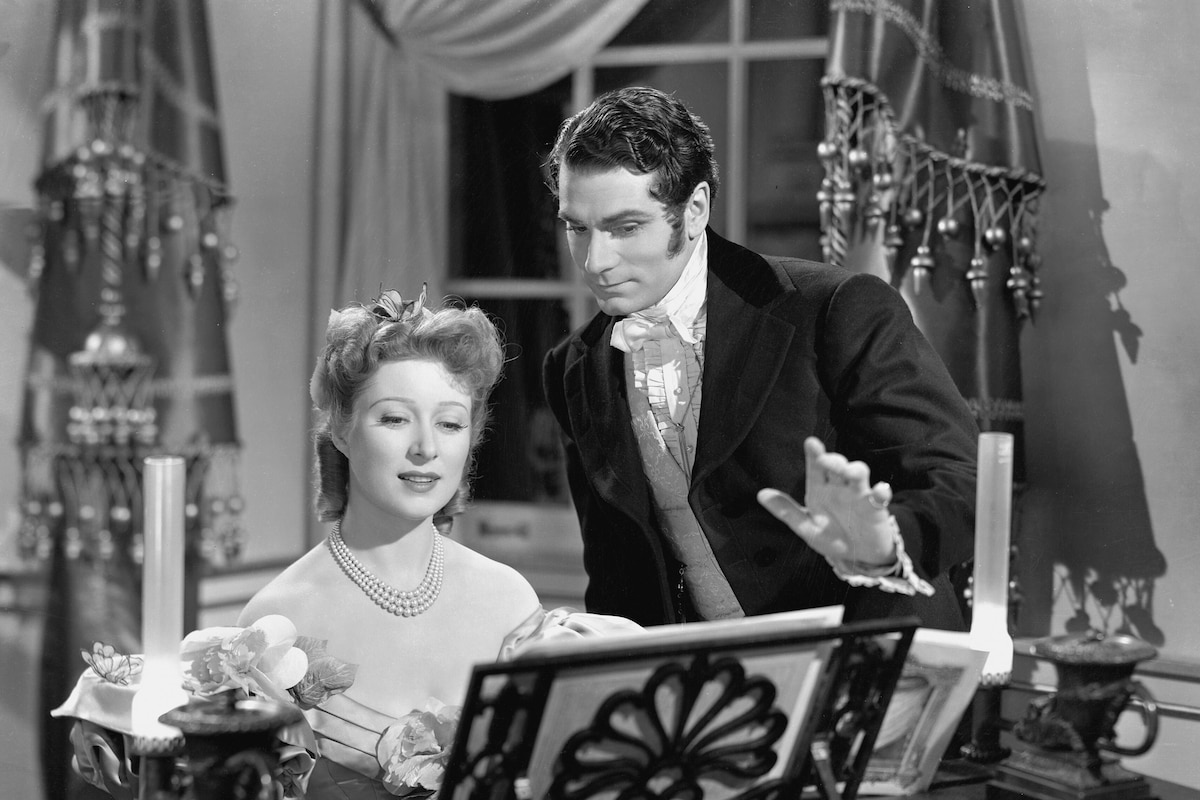
Greer Garson and Laurence Olivier had worked together twice prior to Pride and Prejudice. She played Juliet to his Romeo in one of the earliest BBC television transmissions. And in 1935, he produced and directed a play called Golden Arrow, casting Garson and predicting stardom for her in an opening night speech.
Pride and Prejudice was the last in a string of highly successful American film appearances for Olivier during the roughly two-year period that he and Vivien Leigh spent in the U.S. They returned to England in 1941, and he did not make another Hollywood picture until Carrie (1952), although in the interim he won Academy Awards for his production of Hamlet (1948) and his performance in the lead.
In spite of his determination to have wife Vivien Leigh cast opposite him in Pride and Prejudice and several other pictures he made during their first stay in Hollywood (when she played Scarlett in Gone with the Wind, 1939), Olivier only appeared with her in three British-produced films: Fire Over England (1937), 21 Days (1940), and That Hamilton Woman (1941). Their tempestuous relationship began in the 1930s when they were still married to others and lasted until the dissolution of their marriage in 1960.
Robert Z. Leonard's directing career began in 1914. In the 1930s, he became one of MGM's most dependable directors, churning out productions for many of its biggest stars, including Joan Crawford, Judy Garland, Greer Garson, Lana Turner, and several Jeanette MacDonald/Nelson Eddy operettas. Never considered a great cinema artist, he nevertheless could be counted on to make hit movies quickly and efficiently in the patented high-gloss MGM style. He also had some success with guiding performers to some of their best work, receiving Oscar® nominations for his direction of two stars in roles that won them Academy Awards: Norma Shearer in The Divorcee (1930) and Luise Rainer in The Great Ziegfeld (1936).
Jane Murfin was a popular playwright in the 1920s (usually in collaboration with Jane Cowl) and a busy and talented screenwriter in the following two decades. Among her better-known scripts were those for Alice Adams (1935) and The Women (1939). She and Adela Rogers St. Johns shared an Academy Award nomination for their work on What Price Hollywood? (1932), a prototype for the much-filmed A Star Is Born story.
Co-scripter Aldous Huxley is far better known for his novels, many of them social satires, and his influence on the mysticism and drug culture of the 1960s. His most famous work is the cautionary futuristic thriller Brave New World, which was filmed twice for television, in 1980 and 1998. In 1937 he left his native England for work in Hollywood, where he contributed to screenplays for Madame Curie (1943, with Greer Garson), Jane Eyre (1944), and the Disney version of Alice in Wonderland (1951) for which he was uncredited. Pride and Prejudice was his first screenwriting credit.
Innovative cinematographer Karl Freund started his career in Germany in 1912, providing the memorable photography to a number of great films by such master directors as F.W. Murnau (The Last Laugh, 1924) and Fritz Lang (Metropolis, 1927). He came to Hollywood in 1929 and soon built an impressive list of credentials: Dracula (1931), The Good Earth (1937), Golden Boy (1939), A Guy Named Joe (1943). He also directed a handful of movies, including The Mummy (1932) and Mad Love (1935). In the 1950s, he developed the three-camera system for shooting television shows, revolutionizing the industry through his work on the landmark sitcom I Love Lucy.
Marsha Hunt, who plays the awkward, bookworm sister Mary, made her film debut in 1935 and played a number of good supporting roles in major films and leads in B movies through the 1940s. Her career was derailed in the 50s by the Hollywood blacklist but she survived due to a great deal of television work over the decades. At nearly 90, she appeared in the independent film Chloe's Prayer (2006). Hunt is also the honorary mayor of Sherman Oaks, California.
Scottish-born actress Frieda Inescourt, who plays the snobbish Caroline Bingley, had a long and busy career between 1935 and 1961, despite being diagnosed with multiple sclerosis since 1932.
Rumor has it that American comic Phil Silvers "screen-tested" for a minor role in this film, not knowing it was a cruel prank by studio executives.
Memorable Quotes from PRIDE AND PREJUDICE:
MRS. BENNET (Mary Boland): Five thousand pounds [annual income] and unmarried. That's the most heartening piece of news since the Battle of Waterloo.
MR. BENNET (Edmund Gwenn): You mistake me, my dear. I have the highest respect for your nerves. I have heard you mention them with consideration for the past 20 years.
MRS. BENNET: Look at them! Five of them without dowries. What's to become of them?
MR. BENNET: Yes, what is to become of the miserable wretches? Perhaps we should have drowned some of them at birth.
MR. DARCY (Laurence Olivier): I am in no humor tonight to give consequence to the middle classes at play.
MR. DARCY: I have made the mistake of being honest with you.
ELIZABETH (Greer Garson): Honesty is a greatly overrated virtue. Silence in this case would have been more agreeable.
MRS. BENNET: To think we have to feed the man who will snatch the bread from our mouths.
ELIZABETH: If you want to be really refined, you have to be dead. There's no one as dignified as a mummy.
MR. COLLINS (Melville Cooper): What graciousness, what condescension.
ELIZABETH: What snobbery.
MR. BENNET: An unhappy alternative is before you, Elizabeth. Your mother will never see you again if you do not marry Mr. Collins. And I will never see you again if you do.
LADY CATHERINE (Edna May Oliver): I've never met a painter or an architect who didn't admire me for my taste.
LADY CATHERINE: Insolent, headstrong girl! ... I take no leave of you, Miss Bennet. I send no compliments to your mother. You deserve no such attention. I am seriously displeased.
MRS. BENNET: Think of it. Three of them married and the other two just tottering on the brink!
Compiled by Rob Nixon
Trivia & Fun Facts About PRIDE AND PREJUDICE
by Rob Nixon | March 02, 2007
SIGN UP FOR OUR NEWSLETTERS

CONNECT WITH TCM