During production, Olivier was distracted by plans for a stage production of Shakespeare's Romeo and Juliet. He occupied his thoughts off camera with every detail of the production: blocking, lighting, set design and the total look of the play. He also took lessons in music composition and began composing motifs and flourishes for the stage production. It delighted him that he and Vivien would finally be acting together and capitalizing on their off-screen romance, after their efforts to co-star in Hollywood films had been repeatedly thwarted.
Olivier wanted Leigh to appear opposite him in Pride and Prejudice, Wuthering Heights, (1939), and Rebecca (1940); Leigh hoped he could play opposite her in Waterloo Bridge (1940) instead of Robert Taylor. They had to return to England for Alexander Korda's costume epic That Hamilton Woman (1941) before they got the chance. As for Romeo and Juliet, it was an unmitigated critical and commercial disaster and their plans for a film version never materialized.
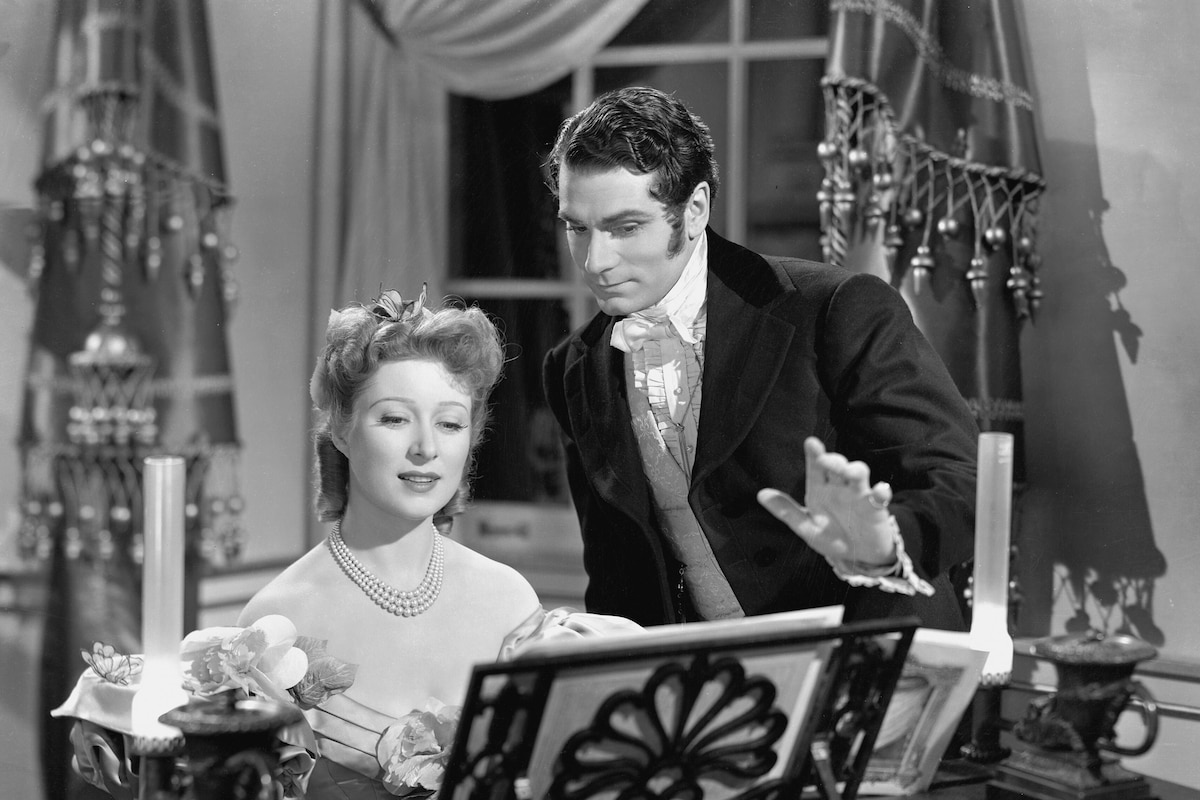
Olivier was less than thrilled with Pride and Prejudice after production began, certain it would be a flop and complaining that key scenes were missing and that more attention was lavished on the costumes than the actors.
Although Austen's novel was set in Regency England (late 18th-early 19th century), the period was set at a later time. This anachronism has been explained in a couple of ways. Those more favorably disposed to the studio system claim the styles of the Regency Period (when women's dresses resembled nightgowns) were thought too plain for public taste, so new gowns were created in the voluminous Victorian style of the 1830s to give it a more romantic flair. Others have pointed out that because MGM wasn't willing to put a huge budget behind the risky venture, costumes left over from Gone with the Wind (1939) were altered slightly and placed on background players to save money. New gowns in the same flouncy style were designed for the female leads.
Co-star Marsha Hunt, who played one of the Bennet sisters, noted that the gowns were difficult to maneuver in the narrow restroom stalls of the studio soundstage during brief bathroom breaks.
Because so many English people worked on the picture, 4:00 p.m. tea breaks were a daily ritual.
Key characters from Austen's novel underwent changes during scripting, filming and editing. To avoid the Production Code taboo against portraying the clergy in a negative light, the theological occupation of the Bennets' hypocritical, toadying cousin Mr. Collins was considerably downplayed. Either to provide a more upbeat tone to the ending or to accommodate the sort of character most often associated with the actress Edna May Oliver, the haughty and forbidding Lady Catherine de Bourgh was portrayed as a comic figure; her final visit to Elizabeth is presented as merely a ruse to test the girl's feelings for Darcy. Finally, the last scene, contrary to the novel, shows all the Bennet girls on the verge of marriage.
Film scholars have noted that the production also made excellent use of several dance sequences to advance the story and provide an active, visual metaphor for the approach/avoidance dance of Elizabeth's and Darcy's relationship.
by Rob Nixon
Behind the Camera
by Rob Nixon | March 02, 2007
SIGN UP FOR OUR NEWSLETTERS

CONNECT WITH TCM