Director William Wyler and producer Samuel Goldwyn had a long and fruitful association-nine movies between their first, Barbary Coast (1935), and their last, the Oscar®-winning The Best Years of Our Lives (1946). The relationship wasn't always a smooth one. Unhappy with the work Howard Hawks had done on Come and Get It (1936), Goldwyn fired him from the picture and assigned his contractee Wyler to take it over. Wyler and Hawks were friends, and taking a job from another director, particularly one as highly respected as Hawks, was not the best form. Wyler repeatedly refused, sending the bedridden Goldwyn into such a rage that his wife Frances began beating him across the legs with a flyswatter while he screamed at Wyler. Informed by his lawyer that he had no choice, Wyler reluctantly took the assignment.
Making an inside joke reminiscent of Alfred Hitchcock, Wyler put himself into one shot, as a violin player in the Vienna nightclub where Fran goes dancing with her Austrian suitor. "Don't cut shot of orchestra, whatever you do," he memoed editor Daniel Mandell.
Sidney Howard's writings for the stage have been adapted into many films, most often by himself. His Pulitzer Prize-winning play They Knew What They Wanted was the basis for the films The Secret Hour (1928) and A Lady to Love (1930). It was also produced under its original title in 1940 with Carole Lombard and Charles Laughton (and although not credited as such, the story of the 1957 movie Wild Is the Wind, based on a novel by Vittorio Novarese, bears some resemblance to Howard's play). The play was also made into the Broadway musical The Most Happy Fella years after Howard's death.
Sidney Howard was the first American writer to win both a Pulitzer Prize (for his 1924 play They Knew What They Wanted) and an Academy Award (his screenplay for Gone with the Wind, 1939, awarded posthumously).
Dodsworth previewed at the Warner Bros. Hollywood Theater in Los Angeles to an invitation-only crowd and opened a week later at New York's Rivoli Theatre on September 18, 1936.
Dodsworth was re-released in 1946.
"I do not see how a better motion picture could have been made from both the play and the novel." Sinclair Lewis, in a cable to Sam Goldwyn shortly after the film's opening.
"I can only thank you for such a distinguished and lively job of directing." Sidney Howard in a cable to William Wyler.
"I cannot remember having enjoyed a picture as much as Dodsworth in a long time. It is really marvelous." director Ernst Lubitsch in a cable to William Wyler.
"The book was good, the play was good and the picture was wonderful, and I still think Edith Cortright is my favorite character." Mary Astor, A Life on Film (Bantam Doubleday Dell, 1971).
"I lost my goddam shirt. I'm not saying it wasn't a fine picture. It was a great picture, but nobody wanted to see it. In droves." Sam Goldwyn.
"One of the biggest hits I ever had. It made a fortune." Sam Goldwyn
A man who enjoyed the quiet rural life, Howard maintained a hobby farm in Massachusetts. He died there in August 1939 at the age of 48, crushed to death in a tractor accident.
Sidney Howard's close working relationship with Sam Goldwyn (they made eight pictures together between 1929 and 1939) carried into their personal lives. In 1950, Howard's daughter Jennifer married Samuel Goldwyn, Jr., with whom she had four children, including actor-director Tony Goldwyn.
Sinclair Lewis's novels and stories have been made into numerous films. Babbitt and Main Street were each adapted twice, and Arrowsmith was filmed in 1931 and again as a mini-series on Czech TV in 1999. Burt Lancaster won a Best Actor Academy Award in the title role of the film version of Lewis's Elmer Gantry (1960).
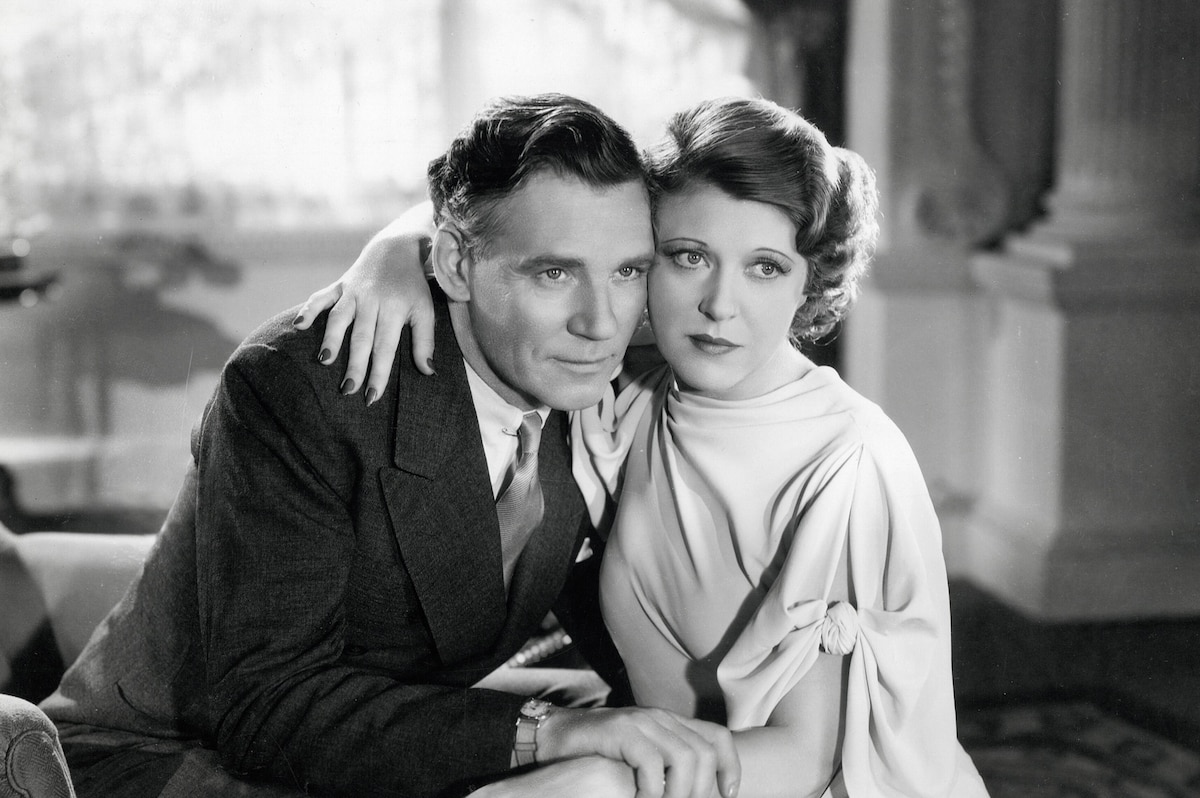
Walter Huston appeared earlier in another Sinclair Lewis adaptation, Ann Vickers (1933), opposite Irene Dunne. Considered one of the finest actors of his generation, Huston didn't make his first film until he was in his mid-40s. In addition to Dodsworth, he was nominated for Best Actor as the Satanic Mr. Scratch in The Devil and Daniel Webster (1941) and Best Supporting Actor as George M. Cohan's father in Yankee Doodle Dandy (1942). He was finally awarded a Best Supporting Actor statuette for his role in The Treasure of the Sierra Madre (1948), written and directed by his son John Huston.
Ruth Chatterton stood by her co-star Mary Astor during Astor's scandal-ridden divorce and custody proceedings and appeared as a character witness on her behalf.
The low opinion David Niven held of William Wyler was apparently mutual. The director complained about the actor's ability in their third and final film together, Wuthering Heights (1939): "When he had to cry in [Cathy's] death scene, the tears came out of his nose instead of his eyes." Niven also worked with Wyler in an uncredited bit in the Miriam Hopkins-Edward G. Robinson movie Barbary Coast (1935).
Hungarian-born Paul Lukas, who plays the oily sophisticate Arnold Iselin, one of the objects of Fran Dodsworth's amorous attentions, never made it to leading man star status. He did, however, win a Best Actor Oscar® (and several other awards) for his role as a member of an anti-Nazi underground in Watch on the Rhine (1943) opposite Bette Davis.
A native of Russia, Maria Ouspenskaya received her first Best Supporting Actress nomination for her single four-minute scene-and first American film appearance-in Dodsworth. A dominant Broadway actress in the 1920s, she was also an important teacher and founder of New York's School of Dramatic Art. In fact, she took the role in this picture to help support the school. A student and proponent of the Stanislavsky method, she taught future acting teachers Stella Adler and Lee Strasberg. Despite her many distinguished roles, she is probably most familiar to a wide audience as the mother of the werewolf in The Wolf Man (1941).
John Payne made his film debut in this picture. He went on to become a popular leading man of the 1930s and 40s, primarily at Fox, where he often appeared opposite Alice Faye and Betty Grable.
Memorable Quotes from DODSWORTH:
SAM DODSWORTH (Walter Huston): How would any man feel who just sold 20 years of his life?
FRAN DODSWORTH (Ruth Chatterton): I can't go on liking the same things forever and ever. ... I'm begging for life. No, I'm not, I'm demanding it.
FRAN: Why is it that traveling Americans are always so dreadful?
CAPTAIN LOCKERT (David Niven): Why is it Americans are always such snobs?
EDITH CORTRIGHT (Mary Astor): Drifting isn't nearly so pleasant as it looks.
FRAN: Oh, you're hopeless. You haven't the mistiest notion of civilization.
SAM: Yeah, well maybe I don't think so much of it, though. Maybe clean hospitals, concrete highways, and no soldiers along the Canadian border come near my idea of civilization.
FRAN: (lying about her age) No woman enjoys getting to be 35.
EDITH: When you're my age, you'll look back on 35 as a most agreeable time of life, Mrs. Dodsworth.
FRAN: I hope I look as young as you do when I'm you're age.
EDITH: You're almost sure to, my dear.
FRAN: Why should I divorce you? You're my husband.
SAM: You couldn't very well divorce me if I weren't.
BARONESS VON OBERSDORF (Maria Ouspenskaya): Have you thought how little happiness there can be for the old wife of a young husband?
EDITH: I suspect most people travel to get away from themselves.
SAM: Well, I've been at it three months now. I'm glad to know why.
SAM: Love has got to stop someplace short of suicide.
Compiled by Rob Nixon
Trivia & Fun Facts About DODSWORTH
by Rob Nixon | March 02, 2007
SIGN UP FOR OUR NEWSLETTERS

CONNECT WITH TCM