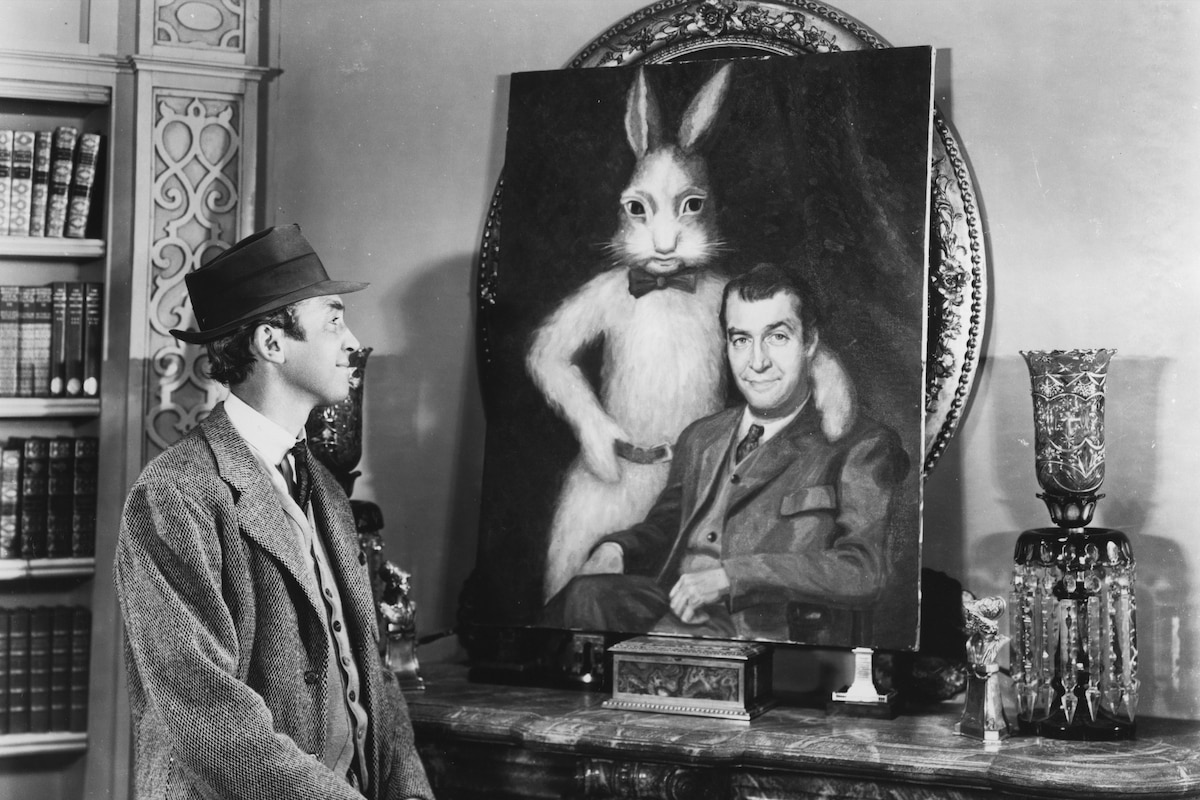
Production on Harvey began in April 1950 at Universal in Los Angeles. Director Henry Koster stayed true to his plan to keep the movie close to the stage version, and made very few changes. To open the play up a bit, he worked with writer Mary Chase. "She was a very nice lady to work with and a great writer of comedy," said Koster of Chase. "She wrote additional dialogue for us, and we had to rearrange it for cinematic purposes, from the stage play which takes place in one or two rooms, to the show that takes place in twenty or thirty rooms. We wanted to get the visual effects just as much as we wanted that lovely dialogue." Jimmy Stewart and the Broadway veterans played off of each other expertly, successfully capturing Harvey's playful and eccentric spirit.
Though it is made clear in a subtle way that the character of Elwood P. Dowd is a raging, though benign, alcoholic, the Hollywood Production Code at the time would not allow Stewart to be shown getting drunk on film. Instead, his on-screen character does a lot of drink ordering at the bar but you never see him actually drinking.
Koster and Stewart discovered that they worked extremely well together. Koster said later that working with Stewart was "without any doubt one of the most pleasant experiences of my life...It must have been his spirit. There was very little friction, ever, only ambition and craftsmanship and precision, just doing it right professionally. On top of that he put the whipped cream of great talent...He was always the first on the set."
Shooting was quick and pleasant for all. "I must say it was a complete, one hundred percent pleasure, the whole picture," said Henry Koster. "I had the most wonderful performers. The spirit of Harvey, that splendid and helpful ghost, was always with us while we did it." In fact, as a joke, the cast and crew of Harvey would often set a chair for the title character at lunch and order him something to eat.
Mary Chase had the idea that film audiences should actually see Harvey at the end of the film because she "didn't want anybody to go out of the theater thinking Elwood is just a lush. He believes in Harvey...and I think the audience ought to believe in Harvey, too." The studio reportedly considered this and experimented with how to show him to the audience, including his appearance in silhouette, and even by attaching a rabbit tail to the taxi driver at the film's conclusion. In the end, however, the studio won out and wisely decided NOT to ruin the illusion. Only once had a giant rabbit actually appeared on stage in the play of Harvey, and the results were disastrous. Theatrical Producer Brock Pemberton recalled in a 1945 interview that at that performance in Boston, "a chill descended on the gathering, which never quite thawed out afterwards."
Harvey opened to positive reviews in October 1950. There were some loyalists to Frank Fay's original stage interpretation of the role, but Jimmy Stewart made Elwood P. Dowd his own.
Henry Koster was unable to attend the U.S. premiere of the film because he was working in London on his next picture No Highway in the Sky (1951). Instead, he watched the film in a projection room at the London Universal offices along with Jimmy Stewart and actress Marlene Dietrich.
Harvey did well at the box office, but not quite well enough to recoup its production costs, which had been driven way up with the one million dollar price tag for the rights to the play. However, in 1990, Jimmy Stewart recorded an introduction to the VHS release of the film, which turned out to be one of the biggest selling videos of the year.
Jimmy Stewart was nominated for an Academy Award as Best Actor for his performance, but lost to Jose Ferrer in Cyrano de Bergerac (1950). Josephine Hull, however, won for her supporting role as Stewart's sister.
Henry Koster and Jimmy Stewart enjoyed working together so much that they went on to make four more films together including Mr. Hobbs Takes a Vacation(1962) and Take Her She's Mine(1963).
20 years after the film's release, Stewart played the role of Elwood P. Dowd once again in a triumphant Broadway revival of Harvey in 1970. This time, Helen Hayes played his sister. Stewart and Hayes reprised their roles for a Hallmark Hall of Fame television production in 1972. Stewart reprised the role for the final time in a 1975 stage revival in London.
by Andrea Passafiume
Behind the Camera
by Andrea Passafiume | March 02, 2007
SIGN UP FOR OUR NEWSLETTERS

CONNECT WITH TCM