For the temporary production headquarters, John Huston set up shop in Kindu (then called Ponthierville) which was little more than a collection of tin roof huts at the end of a small railway line that carried river cargo to and from the nearest town, Stanleyville. Huston hired locals to clear an area and build a camp for the production within 8 days. There were makeshift dorms, bungalows, offices, a storage hut, makeup hut, a dining area and, of course, a bar. With added cots, chairs and mosquito netting, the camp was ready for habitation just prior to the arrival of the rest of the cast and crew. It would prove to be an adventure of a lifetime for all involved.
John Huston and Sam Spiegel settled into their makeshift camp in Africa, and the other cast and crew arrived shortly thereafter. Humphrey Bogart and Lauren Bacall, who came along for the ride, traveled together via London, and Katharine Hepburn arrived solo.
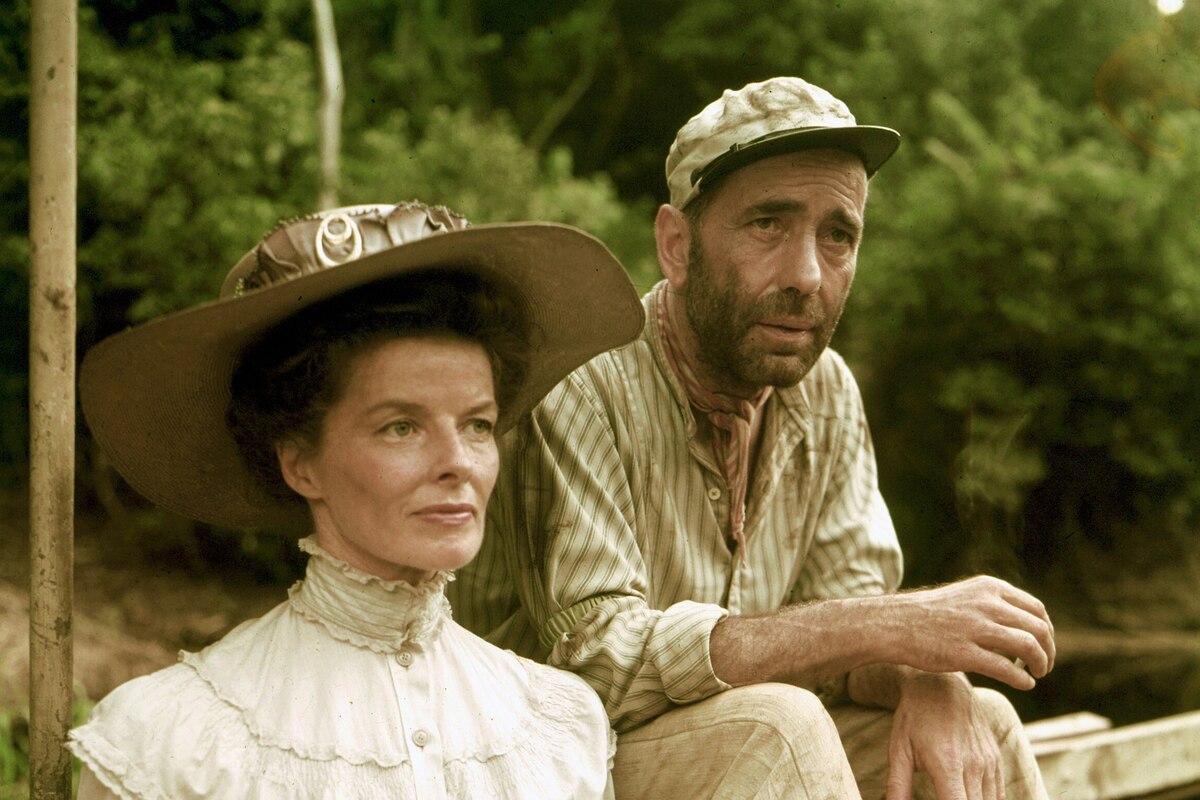
Bogart hated Africa immediately and was miserable, but Hepburn adored it, calling it "utterly divine." Bogie complained about everything: the heat, the humidity, the dangers, the food. "While I was griping," said Bogart in a later interview, "Katie was in her glory. She couldn't pass a fern or berry without wanting to know its pedigree, and insisted on getting the Latin name for everything she saw walking, swimming, flying or crawling. I wanted to cut our ten-week schedule, but the way she was wallowing in the stinking hole, we'd be there for years."
John Huston loved being in Africa just as much as Hepburn, which further irritated Bogart. Huston took his time with everything and was in no rush to leave. Huston became intent on shooting an elephant while he was there, fancying himself a great hunter. Whenever it would rain, which was often, Huston would go off hunting with his rifle, obsessed with bagging his ever-elusive elephant. "John really became a white hunter in Africa," wrote Lauren Bacall in her autobiography, "he believed he was one-and he adored it; he didn't care how long he stayed. That was John. Bogie was different-he wanted to be back in civilization."
Though Hepburn was having the time of her life in Africa, she was dubious about the production in the beginning. "Frustrated rage was my constant mood," she said. She remained alarmed at the lack of a completed screenplay from Huston, lack of clear communication, the vagueness of the details, and the general attitude of just winging it. She didn't really know Bogart or Huston except that they made great movies together and liked to drink - a pastime she took no pleasure in, having dealt with Spencer Tracy's alcoholism for years. To make matters worse, Huston and Bogart enjoyed having fun with the haughty Hepburn. "Both Bogie and I teased Katie unmercifully at the beginning," said John Huston in his 1980 autobiography An Open Book. "She thought we were rascals, scamps, rogues. We did everything we could to support this belief. We pretended to get roaring drunk. We even wrote dirty words in soap on her mirror. But eventually she saw through our antics and learned to trust us as friends."
In Africa at that time, moving heavy film equipment and supplies was a tricky undertaking. The roads in the area were at best just narrow paths cut out between jungles. For shooting on the river, they built the steam powered African Queen; another boat for towing the Queen with a generator, lights and reflector platforms; followed by a raft with heavy camera equipment and a small crew from Britain; another raft with props and sound equipment; and finally a floating makeshift dressing room/toilet for Katharine Hepburn made with bamboo. Hepburn had insisted on having the privacy of a dressing room, but after having it dragged up the river several times it was clear that it was totally impractical, so she valiantly gave it up.
Hepburn had insisted that Huston use Doris Langley Moore as her costume designer, as her costumes were meticulous period recreations. The brutal heat and humidity of the area, however, made it impossible for the clothes, costumes or anything to dry completely, and mold would even grow on the fabric. Hepburn desperately wanted a full-length mirror in order to check her appearance between takes, and she got one. She lugged the cumbersome mirror all over the jungles of Africa-until it broke in half. Without blinking, Hepburn carried around the larger broken half without complaint.
Shooting The African Queen was slow going. Tempers often flared and the cast and crew faced constant dangers and difficulties including torrential rains that would close down shooting, wild animals, poisonous snakes and scorpions, crocodiles, armies of ants, water so contaminated that they couldn't even brush their teeth with it, and food that was less than appetizing. "We decided first night out that it was advisable not to ask what we were eating," said Lauren Bacall, "we didn't want to know." Often the cumbersome raft carrying equipment behind the African Queen refused to follow the curve in the river while being transported, and the heavy scorching boiler would come close to tipping over. Cameras and lamps would get caught on overhanging shrubbery, boats would get caught on submerged logs, the boat engine would stop abruptly, or hornets would attack the cast and crew while shooting. To complicate matters, there was a language barrier between the film people and the locals that led to wild misunderstandings. For instance, for the scene that called for Brother Samuel's mission to be burned by the Germans, the crew built a village for the express purpose of burning it down. Huston asked a local leader to bring a bunch of locals to be extras in the scene. However, when the day came for filming, not one of them showed up. It turned out that a rumor had spread among them that the film people were cannibals and it was a trap-anyone who came would be eaten.
Since she was the only one not directly involved in the filming, Lauren Bacall helped out by preparing lunches for the cast and crew. Bogart was miserable-the jungle noises kept him up at night along with the scorching heat and humidity, and he and Huston drank too much. Bacall did her best to be cheerful and make their accommodations as homey as possible. Slowly but surely she forged a friendship with Katharine Hepburn, while Bogie worried about whether or not they would ever get out of Africa.
Bacall also played nursemaid to the cast and crew whenever anyone got sick, which was often. There was dysentery, malaria, and bites from all sorts of bugs to deal with. One night a crew member even came down with appendicitis. Bacall saved the day by being the only one who had thought to bring antibiotics, which were given to the man before he was rushed to the closest hospital in Stanleyville for emergency surgery. Even the stoic Katharine Hepburn finally succumbed to illness towards the end of shooting, though she had taken every precaution imaginable.
Even though bottled water was brought in, boiled and treated with halazone tablets, people still got sick. The only two people who seemed to be immune were John Huston and Humphrey Bogart. "Bogie and I never got sick," wrote Huston in his autobiography, "possibly because we always drank scotch with our water."
Bogart and Hepburn worked very well together and discovered a chemistry between the two characters that wasn't fully developed in the novel and gave the film a welcome dose of humor. At first, however, John Huston felt that Hepburn was playing her role much too seriously. It didn't help matters that the corners of Hepburn's mouth naturally turned down, making it appear that she was frowning. The relationship between Huston and Hepburn up to this point was somewhat strained. She sill looked upon him with frustration and mistrust, and Huston felt like she ignored all of his suggestions.
One night, Huston had a talk with Hepburn and told her that he felt she was playing her role too intensely. He suggested that she use Eleanor Roosevelt as a reference point for inspiration, noting the way Roosevelt's smile seemed always full of hope. For the rest of her career, Hepburn always cited this simple advice as the best piece of direction she had ever received from any director. All of her doubts about Huston vanished. "I was his from then on," she said. "He may have no common sense-he may be irresponsible and outrageous. But he is talented. He ain't where he is for no reason."
Writer James Agee, who had worked with Huston on the screenplay back in California and had suffered a debilitating heart attack, was never in good enough health to join Huston in Africa to continue working on the script. Huston therefore asked another writer, Peter Viertel, to fly over and help him. The author of the original novel, C.S. Forester, had told Huston that he had never been completely satisfied with the way the book ended. In fact, he had tinkered with the ending so much that two different endings found their way to publication - one for the American version, and another for the English. Huston found neither of them satisfying and always felt that the film should have a happy ending. He set about to write a new ending with Peter Viertel's help and together they pounded out the final scenes that exist in the completed film.
With only two days left to go on the shoot, everyone was on edge and ready to go home. When Huston announced that he would need three additional days to film, there was a near mutiny. Bogart was furious and so was the crew. Huston tried to appease everyone with a rousing "team spirit" speech, which was met with frustration. The cast and crew agreed to stay longer, but they believed that the schedule could be speeded up if they all pulled together. They decided on the last Friday to record all of the sound over Saturday and Sunday, while all props and electrical equipment could be shipped out Sunday night. Only the camera, a few crew members, and Bogart, Hepburn and Huston would remain until the very end. The last location shots were completed by noon on Monday, with everyone going straight to the airport. Bogart was elated to be out of there.
On the way back to the United States, they stopped in London to shoot some more interiors, some underwater filming in a studio tank, and the scenes with Robert Morley (who never went to Africa), who played Rose's missionary brother. Bogart still had some difficult scenes to shoot - in London he had to face a handful of real leeches for one of the film's more memorable scenes. But, as production finally ended and everyone made it back safely to the U.S., everyone had become lifelong friends with nothing but good things to say about each other. "It was a wonderful experience," said John Huston in a 1984 interview. "One of the happiest I've ever had" - even though he never did shoot that elephant.
by Andrea Passafiume
Behind the Camera -.The African Queen
by Andrea Passafiume | March 02, 2007
SIGN UP FOR OUR NEWSLETTERS

CONNECT WITH TCM