In 1932, Paramount Pictures optioned the hit Broadway whodunit Riddle Me This, which they pushed into movie theaters later that year under the title Guilty as Hell (1932), starring Edmund Lowe and Victor McLaglen. The returns must have been satisfactory, because five years later they remade it as Night Club Scandal (1937), in a cast headed by John Barrymore. Barrymore's reputation had suffered greatly because of his alcoholism, but a successful run of Shakespeare plays on NBC radio convinced Paramount that his name was still worth something at the B-movie level.
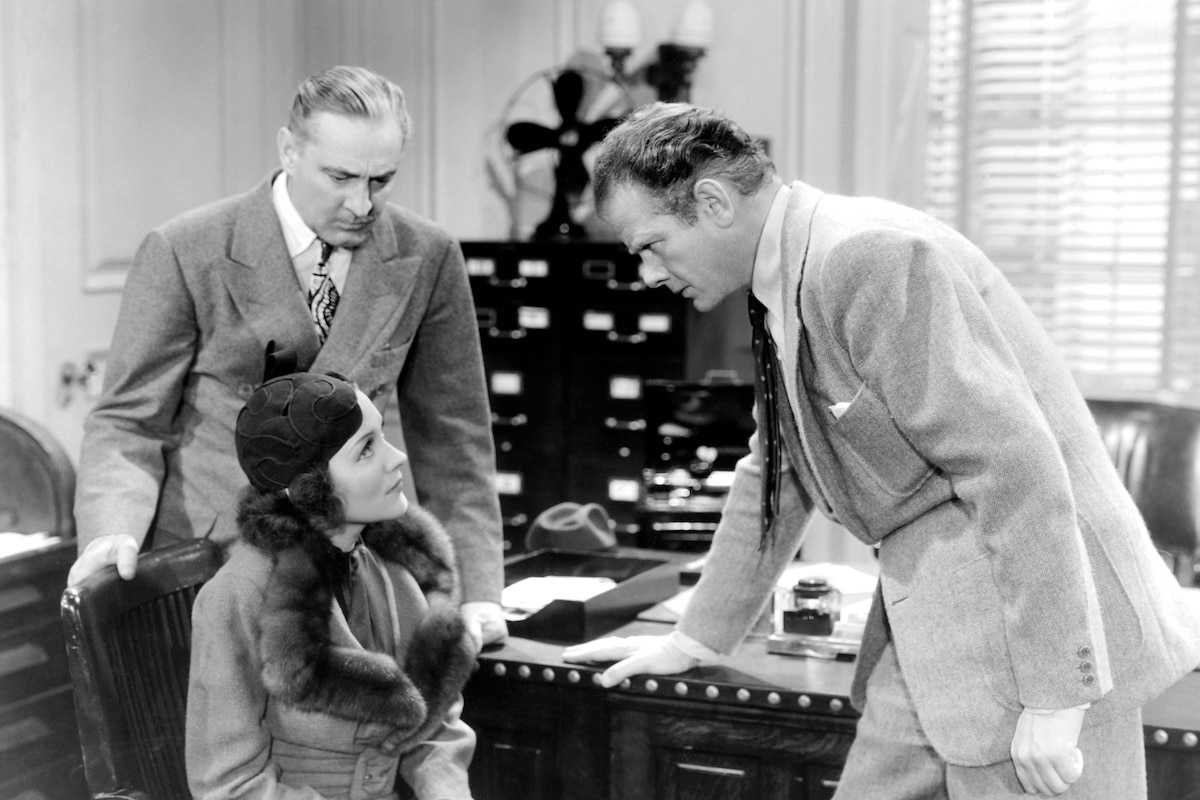
Lillie Hayward adapted the Daniel Nathan Rubin play for the Night Club Scandal script, which opens, Columbo-style, with a depiction of the murder that the cops and reporters will have to solve. So it is no spoiler to say that Dr. Ernest Tindal (Barrymore) strangles his wife and attempts to frame her lover Frank (Harvey Stephens) for the crime. It is up to stone-faced detective McKinley (Charles Bickford, in the McLaglen role) and motormouthed journalist Russell Kirk (Lynne Overman - taking over for Lowe) to unwind Tindal's devious plot.
McKinley is happy to close the case when all the clues point to Frank, but Kirk keeps churning through the clues, convinced of Frank's innocence (in no small part because of his crush on Frank's sister Vera (Louise Campbell)). Bickford and Overman work out an appealing odd couple routine, with Bickford's bulldog playing nicely with Overman's yapping Pomeranian. This is one of nine features Overman made in 1937, and it's remarkable he doesn't pass out at the pace he talks. It's a love-it-or-hate it spin on spitfire journo template established by Lee Tracy, steamrolling witnesses and stealing photographs off of desk tops. He starts off so cynical it's hard to swallow the tonal shift that occurs when Kirk starts seriously investigating the case.
The workmanlike direction is by Ralph Murphy, who does nothing to hide the films' stage origins but keeps things moving swiftly in the 70-minute runtime. This skill would serve him well when John Ford asked him to direct a star-studded charity stage production of What Price Glory in 1949 - which included roles for everyone from John Wayne to Oliver Hardy.
Though it's a supporting role, Barrymore is billed as the lead, and though there are reports of his failing memory in this period, he still brings a bombastic gravitas to the role of the devious doctor, whose effortlessly suave demeanor remains intact until the very end. He had received a series of public relations hits in the mid-1930s, none worse than the "Caliban and Ariel" affair, so dubbed by the press when the 53-year-old started courting the 19-year-old Elaine Jacobs. This along with his frequent stays at hospitals and sanitariums to battle his drinking changed his public image irrevocably from a "hell-raiser, a manly drinker" to an "aging satyr, the has-been alcoholic, the much-married ham" (Michael A. Morrison, John Barrymore, Shakespearean Actor). Film work started drying up for him, so he pivoted to radio, where NBC hired him for an eight-episode run of Shakespeare adaptations, to combat a similar series of the Bard announced by CBS.
This was enough to convince Paramount to give him more roles in their B division, including the Bulldog Drummond series and Night Club Scandal. The reaction from the press was muted but positive, The New York Times' Frank Nugent writing that "The role is merely a quotidian chore for John, but he brings to it a Barrymore-ish dignity, authority and presence which add immeasurably to its dramatic effectiveness. Though not especially 'ambitious' in a productional sense, the film itself - largely in consequences - may be counted among the more tolerable of recent corpse operas."
Barrymore's movie career would be over by 1941, and he would pass away in 1942, his body unable to hold up after so many years of alcohol abuse. But Night Club Scandal was a brief respite from his troubles, allowing him to thrust that great profile onto the big screen and project that innate magnetic Barrymore presence for a few more reels until the director said cut.
By R. Emmet Sweeney
Night Club Scandal
by R. Emmet Sweeney | August 06, 2020
SIGN UP FOR OUR NEWSLETTERS

CONNECT WITH TCM