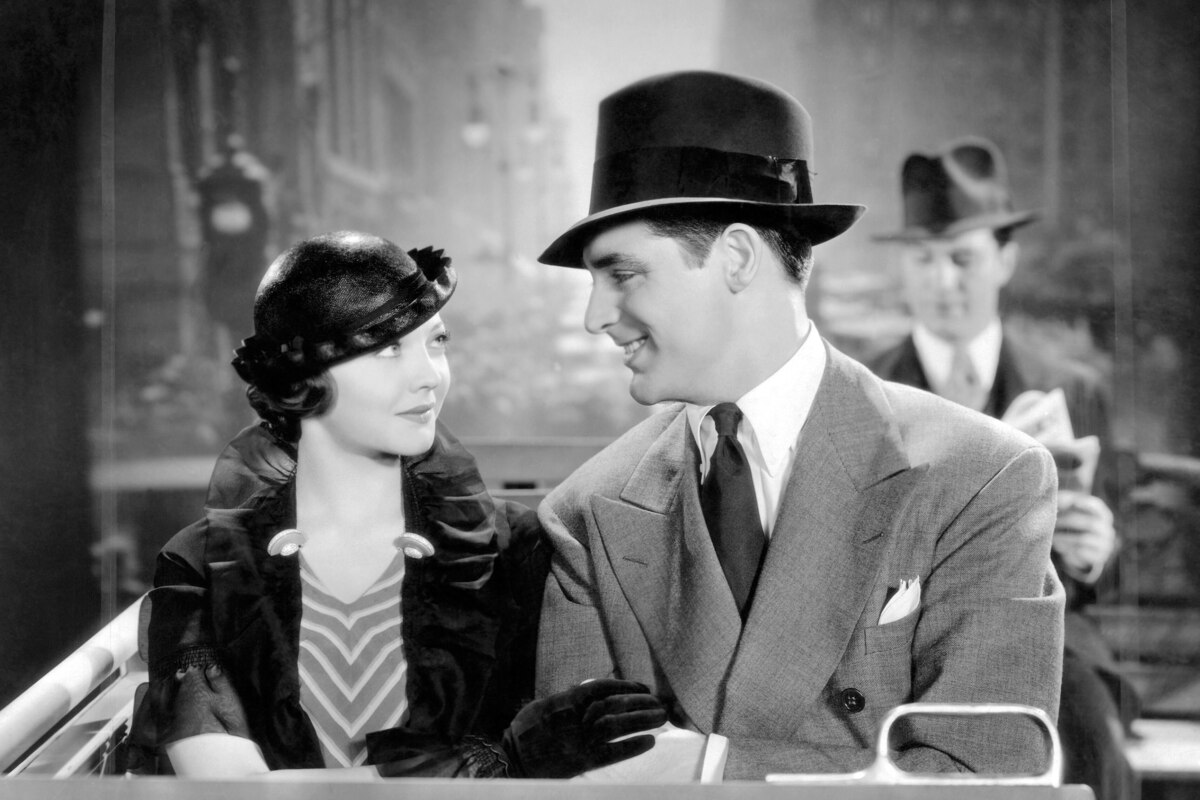
Plagued with financial troubles, the beleaguered Paramount was constantly fine-tuning its moviemaking formula to ensure the studio had a future during a time of great uncertainty. But what benefited Paramount was often at the expense of their stable of talent. The light comedy Thirty Day Princess (1934) was one film in a long line of B pictures Paramount regularly churned out to both keep costs low and ensure box-office success. It stars two of their top talents at the time, Sylvia Sidney and Cary Grant. They were backed by a supporting cast of accomplished character actors including Edward Arnold, Henry Stephenson, Edgar Norton, Robert McWade and the great prankster Vince Barnett. With a Preston Sturges' script, along with Frank Partos, and producer B.P. Schulberg and director Marion Gering at the helm, it seemed like everything would go off without a hitch. However, frustrations with the production led to fraught relationships and ultimately the cracks began to show.
Thirty Day Princess was based off of Clarence Budington Kelland's story serialized in the Ladies Home Journal. Kelland, a former lawyer turned writer who once billed himself as "the best second-rate writer in America," was a familiar name in the magazine world and eventually his stories caught Hollywood's attention. His Scattergood Baines stories were adapted into six films starring Guy Kibbee and his best-known piece, Opera Hat, was adapted into the film Mr. Deeds Goes to Town (1936). Thirty Day Princess was just the type of story Hollywood studios gravitated towards. The Prince and the Pauper theme coupled with a case of mistaken identity had all the makings of a successful romantic comedy.
Recently ousted from Paramout, Schulberg purchased the rights to Kelland's story for his independent company B.P. Schulberg Productions. Schulberg maintained his relationship with Paramount, producing and financing projects the studio would then distribute. Assigned to adapt Kelland's story to the big screen were Paramount contract writers Preston Sturges, Frank Partos, Sam Hellman and Edwin Justus Mayer. Schulberg's working relationship with Sturges was fraught with tension. The two constantly battled over control of the project. Schulberg felt that Sturges should be a team player and Sturges questioned Schulberg's role as producer. According to Preston Sturges biographer Diane Jacob, "Sturges... yearned for credit, but had no desire to change places with Schulberg, who neither wrote nor directed, but merely exhorted others. If Sturges had his way, he'd do everything himself." In the end, Sturges' contributions to the script were minimal as many changes were made. He grew frustrated with his role as a screenwriter and in 1940 he took back control with his directorial debut The Great McGinty.
The year 1934 proved fruitful for Sylvia Sidney. She was at the top of her game at Paramount and was recently named Max Factor's Star of the Year. Sidney was famously quoted as saying "those were the days when they used to pay me by the teardrop." While comedies usually weren't part of her repertoire, she preferred them to the dramatic potboilers. In Thirty Day Princess, Sidney plays the dual role of Princess Catterina "Zizzi" from the mythical country of Taronia, and her doppelgänger, struggling actress Nancy Lane. This was the last of the six films directed by Marion Gering that Sidney had appeared. Sidney also had a close professional and personal relationship with Schulberg, who was instrumental to her success at the studio. While Sidney looked back fondly on the film, her days at Paramount were nearing the end. She made four more films before leaving the studio in 1936.
Cary Grant, on the other hand, was none too happy with his role in Thirty Day Princess. Grant arrived in Hollywood in 1932 and Paramount's Adolph Zukor was eager to groom the charismatic Grant as the studio's next big leading man. Paramount put Grant on a 5-year contract with a starting salary of $450 a week. He made 13 films in two years, and by 1933 Grant was utterly exhausted. He took a brief hiatus to travel to his hometown in England, returning with his newly minted bride Virginia Cherrill. Upon arrival back in L.A., Paramount put him to work immediately on another "tuxedo picture." In Thirty Day Princess, Grant plays Porter Madison III, a newspaper publisher who is courted by Sidney's lookalike princess as a way to distract him from uncovering and reporting on the financial fraud happening behind the scenes. According to Grant biographer Marc Eliot, "Grant hated everything about the film, including the haste with which it was made and the fact that once again he was cast in a role that Gary Cooper had rejected."
The production of Thirty Day Princess moved forward at lightning speed. After a brief delay when William Collier Sr. had to be replaced by Robert McWade due to illness, production began on March 1st, 1934, and the film had a nationwide release on May 18th. The film garnered mostly positive reviews. Variety magazine noted "Miss Sidney is thoroughly convincing in the dual" and Mordaunt Hall of The New York Times noted "Mr. Grant gives an excellent performance." The Chicago Daily Tribune wrote "Thirty Day Princess is G-O-O-D! It's fun. It's clever. It's suspenseful and it presents a running fire of bright dialogue that keeps the corners of your mouth turned up."
Thirty Day Princess was one of many Paramount films that were acquired by MCA/Universal in 1958. It has since been released on DVD and a 35mm nitrate composite print was restored by the UCLA Film & Television Archive.
By Raquel Stecher
Thirty Day Princess
by Raquel Stecher | August 06, 2020
SIGN UP FOR OUR NEWSLETTERS

CONNECT WITH TCM