The African Queen began as a novel written by English author C.S. Forester and published in 1935. This unique adventure story about the relationship between a prim spinster and the scruffy boat captain who takes her down the river was kicked around as a potential movie idea for years in Hollywood. RKO thought about making it with Charles Laughton and his actress wife Elsa Lanchester, but ultimately the project was scrapped. The thinking was that audiences would not want to see a romance between two middle-aged people. One script reader's notes at RKO reads, "It is dated, incredible, quite outside acceptable dramatic screen material...Its two characters are neither appealing nor sympathetic enough to sustain interest for an entire picture...Both are physically unattractive and their love scenes are distasteful and not a little disgusting. It's no bargain at any price. No amount of rewriting can possibly salvage this dated yarn."
Still, others saw potential in The African Queen. In 1946 Warner Bros. bought it as a possible vehicle for Bette Davis. That never came to fruition, however, and by 1947 they were trying to unload the property.
Director John Huston, who had always been a fan of the book, wanted desperately to purchase the rights to the property with his producing partner Sam Spiegel as a project for their independent film company, Horizon Pictures. Warner Bros. was willing to sell it to them for $50,000, but even between the two men they couldn't come up with the cash. They racked their brains to come up with a way to get the money. Finally, Sam Spiegel decided to approach Sound Services, Inc., a company that specialized in supplying sound equipment to studios, and see if they would give them the full amount to finance the project. Sound Services, Inc. wasn't in the business of loaning money to purchase film properties, but Spiegel promised the company that not only would Horizon pay back every cent, but they would also use Sound Services equipment to make The African Queen, giving them full credit in the finished film. Sound Services agreed, and the project became theirs.
Huston was adamant that writer James Agee would be the one to help him write the screenplay. Agee was a poet, novelist and film critic whose work Huston had always admired. The two men had become friendly years before when Huston sent Agee a note of appreciation for a review he had written for The Battle of San Pietro (1945) in Time Magazine, which Huston found "sensitive and perceptive." It was the first and only time Huston ever corresponded with a critic. Huston and Agee didn't meet in person until later when Agee did a profile on Huston for Life magazine. As the two became friends, Agee confessed to Huston his secret desire to write screenplays.
When The African Queen project came around, Huston thought immediately of his friend Agee and offered him the job. Agee agreed and flew out to California, where he and Huston holed up in a resort hotel outside of Santa Barbara to work on the screenplay. They set a strict regimen for themselves of work and exercise. Though they got a tremendous amount done, Agee was not taking care of himself-he was drinking, smoking and eating too much and not getting enough sleep. Before they could finish the script, Agee had a heart attack and was out of commission for a lengthy recuperation.
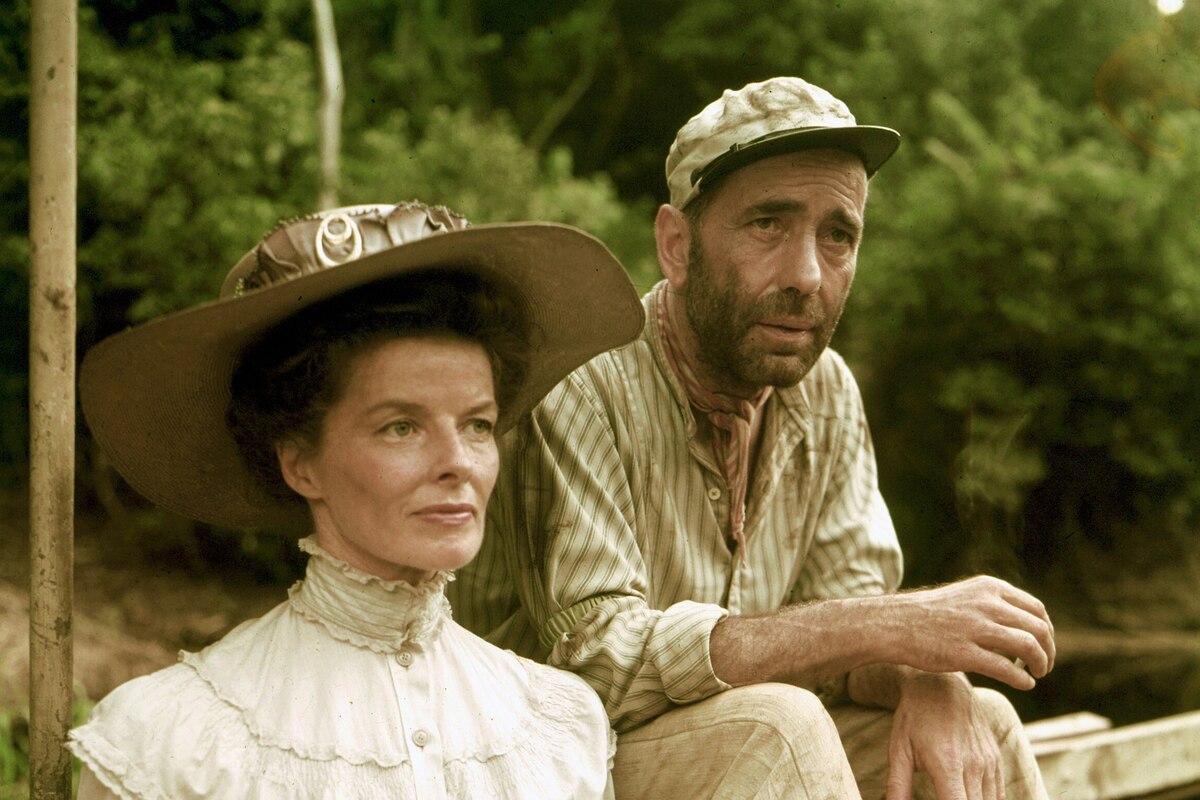
Meanwhile, Huston was searching for the ideal leads. Katharine Hepburn was the first one contacted. In 1950 she was touring with the stage production of Shakespeare's As You Like It, which was currently playing in Los Angeles. Sam Spiegel sent her a copy of the original novel The African Queen to read while she was staying at the home of her good friend Irene Selznick. She read it and loved it, knowing that the part of Rose would be perfect for her.
Sam Spiegel came out to visit Hepburn, and the two discussed the project and potential actors to play opposite her. Charlie Allnut was supposed to have a Cockney accent, which limited their choices until Spiegel suggested Humphrey Bogart. They both thought him perfect for the part and simply decided to make his character Canadian, which would solve the problem of the Cockney accent. As Katharine Hepburn later wrote in her 1987 book The Making of the African Queen; or How I Went to Africa with Bogart, Bacall and Huston and Almost Lost My Mind, "Now, looking back at that conversation-can you imagine anyone but Bogie playing that part? He was really it-hook, line and sinker".
John Huston and Humphrey Bogart had worked well together previously on The Maltese Falcon (1941), Across the Pacific (1942), The Treasure of the Sierra Madre (1948) and Key Largo (1948) so Huston called up his old pal and said, "Hey, old son, I have a great property. The hero's a low-life, and since you're the biggest low-life in town the part is therefore ideal for you!" Though Bogart wasn't keen on shooting in Africa, he trusted his friend Huston. "He's brilliant and unpredictable," said Bogart of Huston. "Never dull. When I work with John, I think about acting. I don't worry about business." Huston, in turn, called Bogart "an ideal collaborator and companion...He's a joy to work with...his figure seemed to find its way into whatever I did."
Bogie had never worked with Katharine Hepburn, and neither had John Huston for that matter. The actor was somewhat leery of working with her, having heard she could be difficult. However, when Bogie and Huston met with Hepburn, she won them over. In her 1979 autobiography By Myself, Lauren Bacall (Humphrey Bogart's wife) said that Bogie had never wanted to travel out of the country, but she herself was longing to go and see the world. "Bogie," she said, "liked his life as it was; going to New York was all the traveling he wanted to do. Finally Sam Spiegel told Katharine Hepburn that he had Bogie and John - told John that he had Bogie and Katie - told Bogie that he had John and Katie - and The African Queen was put together."
John Huston was excited about going on location to Africa and was adamant about shooting it in color, even though it meant more hassles and expense. He felt that color would bring an element of vivid richness to the exotic locale that would bring people into the theater. "I had to do this film on location," explained Huston in an interview. "I wanted these characters to sweat when the script called for it. On a sound stage you fake it, but in Africa you don't have to imagine that it's hot, that it's so hot, that it's so humid and wet that cigarettes turn green with mold; it really is hot and clothes do mildew overnight-and when people sweat it isn't with the help of a make-up man. Africa was the only place to get what I was after."
Securing financing for the ambitious project was complicated. Most banks were uneasy about putting up money for a film that would be shot in such a remote location. There was unpredictable weather to consider along with a host of logistical problems. A new London based company called Romulus Productions, however, was eager to lure Hollywood talent overseas, so they took a chance and provided most of the film's financial backing.
As preparations began, Katharine Hepburn was still waiting to see a finished script. She was growing increasingly irritated with Huston's vagueness about the details, and she often sensed that Huston was avoiding her altogether. It was the first time she had worked with the eccentric director, and she didn't know what to make of him. Bogart tried to reassure her that this was the way Huston always worked.
Pressured to complete the screenplay, Huston dashed off a rather hasty ending just to get something on the page before rushing off to England with Sam Spiegel to begin location scouting. James Agee, they hoped, would eventually join them in Africa to finish the script.
Once in Africa, Huston and Spiegel began scouting the dense jungle areas by air. They were looking for a dark, winding body of water like the one described in the original novel. They logged 25,000 flying miles over the areas, and finally, there it was - the Ruiki, a tributary to the Lualaba that was ink black with decaying vegetation. The area in the Congo was so remote that it wasn't marked on most atlases. It was exactly what Huston wanted.
by Andrea Passafiume
The Big Idea
by Andrea Passafiume | March 02, 2007
SIGN UP FOR OUR NEWSLETTERS

CONNECT WITH TCM