With King Kong's success, a sequel was inevitable. The Son of Kong, released later in 1933, brought back Robert Armstrong as Carl Denham, who returns to Kong's Skull Island home to find a kinder, gentler version of the giant ape. The film was not as successful as the original. Worse, Willis O'Brien used bits and pieces of his Kong models to create the son. One was completely cannibalized. The other survives only as an armature, the original Kong skin having been lost when it was replaced for the sequel.
For King Kong's first reissue, in 1938, some of the original violence and sexuality had to be cut to satisfy the film industry's Production Code, which had not been strictly enforced at the time of King Kong's original 1933 release. Among the lost shots were Kong's removing Fay Wray's clothes, natives being crushed in close-up by the giant ape and a horrifying scene in which he casually drops a woman picked up by mistake during his search for Wray in New York. The footage would not be restored until the late '60s, with a restored print issued theatrically in 1971. In 1976, a new print with the restored scenes was struck from an original print discovered in the United Kingdom.
A 1942 reissue darkened certain scenes to minimize the violence.
In 1949, Willis O'Brien finally won an Oscar® for Best Special Effects (the award was not given until six years after King Kong's release), for another giant ape film, Mighty Joe Young. The film co-stars Robert Armstrong, who played Carl Denham in the original, in a similar role as an impresario out to make a fortune showcasing the giant ape.
In 1956, King Kong was sold to local television stations in syndication. It's first showing in the New York City area was watched by an estimated 80 percent of available households.
In the '60s, college age fans wore buttons reading "King Kong Died for Your Sins."
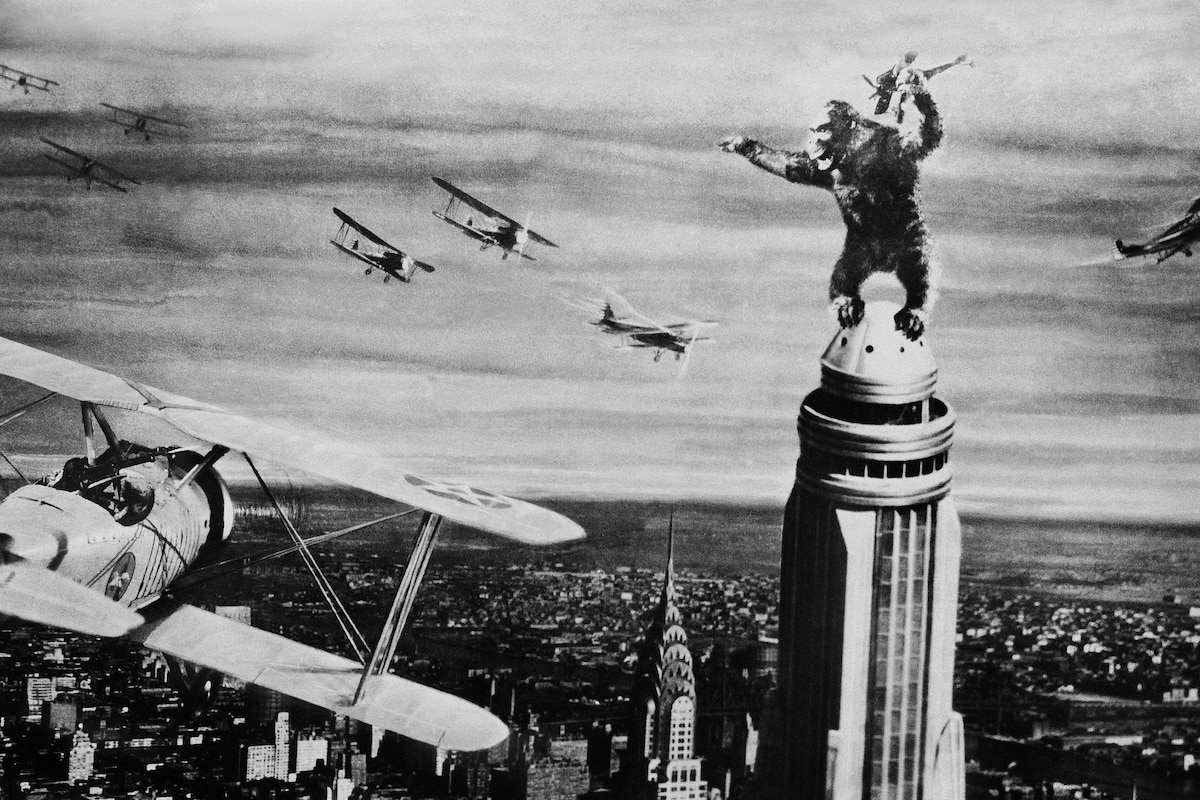
In one of his most famous comedy routines, Bob Newhart played the night watchman at the Empire State Building as Kong was climbing the structure.
In 1962, Japan's Toho Company bought the rights to the character for use in King Kong vs. Godzilla. Although Willis O'Brien had originated the idea, fans were horrified to see Kong played by a man in a rubber suit. According to legend, O'Brien's widow stayed home and cried the night it premiered. A 1967 sequel, King Kong Escapes, pitted Kong against a robot version of himself.
Dino De Laurentiis produced the film's first official remake which was released in 1976, with Jeff Bridges as leading man, now a paleontologist; Charles Grodin as an oil executive whose team discovers Kong's island; and Jessica Lange as Dwan, a shipwrecked actress. For the final scene, Kong fell from the World Trade Centers rather than the Empire State Building. The film's use of a man in a monkey suit angered critics. When the Motion Picture Academy® voted it an Oscar® for special effects, stop-motion animator Jim Danforth handed in his nomination certificates in protest. Contrary to legend, it actually turned a profit, making $80 million on a $24 million investment.
The original King Kong was among many films colorized by Turner Entertainment in the '80s. Although the process was widely derided by critics, bootleg DVD's of the colorized version are a popular item among King Kong collectors.
For King Kong's 50th anniversary in 1983, Hollywood craftsmen reconstructed the 20 foot head used in the original for display at Grauman's Chinese Theater. It looked so authentic that several newspapers thought it was the original.
The film was given a Criterion laserdisc release in 1985. Film restoration expert Ron Haver's audio commentary was the first ever recorded.
In a sequel to his 1976 remake, De Laurentiis released King Kong Lives in 1986, in which doctor Linda Hamilton keeps the giant ape alive with a giant mechanical heart after his fall from the World Trade Centers.
The long-running animated series The Simpsons spoofed King Kong in "King Homer," a story within 1992's "Treehouse of Horror III" episode. Homer Simpson became a giant ape in love with Marge.
In conjunction with the film's 60th anniversary, Turner Home Entertainment released a video package in 1993 including a poster, three mounted film frames and a documentary on the film's production.
Dudley Moore as King Kong! That was the casting for the direct-to-video animated musical The Mighty Kong, released in 1998. Moore also provide the voice for Carl Denham.
In 2005, New Zealand's Peter Jackson, director of the popular Lord of the Rings trilogy, directed a re-make, stating that King Kong was the film that had inspired him to become a filmmaker. It starred Naomi Watts as Ann Darrow, Jack Black as Carl Denham and Adrien Brody as Jack Driscoll. CGI effects created Kong and the other prehistoric creatures, but Jackson also used actor Andy Serkis, who previously had played Gollum in the Lord of the Rings films, as the movement model for Kong. Jackson was in negotiation to have Fay Wray deliver the last line ("It was Beauty killed the Beast.") when she passed away. Made for a record $207 million, the film grossed well over $500 million.
Collector Bob Burns sold the only surviving armature from one of the Kong models to Jackson in 2005.
King Kong was not released on DVD until 2005, when Warner Home Video and Turner Entertainment put out a special two-disc version. They also released a boxed set featuring King Kong, The Son of Kong and Mighty Joe Young.
An original one-sheet poster for the film recently sold for $52,000.
by Frank Miller
Pop Culture 101: KING KONG
by Frank Miller | March 02, 2007
SIGN UP FOR OUR NEWSLETTERS

CONNECT WITH TCM