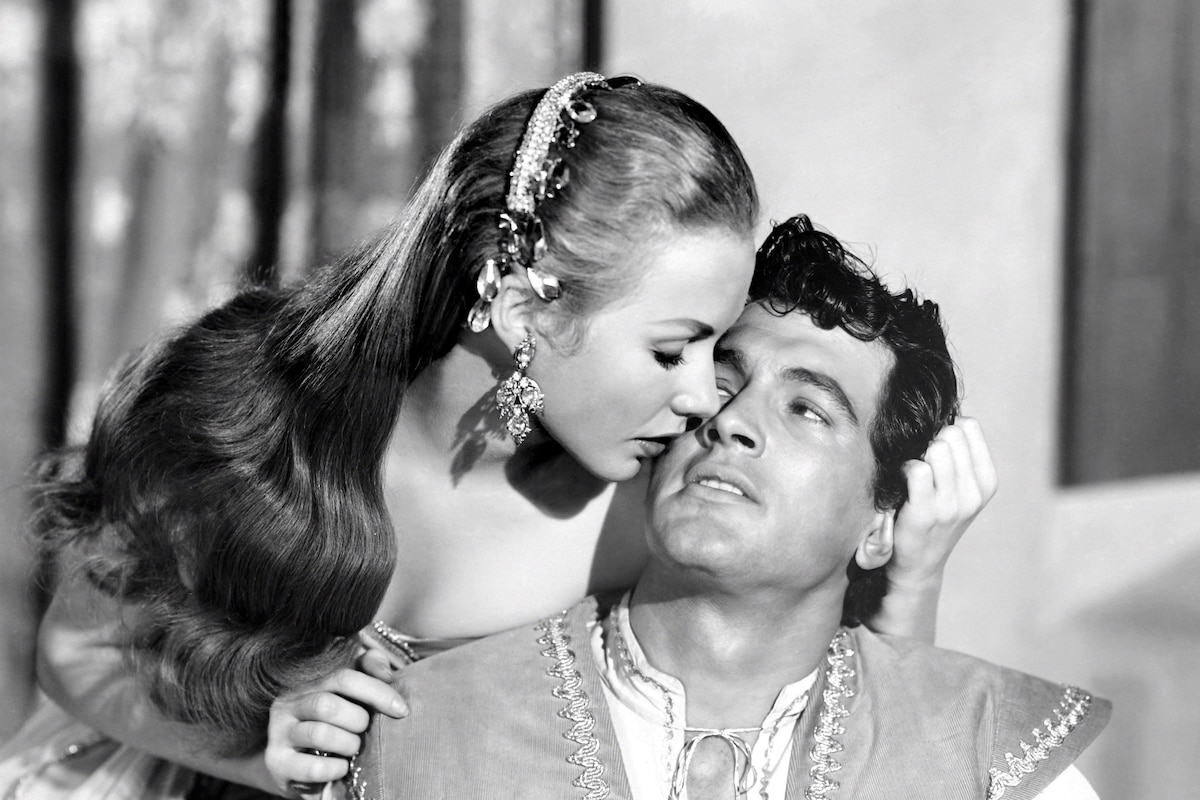
The Golden Blade (1953) was another 1950s Technicolor "sword and sandal" epic featuring beautiful women in harem costumes and muscular men wielding swords. Influenced in heavy doses by The Arabian Nights and the Arthurian legend, The Golden Blade stars Rock Hudson, then one of the hottest up-and-coming actors in Hollywood, playing a Persian named Harun. The film begins with the cities of Basra and Bagdad at war with one another. During the fighting, Harun's father is mortally wounded, but before dying he gives his son a medallion he has taken from the man who injured him and asks him to find a way to bring peace to their city. Harun honors his father's request and goes to Bagdad, where he meets a beautiful Caliph's daughter named Khairuzan (Piper Laurie) who is taken away by guards during a riot for defending Basra. After she is gone, Harun finds a medallion on the ground, which is identical to the one his father gave him, and an old golden sword strong enough to cut other swords in two, which only he can control. The evil vizier Jafar (George Macready) tries to convince the Caliph (Edgar Barrier) that Khairuzan should be married to his own son, Hadi (Gene Evans). To escape her marital fate, Khairuzan disguises herself as a boy and flees the palace, where she soon meets up with Harun and the adventures begin. Also in the cast are Kathleen Hughes, future international star Anita Ekberg as a handmaiden and future television stars Dennis Weaver and Guy Williams in bit parts.
Directed by Nathan Juran from a script and original story by John Rich, The Golden Blade was advertised luridly by the Universal marketing department with slogans like, "Out of Bagdad's mystic past thunders the adventure of all the ages!" and "His blade of gold...a legend in battle! Her kiss of surrender...the prize of victory!" Also known as The Sword of Damascus, the film was shot from mid-November to mid-December 1952 on the Universal back lot in North Hollywood. Farley Granger, then under suspension from the Samuel Goldwyn company, had been the first choice for Harun, but Granger refused to play the role and it was given to Hudson. Piper Laurie was a starlet at Universal and suffering through unsatisfying parts when she was cast as Khairuzan.
In her autobiography, Learning to Live Out Loud, she wrote of being asked to perform a dance in the film, which she happily accepted. Universal hired the famed choreographer Eugene Loring, who worked for several months with Laurie on her dance. Loring kept her to a grueling schedule of eight hours of rehearsal a day, which Piper Laurie didn't mind, because "besides keeping my weight down, working hard at anything made me feel more comfortable with the privileges I had. Eugene demanded that I eat a steak for breakfast every morning before I left the house. That seemed impossible because my breakfast was usually black coffee and a cigarette." In the morning, Loring had Laurie do stretches and strength training, and in the afternoon "modern dance movements that I repeated and repeated until I collapsed to the floor." After all those months of rehearsal, the dance number was filmed in one day. However, when Laurie saw the final edit of The Golden Blade months later, she was shocked to find that most of the dance had been reshot with a professional dancer. "They must have gone to some pains to make sure I wasn't on the lot when they shot it. I suppose if I hadn't been so numb emotionally, I would have been angrier, but I never thought my efforts had been wasted. [...] I didn't like the deception, of course, but somehow it didn't surprise me."
Hudson and Laurie had first met when she was being tested by Universal in order to secure a contract. They later became friends when they worked together on Has Anybody Seen My Gal (1952) and often hung out together. Laurie said that Hudson never made a pass at her, and that at the time she was unaware of his sexual orientation. The studio manufactured a fictitious romance between the two for the benefit of the newspapers and fan magazines, a common practice in the Golden Age of Hollywood in order to both promote the films and their stars, and often to hide the fact that one or both of the stars were gay, as in Hudson's case. After the film was completed, Laurie was asked to "write" a profile of Hudson for Modern Screen in which she described him as "the nicest person to have around because he's so much fun. [...] I've seen him in a serious mood only a couple of times, and both of them concerned his work. He's quite sober about it, and when we sat in a projection room to watch a rough cut of The Golden Blade, he began hacking himself to pieces with his criticism." Most fan magazine articles supposedly written by stars were ghostwritten by either the staff of the magazines or the studio publicists. To help further promote the film, Piper Laurie would appear as one of the surprise guests when Rock Hudson was profiled on the 12th episode of the first season of Ralph Edwards' famed This Is Your Life television program in 1952.
When it was released in September 1953, The Golden Blade received generally favorable notices. Modern Screen said the film had "enough plots and counterplots to make you dizzy - but not bored."
By Lorraine LoBianco
The Golden Blade
by Lorraine LoBianco | August 03, 2020
SIGN UP FOR OUR NEWSLETTERS

CONNECT WITH TCM