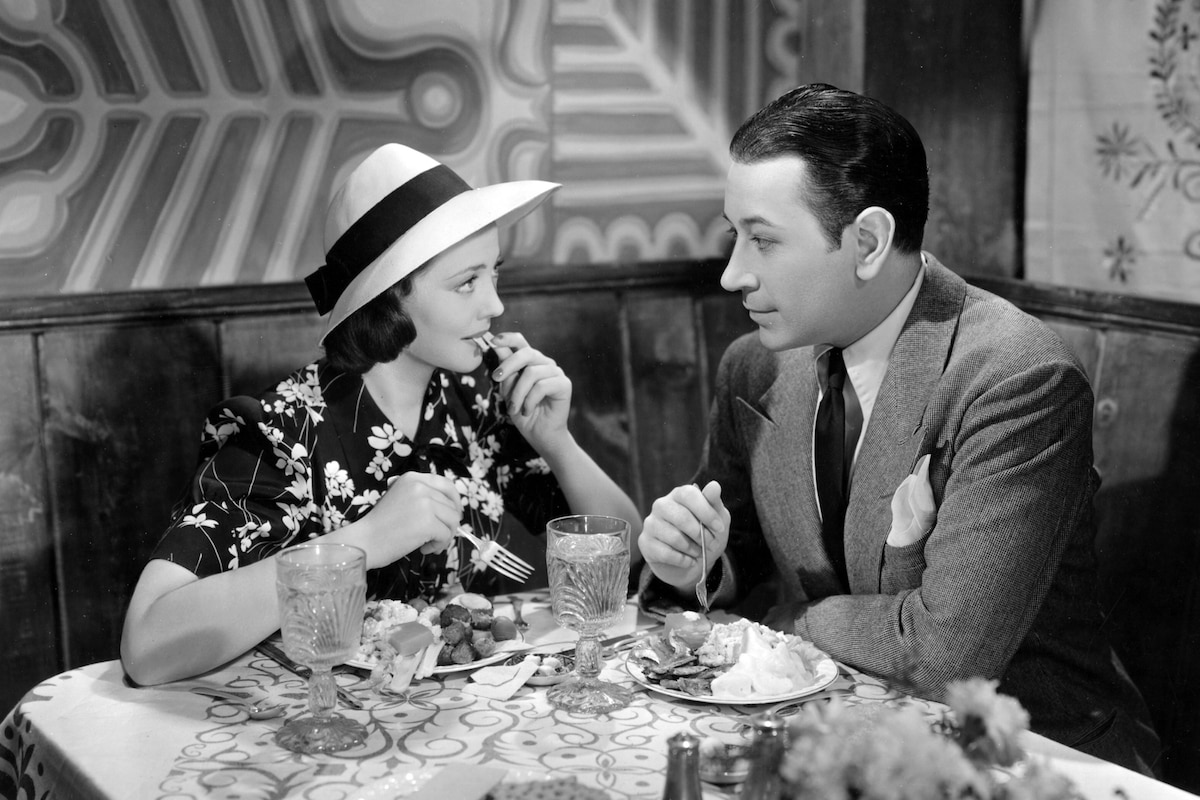
The great German director Fritz Lang, creator of such masterpieces as Metropolis (1927) and M (1931), fled Germany after Hitler rose to power and marked his arrival in Hollywood with a loose trilogy of films that addressed serious social issues. You and Me (1938), a drama of ex-convicts given a second chance at an honest life working in a big city department store, was the third film in the trilogy. It was also a rarity in Lang's career in the way it used comedy and quasi-musical elements to tell its story.
The project was born from an original script by Norman Krasna, who specialized in romantic comedies and witty dialogue but had also written the hard-hitting lynch-mob drama Fury (1936), Lang's first American movie. The prolific screenwriter was set to make the film his directorial debut with George Raft and Carole Lombard in the lead roles until Raft objected to a novice at the helm. Paramount revived it with Sylvia Sidney opposite Raft and Richard Thorpe assigned to direct. This time it was Sidney who objected and she suggested that Fritz Lang, who had directed her in Fury and You Only Live Once (1937), take over. Lang was already getting a reputation for his demanding ways and perfectionism but he had a good relationship with Sidney and the studio was eager to work with the actress, so they agreed.
Lang immediately began reworking the script when he joined the production in 1937, with the blessing of Krasna, with whom he maintained a friendship and a correspondence. "Go get 'em Fritz, you're one of the very few who can," wrote Krasna in one letter. "[T]here's no question that Brecht was most responsible for You and Me," Lang told Peter Bogdanovich in 1965, referring to German playwright Bertolt Brecht. "I wanted to make a picture that teaches something in an entertaining way, with songs." He brought in composer Kurt Weill, Brecht's collaborator on The Threepenny Opera and other plays, to create a different kind of musical. In one scene, when a group of ex-cons get together, their remembrance of life in prison is expressed in a mix of rapping on tables and clinking on glasses, call-and-response dialogue, and rhythmic chants, while flashbacks of life in prison play across the screen.
Work on the script proceeded slowly. Krasna left the project and Lang worked on the script with screenwriters Virginia Van Upp and Jack Moffitt, divvying up scenes between them and meeting with one in the morning and another in the afternoon, while working out songs with Weill before the screenplay was complete, which frustrated the composer. Preproduction dragged on so long that Sidney took a role on Broadway and Weill left Hollywood for New York to work on other projects.
Production finally began in January 1938, with Oscar-winning cinematographer Charles Lang Jr. behind the camera (he won for A Farewell to Arms from 1932 and racked up a record 18 Academy Award nominations over a nearly 50-year career) and veteran actor Harry Carey in the important role as the paternal department store owner who takes a chance on ex-convicts for his sales staff. Barton MacLane was cast as the mobster who tries to lure the former crooks back into a life of crime. Character actors Roscoe Karns, Warren Hymer, and George E. Stone are among the familiar faces filling out the cast of ex-cons along with a young Robert Cummings, a fresh face soon to become a leading man in his own right in such films as The Devil and Miss Jones (1941) and Alfred Hitchcock's Saboteur (1942).
Lang's perfectionism slowed the production schedule and he forced his cast and crew to work overtime (sometimes to midnight) and weekends. He clashed with Raft and even fellow German émigré Kurt Weill bristled at Lang's arrogance and demanding manner. "Nobody in the whole world is as important as he imagines himself to be," the composer wrote his wife, actress Lotte Lenya. "I completely understand why he is so hated everywhere." Principle photography ended in March, seven days behind schedule, and post-production went into overdrive to meet a June release date. Weill's music was worked over by studio composer Boris Morros and lyricist Sam Coslow, songs were overdubbed, others were cut.
Lang's idiosyncratic approach was not lost on the critics. "Confronted with a slightly Runyonesque crime story by Norman Krasna, [Lang] has chosen to intersperse its open-faced narrative with a number of unconventional stylistic asides--chants, sepulchral voices, montages of sound and imagery," wrote The New York Times film critic Frank S. Nugent. Variety described it as "a sort of cinematic Mercury Theatre, by way of Marc Blitzstein--Orson Welles, with European flavoring, also." But for all the ambition, You and Me was a commercial flop and a critical disappointment. In his 1965 interview with Bogdanovich, Lang called it "an unfortunate affair from the beginning--you know, some things are just jinxed," and in a later interview confessed that "It was--I think deservedly--my first real flop."
But it's also an inventive picture that mixes social commentary, romantic comedy, and characters reminiscent of Damon Runyon with sophisticated storytelling techniques. It was Lang's version of a Bertolt Brecht "Lehrstuck--a play that teaches" as a Hollywood entertainment and it remains one of the most unusual films in his career.
Sources:
Fritz Lang in America, Peter Bogdanovich. Studio Vista, 1967.
Fritz Lang: The Nature of the Beast, Patrick McGilligan. Faber and Faber, 1997.
Fritz Lang, Lotte Eisner. Secker and Warbug, 1976.
George Raft: The Man Who Would be Bogart, Stone Wallace. BearManor Media, 2008.
"The Screen in Review," Frank S. Nugent. The New York Times, June 2, 1938.
"You and Me," unsigned review. Variety, June 8, 1938.
AFI Catalog of Feature Films
IMDb
by Sean Axmaker
You and Me
by Sean Axmaker | July 31, 2020
SIGN UP FOR OUR NEWSLETTERS

CONNECT WITH TCM