When Gregory Hines died of liver cancer in 2003 at only 57 years old, the world lost one of its greatest dancers and an arresting screen personality. This film is arguably the best tribute to Hines and the first in many years to turn the spotlight on the art form he loved and advanced.
Hines was the son of dancer, musician and actor Maurice Hines. He began tap dancing when he was two years old and by the age of five was a semi-pro performer. He and his brother Maurice studied with famed choreographer Henry LeTang, and the two soon formed an act, making their Broadway debut in The Girl in the Pink Tights in 1954. Known variously as "The Hines Kids" and "The Hines Brothers," they also learned from acts they performed with, among them Howard "Sandman" Sims and The Nicholas Brothers. After their father joined the act as their drummer in 1963, they changed the name to "Hines, Hines and Dad."
At one time, tap dancing had been a celebrated staple of musicals and dance performances, a uniquely American evolution from Irish jigs, English clog dancing and the highly rhythmic Juba or hambone dance of African slaves. Made famous by such stars as Bill "Bojangles" Robinson, John W. Bubbles and The Nicholas Brothers, it became integrated into the styles of famous white dancers like Fred Astaire, Eleanor Powell and Gene Kelly. But by the time this picture was made, it had largely disappeared from the dance vernacular.
But not in Gregory Hines' world. Always passionate about the form, he had taken it to Broadway, earning Tony Award nominations in the late 1970s and early 1980s for the musicals Eubie!, Comin' Uptown and Sophisticated Ladies. He began to innovate and take the art to new places, improvising steps, sounds, rhythms and phrasing, rather like a jazz drummer, while maintaining an easy laid-back style. (He has a credit on Tap as "improvographer.")
He was a natural, then, to collaborate with director Nick Castle and producer Gary Adelson on their new project. Castle, the son of famed Hollywood choreographer and dance director Nick Castle Sr. (Stormy Weather, 1943; Royal Wedding, 1951), wanted to do a tap dance movie, and the two got Hines on board to develop it.
In addition to his vision, expertise and improvisational work, Hines brought in some of his personal and professional heroes, including LeTang to choreograph and Sammy Davis Jr. to play Little Mo, the old timer who guides Hines' character, newly released from prison, away from a life of crime and toward redemption through dance. In his last theatrical feature before his death, Davis was lauded by critic Roger Ebert: "Davis has never had a juicier role in a movie, and for once he isn't playing himself; he's playing the opposite of glitter and glitz, and his sincerity is believable."
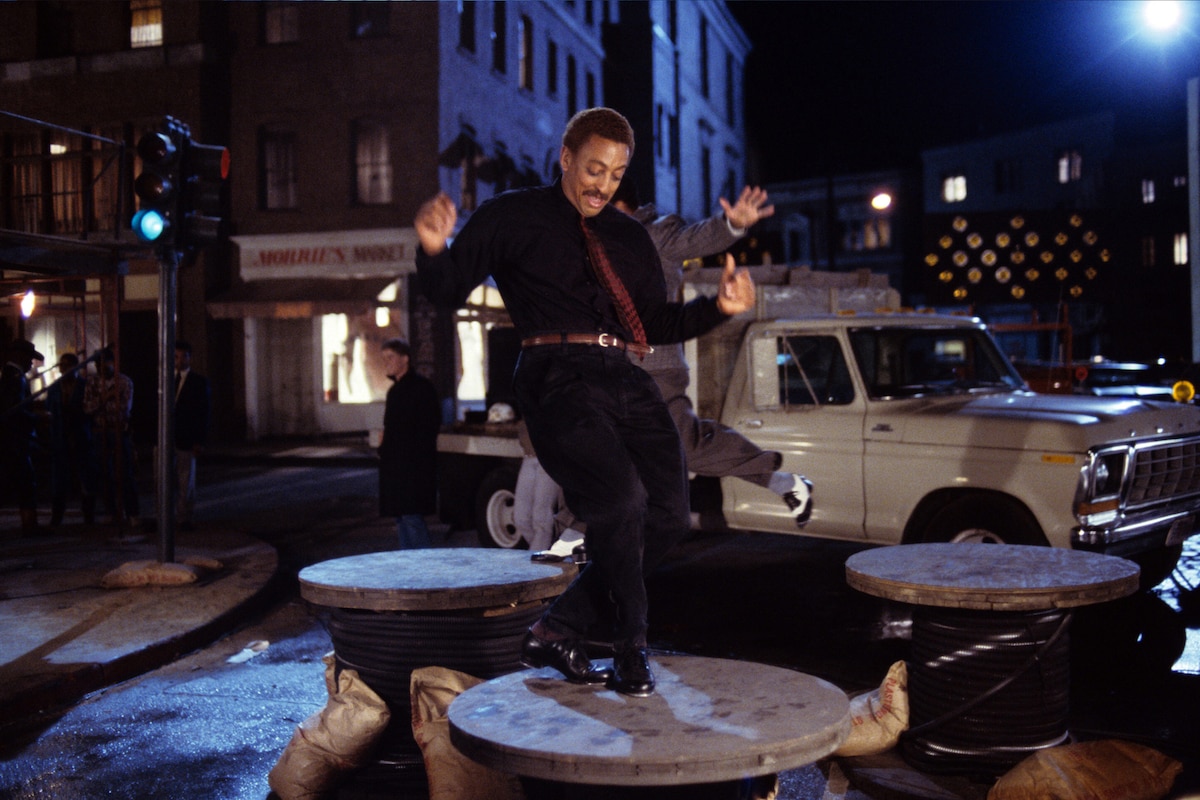
The plot is little more than an excuse to showcase tap, and its shining moment comes during a challenge sequence featuring cameo performances by tap legends dancers Arthur Duncan, Bunny Briggs, Howard "Sandman" Sims, Steve Condos, Jimmy Slyde and Harold Nicholas of The Nicholas Brothers. Just as Hines pays tribute to his mentors in this film, he also introduces teenaged dancer Savion Glover, who would pick up the torch from Hines in later years and carry the art form to new expressions and innovations.
Principle photography began in March 1988. Tri-Star, the company that picked up the production, wanted the finished product ready for fall 1988 to fill an opening in its distribution schedule, according to a Hollywood Reporter column, but when executives saw the final cut, they realized the film had suffered from a rushed schedule and moved the release date to February 1989 to give Castle and Adelman more time to polish it. In any case, the film failed to find a widespread audience; it did not fare well at the box office and quickly disappeared.
Hines had another chance to bring his love of dance to a far wider audience. Shortly after the release of Tap, he created, hosted and performed in the PBS special Gregory Hines' Tap Dance in America, featuring many of the dancers seen in the movie. The main criticism leveled against it by the Los Angeles Times was that "It settles for being a one-shot special when it should be the pilot for a series."
Director: Nick Castle
Producer: Gary Adelson
Screenplay: Nick Castle
Cinematography: David Gribble
Editing: Patrick Kennedy
Production Design: Patricia Norris
Music: James Newton Howard
Cast: Gregory Hines (Max Washington), Sammy Davis Jr. (Little Mo), Suzzanne Douglas (Amy Simms), Savion Glover (Louis Simms), Terrence E. McNally (Bob Wythe), Joe Morton (Nicky)
By Rob Nixon
Tap
by Rob Nixon | July 31, 2020
SIGN UP FOR OUR NEWSLETTERS

CONNECT WITH TCM