Will Rogers' films are rarely screened today, and he'll most likely be unfamiliar to younger audiences, but even the least of his pictures could be worth a look to see an immensely popular and influential personality at work. Seen from today's perspective (and even among some in his own time), his "homespun" philosophy, easy-going storytelling style and appeals to common sense barely mask a rigid, reactionary populism that scorned intellect and sophistication and often traded heavily on stereotypes. Come to think of it, he may just be ripe for revival in the climate of 2020.
Rogers started out in vaudeville and became a star feature of the Ziegfeld Follies on Broadway. A decade or so in silent films proved less successful, lacking the verbal humor and cracker-barrel inflection for which he became known. In the sound era he found a natural home at Fox, a studio dedicated to fostering a sense of down-home Americana in line with Rogers' appeal. He became one of the studio's biggest stars in such high-profile movies as the Mark Twain adaptation A Connecticut Yankee (1931) and State Fair (1933).
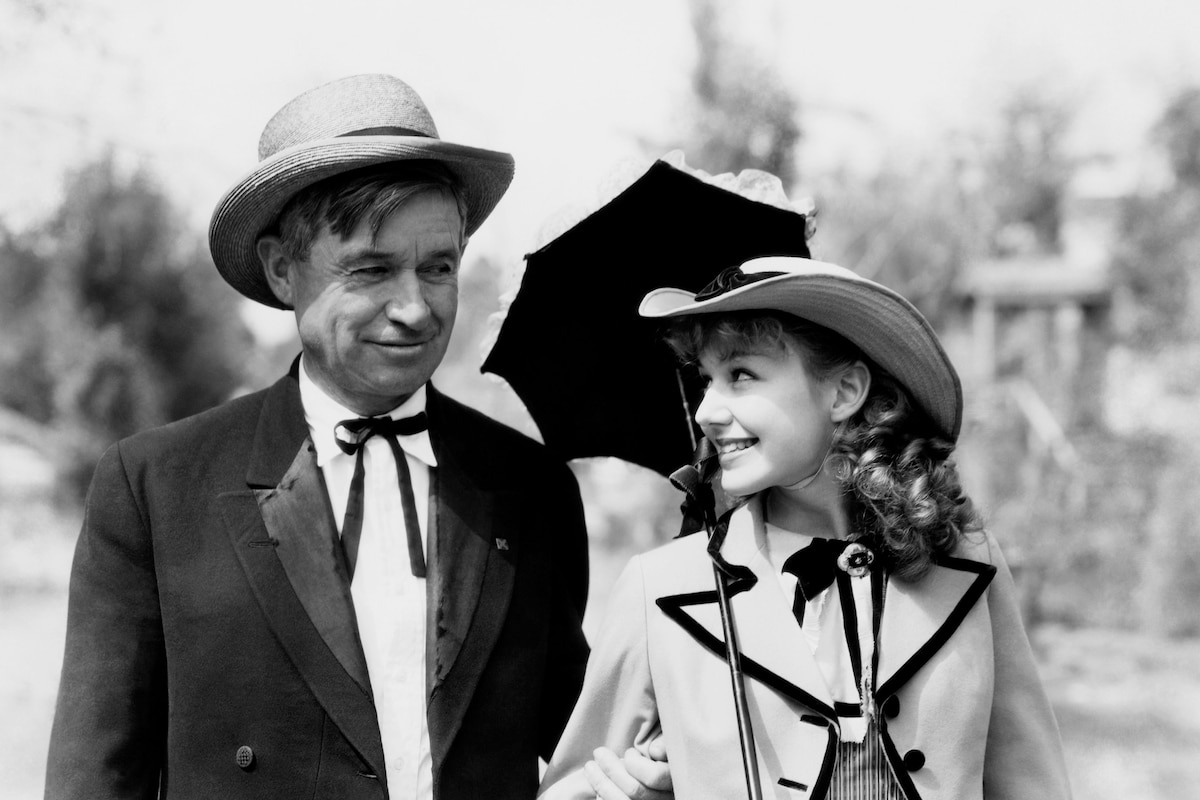
Doctor Bull (1933) began a three-picture association between Rogers and director John Ford that continued with one of Rogers' best releases, Judge Priest (1934), and ended with Steamboat Round the Bend, his next-to-last film performance and the first of two released after his death in a plane crash in 1935 at the age of 55. Unsurprisingly, it was the studio's biggest hit of the year.
Rogers plays a patent medicine con man who enters a broken-down steamboat in a river race while trying to raise money and find a witness to clear his wrongly accused nephew who's about to hang for murder. Rogers paid $10,000 to get the rights to a popular serialized novel, and frequent Ford collaborators Dudley Nichols (The Informer, 1935; Stagecoach, 1939) and Lamar Trotti (Young Mr. Lincoln, 1939; Drums Along the Mohawk, 1939) turned it into a screenplay particularly suited to his talent and image.
Back on the subject of stereotypes, the film prominently features Stepin Fetchit, a talented comic who became the most successful Black actor of the 1930s and one of Hollywood's most controversial figures. Born Lincoln Perry in Key West, Florida, in 1902, he was a highly literate and intelligent man who once wrote for an important African-American newspaper, The Chicago Defender. In his early vaudeville days, he developed a comic character known as "The Laziest Man in the World," a persona he carried into nearly 60 films over the course of his career.
Today, of course, Fetchit is seen as the epitome of the "shufflin' Negro" stereotype, and even during the peak of his success in the 1930s, he was frequently the target of civil right activists who saw him as damaging to the image of Blacks in America and an impediment to their integration into mainstream society. But he has also been re-evaluated over the years, not only for his unprecedented fame and financial success but for a subtly defiant aspect of his character masked behind feigned ignorance and shiftlessness. Film historian Mel Watkins, author of the biography Stepin Fetchit: The Life and Times of Lincoln Perry, explained this view of the character in a 2006 NPR interview.
"The lazy man character that [Perry] played was based on something that had come from slavery," Watkins said. "It was called 'putting on old massa' - break the tools, break the hoe, do anything to postpone the work that was to be done." As a result, the white characters would become exasperated and do the work themselves, which Watkins said Black audiences understood perfectly and laughed at heartily.
By the end of the 30s, his career began to wane. Faced with an increasingly influential civil rights movement and constantly thwarted attempts to gain equal pay and billing as his white co-stars, Perry left the big Hollywood studios. He made only a handful of shorts in the 1940s and two low-budget features for companies that specialized in entertainment for Black audiences. He returned briefly for two features, Anthony Mann's Western Bend of the River (1952) and John Ford's The Sun Shines Bright (1953), a comedy cobbled together from three "Judge Priest" short stories by writer Irvin S. Cobb.
Cobb was also an actor, and he appears in Steamboat Round the Bend as Rogers' rival in the river race. After Rogers' death, the studio changed the ending, which showed him waving goodbye to Cobb, a gesture deemed too poignant in light of the tragedy.
Director: John Ford
Producer: Sol M. Wurtzel
Screenplay: Lamar Trotti, Dudley Nichols, based on the novel by Ben Lucien Burman
Cinematography: George Schneiderman
Editing: Al DeGaetano
Art Direction: William Darling, Albert Hogsett
Music: Samuel Kaylin (uncredited)
Cast: Will Rogers (Doctor John Pearly), Anne Shirley (Fleety Belle), Irvin S. Cobb (Captain Eli), Eugene Pallette (Sheriff Rufe Jeffers), Stepin Fetchit (Jonah)
By Rob Nixon
Steamboat Round the Bend
by Rob Nixon | July 31, 2020
SIGN UP FOR OUR NEWSLETTERS

CONNECT WITH TCM