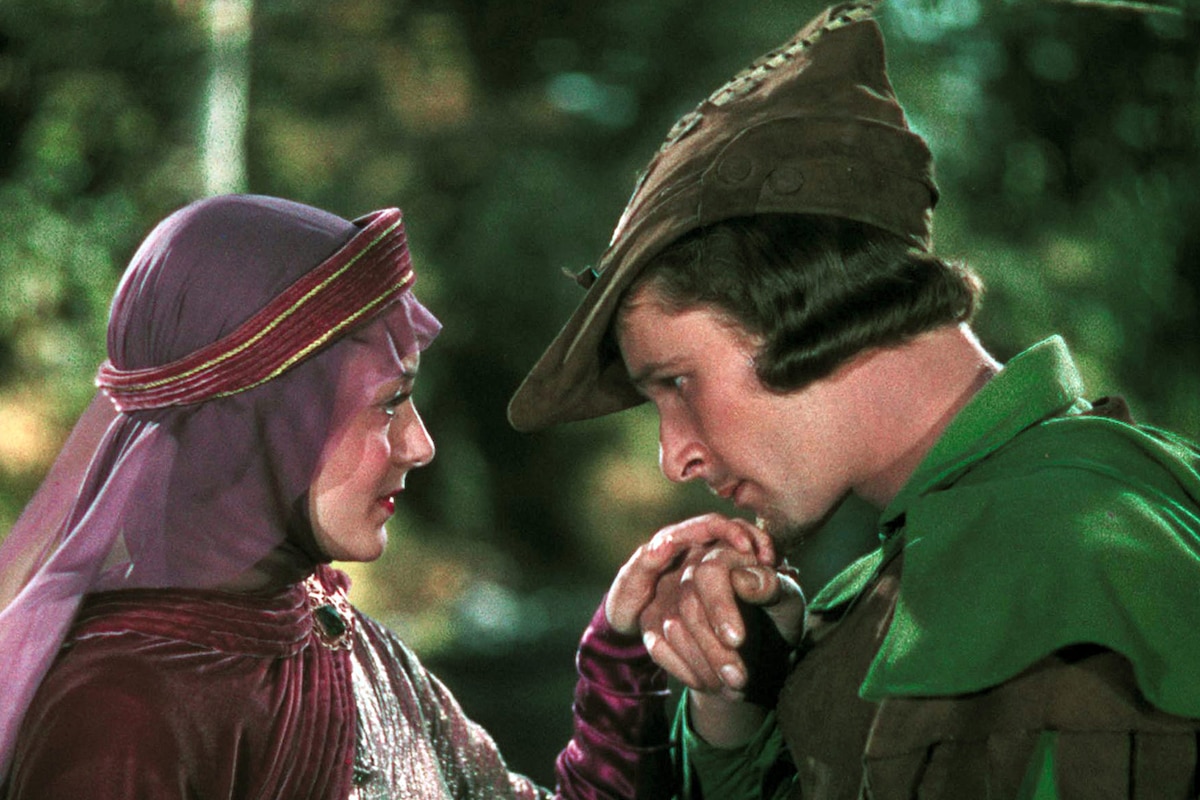
At the time of the film's release, Warner Brothers printed special materials for schools for beginning studies on the Middle Ages featuring Robin and Sherwood Forest. Other educational tie-ins soon popped up across the country. The May 1938 issue of Boy's Life magazine featured Robin Hood and initiated a national archery contest. That same month, Scholastic Magazine (widely distributed to schools throughout America) featured the movie on its cover; it was the first time it had featured a movie on its cover with an article and 15-minute radio script inside. The New York Public Library set up a display featuring a reading list of books related to the legends.
Another educational tie-in, called Photoplay Studies, featuring detailed commentaries on specific films with accompanying study materials and test/essay questions, was underwritten by the National Council of Teachers of English. The series featured not only The Adventures of Robin Hood but two other Flynn movies, The Charge of the Light Brigade (1936) and The Private Lives of Elizabeth and Essex (1939).
Various products, whether initiated by Warner Brothers or not, solidified the identification of Flynn and the movie with the Robin Hood legends forever. Grosset and Dunlap publishers issued a paperback of the story with the actor on the cover, and it was reviewed in the legitimate literary press. A character called The Black Pirate, featured in Action Comics shortly after the picture's release, bore a marked resemblance to Flynn (though it was based on his appearance in Captain Blood, 1935). The prestigious (by comic book standards) Classics Illustrated featured Robin Hood as the seventh title in its series; the overall concept, story, and artwork were clearly indebted to the Flynn version.
Games, toys, and puzzles soon appeared with Robin Hood motifs, and one company manufactured a cardboard replica of the castle seen in the film.
The style of Robin Hood, its mixture of action, humor, and romance, has influenced adventure films up to the present day. Additionally, its story of heroes arising to protect the oppressed and overthrow evil rulers has been a particularly potent theme in such modern action pictures as the Star Wars series.
The Robin Hood legend has received countless film treatments on both the big and the small screens, from the earliest days of silents to Robin Hood: Prince of Thieves (1991), an ill-conceived version starring Kevin Costner. The most famous, after the Flynn version, is Douglas Fairbanks, Sr.'s athletic take on the tale in 1922; it was the most successful movie of that star's highly successful career. A 1952 British release featured Richard Todd as Robin and future Oscar-winner Peter Finch as the Sheriff of Nottingham.
Richard Greene played Robin Hood in a popular British-made TV series (which was aired in the U.S.) from 1955 to 1960. A number of well-known British actors played on the show at various times, including Leo McKern, Jill Esmond (as Eleanor of Aquitaine, King Richard's mother), Peter Asher (future record producer and half of the 60s pop group Peter and Gordon), Donald Pleasence, and the actor who played King Richard in the Flynn version, Ian Hunter, as "Sir Richard." John Schlesinger, who later directed such films as Midnight Cowboy (1969) and The Falcon and the Snowman (1985), played Alan-a-Dale in two episodes, several years before making his directorial debut. The series also spawned a feature film, Sword of Sherwood Forest (1960).
The Robin Hood story has also been animated for both film and television a number of times, most notably the 1973 Disney version in which the characters appear as animals, with Robin Hood (voiced by Brian Bedford) as a fox. The film featured the voice talents of Peter Ustinov, Andy Devine and singer-songwriter Roger ("King of the Road") Miller. Other well-known cartoon characters, such as Bugs Bunny and Daffy Duck, have played their versions of the story. The Bugs Bunny version, made in the year of the film's popular 1948 re-release, incorporates footage of Errol Flynn from the original movie. In the animated film The Brave Little Toaster (1987), The Radio starts swashbuckling with his antenna, dueling with The Lamp using dialogue referencing King Richard, Marian, the Normans and the Saxons; it sounds very much like Flynn's repartee with Basil Rathbone in the climactic sword fight in The Adventures of Robin Hood.
Major liberties have been taken through the years to adapt the Robin Hood tales to fit any genre from stories about the legendary hero's son (played by Cornel Wilde in 1946) to sci-fi adventures (a German TV series in which Robin Hood's descendant often travels back in time to fight her ancestor's enemies) to the inevitable softcore adult market.
The Robin Hood story was given the Mel Brooks comic treatment in the spoof Robin Hood: Men in Tights (1993) with Cary Elwes as Robin and Patrick Stewart as King Richard.
The British comedy troupe Monty Python's Flying Circus spoofed the story in its sketch about "Dennis Moore," a highwayman and fighter for justice who gets so caught up in the thorny issue of redistribution of wealth that he ends up stealing from the poor and giving to the rich.
An episode of the TV series Star Trek: The Next Generation contrived to have Captain Picard (Patrick Stewart) turned into Robin Hood to fight the evil Sir Guy of Gisbourne (veteran British stage and screen actor Clive Revill, who also played in the Mel Brooks spoof).
One of the most acclaimed and original treatments of the legend is Richard Lester's elegiac Robin and Marian (1976), which picks up the story many years later. Sean Connery played the aging Robin Hood with Audrey Hepburn as his long-lost love Marian, Robert Shaw as the evil Sheriff of Nottingham, Richard Harris as a rather loony King Richard and Nicol Williamson as Little John.
A half century after his death, Errol Flynn continues to be the model of the dashing, roguish swashbuckler hero. His notorious love life even brought his name into everyday language in the expression "in like Flynn." The phrase was slightly altered for the title of the James Coburn spy spoof In Like Flint (1967).
by Rob Nixon
Pop Culture 101: THE ADVENTURES OF ROBIN HOOD
by Rob Nixon | March 01, 2007
SIGN UP FOR OUR NEWSLETTERS

CONNECT WITH TCM