In addition to a top-notch cast, Warner Brothers put together an A-list production team that included art director Carl Jules Weyl, whose architecture background ideally suited his designs for the Norman castles. Weyl's sets incorporated a degree of historical accuracy while favoring the cinematic needs for a stylized and romanticized setting.
Milo Anderson, who had designed costumes for three previous Flynn period films as well as 1935's A Midsummer Night's Dream (for which he was uncredited), was assigned to create the clothing for the picture, making a slight nod to historical veracity while providing the kind of glamour that would appeal easily to 1930s audiences; that same strategy was used to guide the art direction and set design. Anderson especially liked working with Olivia de Havilland because she did research on her costumes and her look and came in with many ideas.
Errol Flynn also had some of his own design ideas, notably complaints about the fringed wig designed for his character. After a convincing note from Flynn to Hal Wallis back at the studio, the wig was redesigned according to the actor's needs and suggestions. Reshooting was unnecessary since up to that point, the offending hairpiece had only been photographed under a hat.
Swordmaster Fred Cavens, who staged the duels in Captain Blood (1935), was assigned to make the fight scenes exciting. Cavens believed the duels should be magnified and exaggerated for effect; his approach was to create a routine that was choreographed like a dance, with counts and phrases. Rathbone was already an impressive fencer, so Flynn trained with Cavens, though many sources say Flynn was less than dedicated to the task and relied more on his innate athletic ability. In this area, liberties were also taken with history. Although broadswords that would have been typical for the era were used (but designed as lighter and more manageable replicas), the fight scenes incorporated fencing techniques that would not be developed until decades later. Medieval swordplay involved a lot more hacking than finessed lunges and parries.
One of the first steps in production was to send the cast, crew and some extremely expensive Technicolor cameras north to Chico, California, in late 1937 to do location work for what were to be the Sherwood Forest scenes. Production Manager T.C. Wright questioned the decision. Since it was already early autumn and the Northern California rainy season would be starting soon, Wright didn't see why the work couldn't be done close to home in the Lake Sherwood area, which got its name after being used as the location for the Fairbanks silent version. But the studio decided to stick by the decision, and the shoot did, indeed, encounter considerable bad weather, stretching the location time to six weeks. Adding to the expense was the need to bring in prop rocks and tree trunks to augment the natural environment. Because much of the foliage was already turning fall colors, it had to be spray-painted green.
Director William Keighley immediately ran afoul of Wallis and production executives, as well as the writers, with his insistence on starting the film with a splashy jousting tournament. Opponents of the idea felt that it would set the picture seriously off balance by placing the biggest scene at the beginning. Besides, the story could hold up quite well on its own without it. Wright suggested to Wallis that they let Keighley go off to Chico thinking the tournament scene would be used, then reject it toward the end of production.
Wallis and Wright also became seriously concerned with delays on location. And they were not pleased with footage that was coming out of Chico, since the action scenes lacked the panache and excitement they felt were needed. Shortly after, the project was turned over to Michael Curtiz, one of the studio's top directors and an experienced hand at action films, having already directed Captain Blood and The Charge of the Light Brigade (1936), with Flynn in the lead. Wallis, however, did warn Associate Producer Henry Blanke to keep an eye on Curtiz because "in his enthusiasm to make great shots and composition and utilize the great production values in this picture, he is more likely to go overboard than anyone else, because he just naturally loves to work with mobs and props of this kind."
Curtiz shot the film's remaining scenes and embellished many of the exterior sequences Keighley had completed. However, he did not return to Chico for these; the work was done instead at Lake Sherwood, Wright's original idea. Curtiz and Keighley shared the on-screen directing credit.
The archery tournament was shot at the now gone Busch Gardens in Pasadena, which was later used for the Wilkes plantation exteriors in Gone with the Wind (1939) and in many other films.
Flynn enjoyed working with the sophisticated and easy-going Keighley but despised the temperamental and demanding Curtiz. Problems between the two were reportedly exacerbated by Flynn's casual approach to production schedules and scene preparation, as well as his reputed bad memory for dialogue.
Flynn claimed to have done all of his own stunts, but that seems unlikely considering the dangerous nature of some of them. No studio would allow a major star to put himself in such jeopardy. However, he apparently did cause some consternation with his insistence on performing many of the stunts himself.
More stunt men were used on The Adventures of Robin Hood than any other up to this time. A stuntman got paid extra for taking an arrow. A steel plate was inserted under the costumes to prevent penetration (although impact was still often painful). On top of the steel plate was a layer of balsa wood that caught and held the arrow tip. All the "fatal" shots were delivered by world champion archer Howard Hill, who had a deserved reputation for never missing. Hill also appeared in the film as Owen the Welshman, a contestant in the archery contest. It was Hill who made Robin Hood's shot that splits one arrow with another, reportedly done in one take.
Hill used a special bow and a thicker arrow to make the distinctive sound of the flying arrows that was recorded from various perspectives and added to the soundtrack.
Rathbone suffered an injury during the scene of Robin's escape from the castle. He was knocked down by a mob of extras and received a spear wound in his right foot that required eight stitches.
The production phase of The Adventures of Robin Hood ran a month behind schedule and went over budget. The total cost eventually ballooned to more than $2 million, Warner Brothers most expensive motion picture made at that time.
With principle photography completed, Wallis made extensive and detailed cutting notes, with particular attention paid to sound. One element of that aspect was the film's score. The original idea of using contract composer Max Steiner was thrown out in favor of hiring Erich Wolfgang Korngold, an Austrian-born former child prodigy who had become a critically acclaimed composer of operas and orchestral music.
Korngold had composed scores for other films (including Flynn's 1937 release, The Prince and the Pauper) and was excited about the prospects of working on The Adventures of Robin Hood; he had even worked out possible themes and passages in his head as he made the crossing from Austria to Hollywood. But when he saw the completed film, he got cold feet, pleading with Wallis to release him from his contract on the grounds that "I am a musician of the heart, of passions and psychology; I am not a musical illustrator for a 90% action picture." History, however, intervened in the form of Hitler's invasion of Vienna. With his home and assets seized and his son and other family members in need of rescue from Austria, Korngold went forward with the job, later saying "My life was saved by Robin Hood."
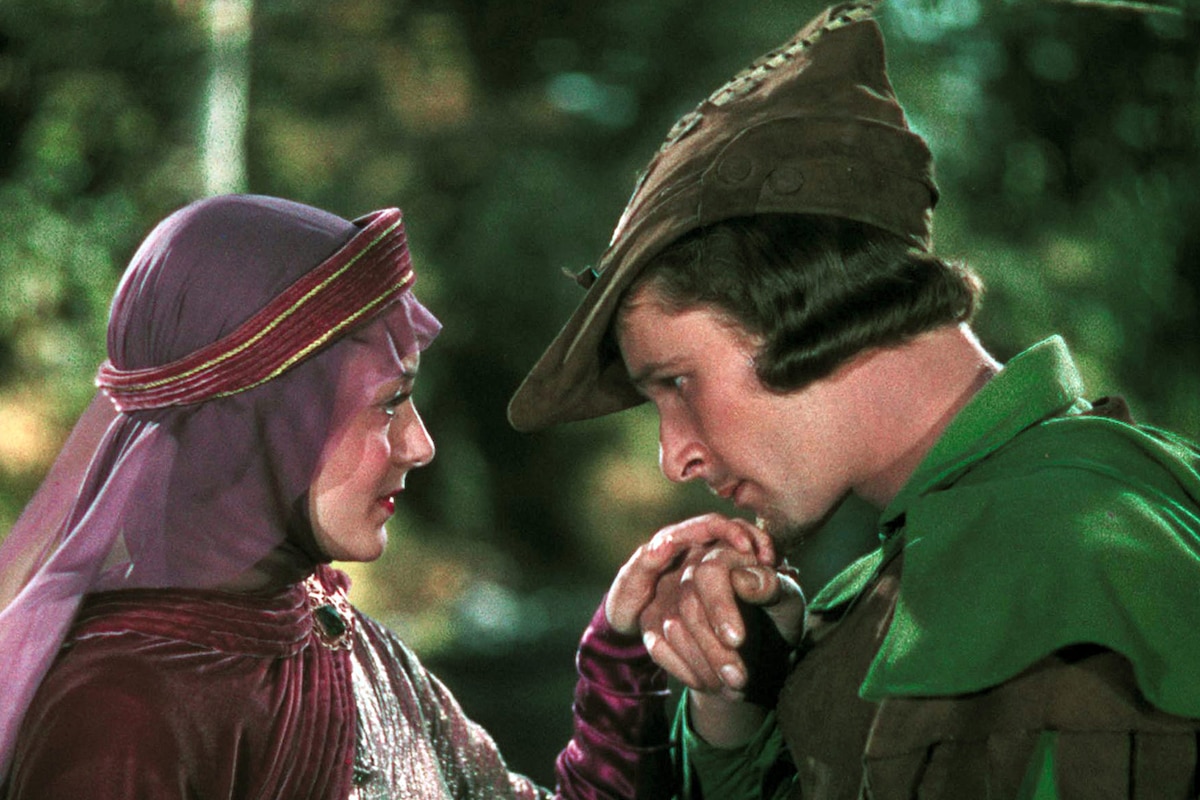
Korngold not only rose to the occasion of writing a rousing score for The Adventures of Robin Hood, he also managed to work in his music of passion and psychology, notably in the sequence in which Robin and Marian talk of war and politics with a romantic score behind them, signaling their growing love while scarcely a word of it is spoken. One of his most brilliant touches was to write motifs in the same key as the actors' speaking voices.
by Rob Nixon
Behind the Camera
by Rob Nixon | March 01, 2007
SIGN UP FOR OUR NEWSLETTERS

CONNECT WITH TCM