In the early 1930s, Warner Brothers was primarily the contemporary urban studio, known for the gritty, staccato style of its crime thrillers, socially conscious dramas and lavish Busby Berkeley musicals with its casts of working class chorines. But the studio also longed to enter the big-budget prestige picture field, and one of the first efforts toward that was its production of A Midsummer Night's Dream (1935), with many Warners contract actors bringing their modern-day styles and personas to Shakespeare's characters. Costume designer and period adviser Dwight Franklin thought the same formula would translate well to another period piece, one that had been a huge success a decade earlier for Douglas Fairbanks - the story of the legendary bandit hero of Sherwood Forest. Studio executives liked Franklin's idea of casting Warners star James Cagney as Robin Hood and the studio's stock company as his Merry Men and Norman enemies.
While contemplating the idea of a James Cagney Robin Hood, Warners discovered they owned the rights to an 1890 operetta version of the story. That proved to be an attractive property for MGM, who thought it would make a fine addition to the repertoire of projects they were planning for their newly popular musical team, Jeanette MacDonald and Nelson Eddy. They struck a deal with Warners to get the operetta (which was never filmed) in exchange for some non-musical scripts developed at Metro by Edward Small.
There were many other sources from which to draw. The first literary mention of Robin Hood dates to the allegorical poem of the late 1300s, Piers Plowman, although variations on the name appear as early as the 13th century in several judges' rolls. In fact, the name Robin Hood has become a generic term for a fugitive, one who often dwells with a band of thieves in a forest.
Over the centuries, Robin Hood legends, stories, and ballads evolved to suit the changing political and social conditions of various eras. As a result, the hero eventually became a freedom fighter of noble birth, acquiring his band of Merry Men, his romantic attachment to Maid Marian, and his loyalty to the absent King Richard the Lionhearted along the way. The Warners scenario also borrowed from references to the character in Sir Walter Scott's 1819 novel Ivanhoe, and was doubtless influenced by earlier film versions, particularly the phenomenally successful 1922 release starring Douglas Fairbanks.
British writer Rowland Leigh was brought on board to write the screenplay from Small's material and other sources. Going back to the original Robin Hood ballads, Leigh tried to capture the period through a rather flowery, archaic language. Hal B. Wallis, Warners head of production, didn't like the script so using Rowland's work as the structural basis, he assigned the script to Norman Reilly Raine. Shortly after, Seton I. Miller was added to the team. Miller had penned a few Cagney pictures, as well as contemporary dramas for such Warners stars as Edward G. Robinson, Paul Muni and Bette Davis.
In the midst of development, Cagney had one of his frequent and bitter disputes with the studio and walked out on his contract for almost two years. With so much money and time already invested in the project, the studio couldn't afford to put it on hold for its volatile star and began considering a replacement.
In the meantime, contractee Errol Flynn had been given his first big break as the star of a period action epic, Captain Blood (1935), and proved to be not only very appealing to audiences but exactly the dashing, athletic, devilish figure needed for the part of Robin Hood as the Warners team envisioned it. In 1936, Wallis issued a memo to Jack Warner recommending the project as a good follow-up for Flynn after completion of The Charge of the Light Brigade (1936) and suggesting they publicize the casting to "let Cagney know he is losing these properties by his attitude."
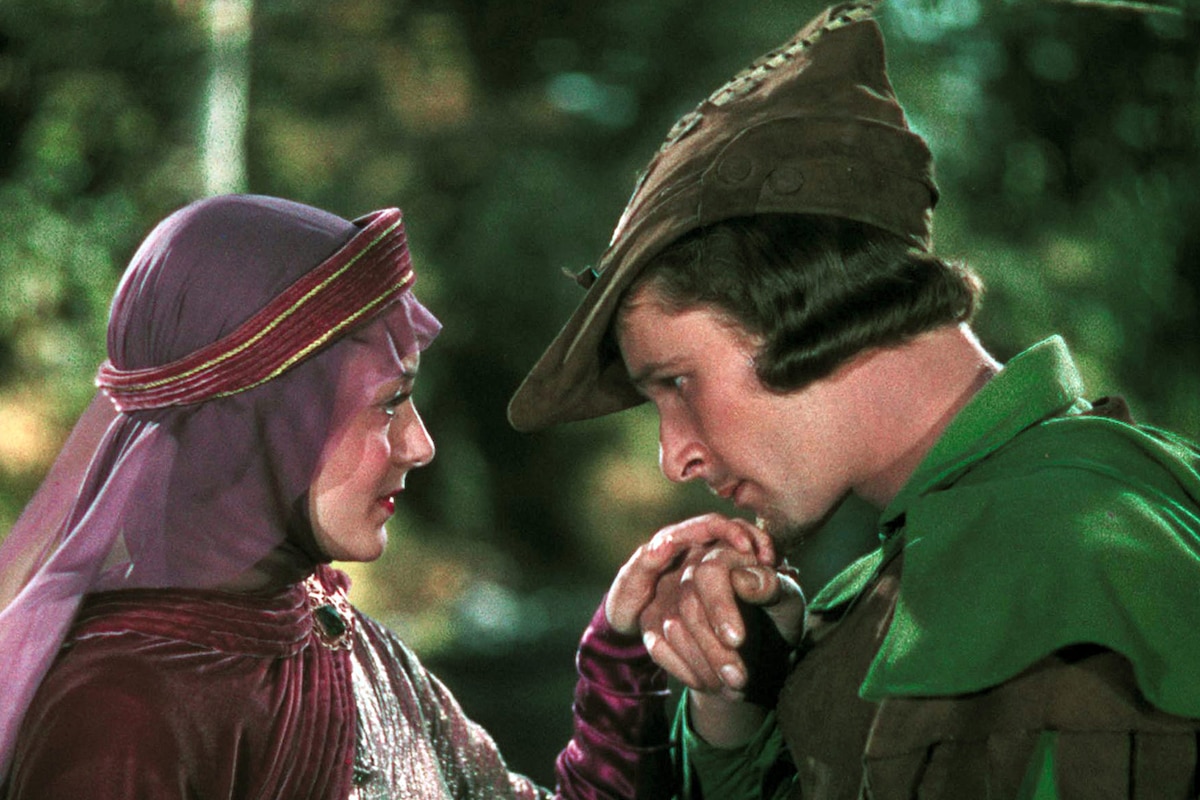
With Flynn set for the lead, it was a natural next step to cast Olivia de Havilland as Maid Marian. The two had displayed an undeniable on-screen chemistry in Captain Blood and The Charge of the Light Brigade.
Robin's Merry Men were drawn mostly from the ranks of sought-after character actors. Alan Hale, who had played Little John in Douglas Fairbanks' 1922 version, was cast in the role again. Guy Kibbee was originally slated for the part of Friar Tuck, but it eventually went to Eugene Pallette. The role of Will Scarlett was originally intended for David Niven, but he was unavailable, so the part went to Patric Knowles, who had appeared with Flynn in The Charge of the Light Brigade (1936).
Robin Hood's nemeses came from distinguished ranks. Basil Rathbone, an acclaimed actor for more than 15 years (he had also appeared in Captain Blood) was cast as Sir Guy. Claude Rains, who would soon be seen with Flynn in The Prince and the Pauper (1937), was chosen for the wryly amused, aloof and effete air he could bring to the villainous Prince John. In earlier stories (and future film and television versions), Robin's chief adversary was the Sheriff of Nottingham, the rivalry with Sir Guy being largely an invention of the 1890 operetta. Here, the Sheriff was depicted with more humorous buffoonery, perfect for first-rank character actor Melville Cooper, who specialized in both menacing heavies and comic roles.
As the project started coming together, the studio decided to go for broke and shoot the picture in "glorious Technicolor," which increased the budget considerably, thanks to the patented process's need for special cameras and lighting. But Wallis and company considered the expense worth it, and the decision heralded a new, more ambitious style for the studio.
William Keighley was initially assigned to the project because he had made Warners' first excursion into three-strip Technicolor, God's Country and the Woman (1937). He had also directed Flynn in The Prince and the Pauper and the two got along well. Keighley was very enthusiastic about the assignment.
by Rob Nixon
The Big Idea
by Rob Nixon | March 01, 2007
SIGN UP FOR OUR NEWSLETTERS

CONNECT WITH TCM