Charles Chaplin and Adolph Hitler were actually born in the same week in April in 1889.
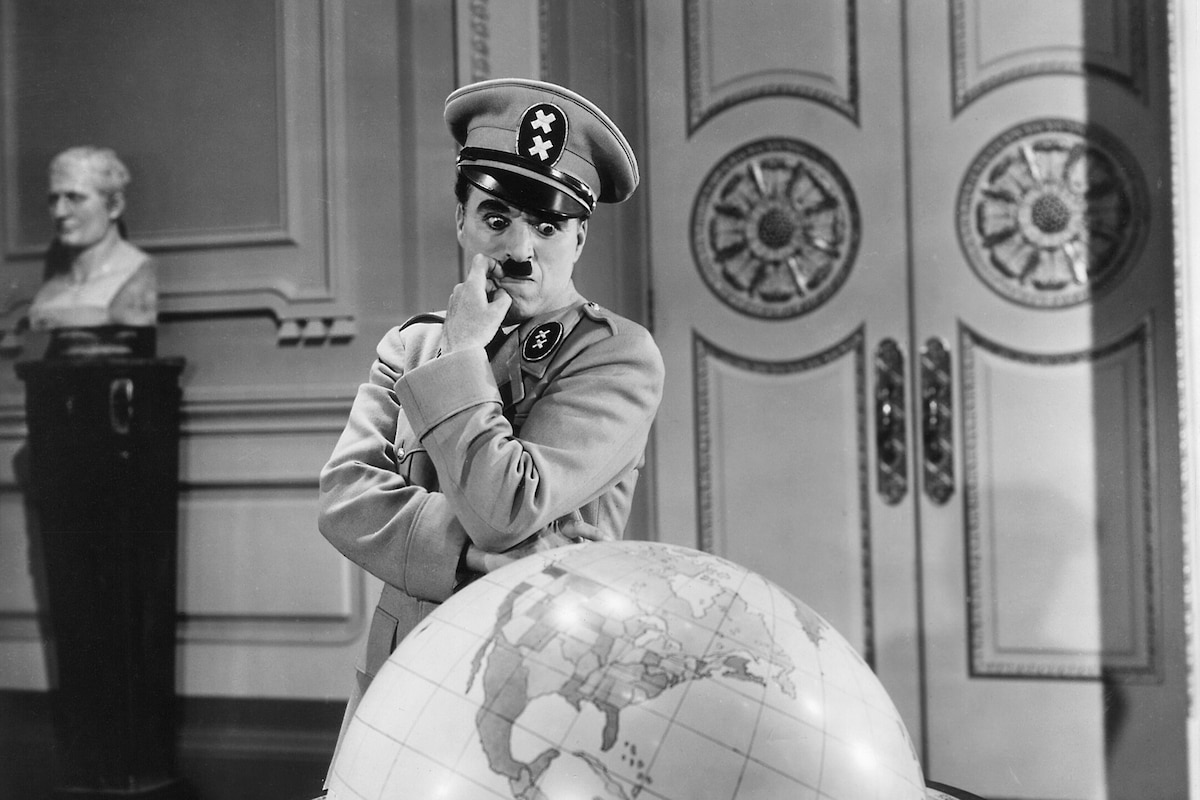
The resemblance between Chaplin and Hitler was so widely noted it even gave rise to a song, "Who Is That Man (Who Looks Like Charlie Chaplin)" sung by British comic Tommy Handley.
Charlie Chaplin's films were already banned in Nazi Germany because of the erroneous belief that he was Jewish.
Before settling on The Great Dictator, Chaplin was looking for a showcase for his protégée and later wife Paulette Goddard. These included a remake of A Woman of Paris (1923), the only silent film he directed but did not star in; Regency, a novel about an independent British noblewoman; and a story about a White Russian countess who stows away on an ocean liner. The latter would eventually become his 1967 A Countess from Hong Kong, starring Sophia Loren and Marlon Brando. All of these would have been sound films.
Chaplin also considered starring in a biography of Napoleon, a project that had interested him on and off since the silent era.
After studying Hitler extensively, Chaplin pronounced him one of the greatest actors he had ever seen.
Scenes documented in press articles and photos that did not make it into the film included a Russian dance performed by the barber and his attempt to escape the concentration camp by chewing through a barbed wire fence.
During production, Picturegoer magazine optimistically reported, "There is always the danger that, by the time the picture is eventually completed and shown, we may all have forgotten who Hitler was."
Publicity for the film centered on its being Chaplin's first talking picture. One tagline read, "Chaplin talks...while You Laugh!"
"Note: ANY RESEMBLANCE BETWEEN HYNKEL THE DICTATOR AND THE JEWISH BARBER IS PURELY CO-INCIDENTAL." -- Opening title for The Great Dictator.
The Great Dictator premiered October 15, 1940, at two theatres in New York (an unusual move).
Despite charges that the film was pro-Communist, Chaplin was invited to read the climactic speech at a Daughters of the American Revolution rally in Washington, D.C.
After the film's opening, Konrad Bercovici sent Chaplin a letter stating that he wanted no money for his story idea, just a screen credit. Chaplin never replied. At a press conference, however, Chaplin admitted that Bercovici had given him the idea for the film's plot.
In 1942, Bercovici sued Chaplin and United Artists for $5 million, claiming that he had given Chaplin the idea for the film. In depositions, Chaplin denied any of Bercovici's contributions to the film. Eventually, however, he and United Artists settled the case for $90,000.
In 1941, Chaplin was among the filmmakers subpoenaed by a Senate subcommittee investigating pro-war propaganda in Hollywood films.
At the height of World War II, Chaplin withdrew the film from circulation, knowing that the international situation lampooned in the film would now be hard to laugh at.
During the war, a group of resistance fighters smuggled the film into the Balkans and replaced a commercial screening of another film with it. The German officers in attendance enjoyed the film greatly until they realized what it was. Then some left, while others shot at the screen.
An escapee from Hitler's Germany who had worked in the Ministry of Culture told Chaplin that Hitler had gotten hold of a print of the film and screened it twice in private. Chaplin responded by saying, "I'd give anything to know what he thought of it."
After the war, Chaplin stated that if he had known of the true horrors of the concentration camps, he never would have made The Great Dictator.
The Great Dictator had a charity screening in Rome in 1944, its first appearance there. The audience laughed at many of Chaplin's scenes, but Oakie's performance was met with embarrassed silence. When it finally played publicly in Rome in 1961, long after Mussolini's death, it became a big hit. Even then, scenes with Grace Hayle as Madame Napolini were cut for fear of offending Mussolini's widow and her family. When it finally played there, it became a huge hit. The uncut version finally screened in 2002.
The Great Dictator was banned in Spain until General Franco's death in 1975.
Memorable Quotes from THE GREAT DICTATOR
"Democracy shtoonk. Liberty shtoonk." -- Charles Chaplin, as Adenoid Hynkel, addressing the nation in Tomanian.
"Strange, and I thought you were an Aryan."
"No. I'm a vegetarian." -- Reginald Gardiner, as Commander Schultz, and Chaplin, as A Jewish Barber
"We've just discovered the most wonderful, the most marvelous poisonous gas. It will kill everybody." -- Billy Gilbert as Field Marshall Herring.
"Far from perfect." -- Chaplin, as Hynkel, responding to another failed invention.
"You a nice-a leetle man, Hynkie." -- Jack Oakie, as Napolini, talking down to Chaplin, as Hynkel.
"Today, democracy, liberty, and equality are words to fool the people. No nation can progress with such ideas. They stand in the way of action. Therefore, we frankly abolish them. In the future, each man will serve the interest of the State with absolute obedience. Let him who refuses beware!" -- Henry Daniell, as Garbitsch, introducing Chaplin, disguised as Hynkel
"I'm sorry, but I don't want to be an emperor. That's not my business. I don't want to rule or conquer anyone. I should like to help everyone if possible; Jew, Gentile, black man, white. We all want to help one another. Human beings are like that. We want to live by each other's happiness, not by each other's misery. We don't want to hate and despise one another. In this world there is room for everyone, and the good earth is rich and can provide for everyone. The way of life can be free and beautiful, but we have lost the way. Greed has poisoned men's souls, has barricaded the world with hate, has goose-stepped us into misery and bloodshed. We have developed speed, but we have shut ourselves in. Machinery that gives abundance has left us in want. Our knowledge has made us cynical; our cleverness, hard and unkind. We think too much and feel too little. More than machinery, we need humanity. More than cleverness, we need kindness and gentleness. Without these qualities, life will be violent and all will be lost. The airplane and the radio have brought us closer together. The very nature of these inventions cries out for the goodness in men; cries out for universal brotherhood; for the unity of us all. Even now my voice is reaching millions throughout the world, millions of despairing men, women, and little children, victims of a system that makes men torture and imprison innocent people. To those who can hear me, I say, do not despair. The misery that is now upon us is but the passing of greed, the bitterness of men who fear the way of human progress. The hate of men will pass, and dictators die, and the power they took from the people will return to the people. And so long as men die, liberty will never perish. Soldiers! Don't give yourselves to brutes, men who despise you, enslave you; who regiment your lives, tell you what to do, what to think and what to feel! Who drill you, diet you, treat you like cattle, use you as cannon fodder. Don't give yourselves to these unnatural men - machine men with machine minds and machine hearts! You are not machines, you are not cattle, you are men! You have the love of humanity in your hearts! You don't hate! Only the unloved hate; the unloved and the unnatural. Soldiers! Don't fight for slavery! Fight for liberty! In the seventeenth chapter of St. Luke, it is written that the kingdom of God is within man, not one man nor a group of men, but in all men! In you! You, the people, have the power, the power to create machines, the power to create happiness! You, the people, have the power to make this life free and beautiful, to make this life a wonderful adventure. Then in the name of democracy, let us use that power. Let us all unite. Let us fight for a new world, a decent world that will give men a chance to work, that will give youth a future and old age a security. By the promise of these things, brutes have risen to power. But they lie! They do not fulfill that promise. They never will! Dictators free themselves but they enslave the people. Now let us fight to fulfill that promise. Let us fight to free the world! To do away with national barriers! To do away with greed, with hate and intolerance! Let us fight for a world of reason, a world where science and progress will lead to all men's happiness. Soldiers, in the name of democracy, let us all unite! Hannah, can you hear me? Wherever you are, look up Hannah! The clouds are lifting! The sun is breaking through! We are coming out of the darkness into the light! We are coming into a new world; a kindlier world, where men will rise above their hate, their greed, and brutality. Look up, Hannah! The soul of man has been given wings and at last he is beginning to fly. He is flying into the rainbow! Into the light of hope, into the future! The glorious future, that belongs to you, to me and to all of us. Look up, Hannah. Look up!" -- Chaplin's final speech, disguised as Hynkel.
Compiled by Frank Miller
Trivia & Fun Facts About THE GREAT DICTATOR
by Frank Miller | March 01, 2007
SIGN UP FOR OUR NEWSLETTERS

CONNECT WITH TCM