The Great Dictator went into production in September 1939.
Chaplin maintained a closed set throughout production, partly out of fear that other filmmakers would steal his idea. When Life magazine printed an unauthorized photo of him as dictator Adenoid Hynkel, Chaplin sued and won. Half the issues printed for that week were recalled before they could hit news stands.
Chaplin spent hours studying films of Hitler to perfect an imitation of his speaking style. He would eventually do this with a combination of nonsense syllables and isolated German words.
The barber's scenes were mostly shot in the slower speed used for silent films (16 frames per second), made possible by the fact that Chaplin gave the character less dialogue than Hynkel, who was shot in the standard speed for sound film.
For the first time in years, Chaplin brought in a new director of photography, Karl Struss, to work with his usual cameraman, Rollie Totheroh. He did so at the urging of his brother, Syd, who felt that Totheroh's techniques were behind the times. Struss quickly learned that the director preferred to shoot scenes as though they were being performed on stage. He finally convinced Chaplin to let him shoot the scenes from two cameras at once, placed at different angles, to make it easier to edit the film.
Chaplin's adapting to talking pictures was complicated by his inability to give up control over any production area, including sound. He labored endlessly to come up with the right effect for the sound of an airplane flying by vibrating different types of celluloid materials in front of an electric fan. After he gave up, the sound technician went to an airport to record the real thing.
To keep the characters separate, Chaplin shot most of his scenes as the barber first, then moved on to Hynkel's scenes.
Chaplin's son Sydney ruined a $15,000 take during the World War I sequence by laughing at one of the gags. The director was furious until he realized that his son had reacted to the scene as he hoped audiences would so it was a good sign.
Initially, Hynkel's big speech was shot on location in the San Fernando Valley in front of an audience of extras. Despite the extreme heat, Chaplin entertained the extras between shots with scenes from Sherlock Holmes and a variety of pratfalls. In the end, he couldn't use any of the footage. The scene required retakes, and Struss couldn't match the lighting from the location.
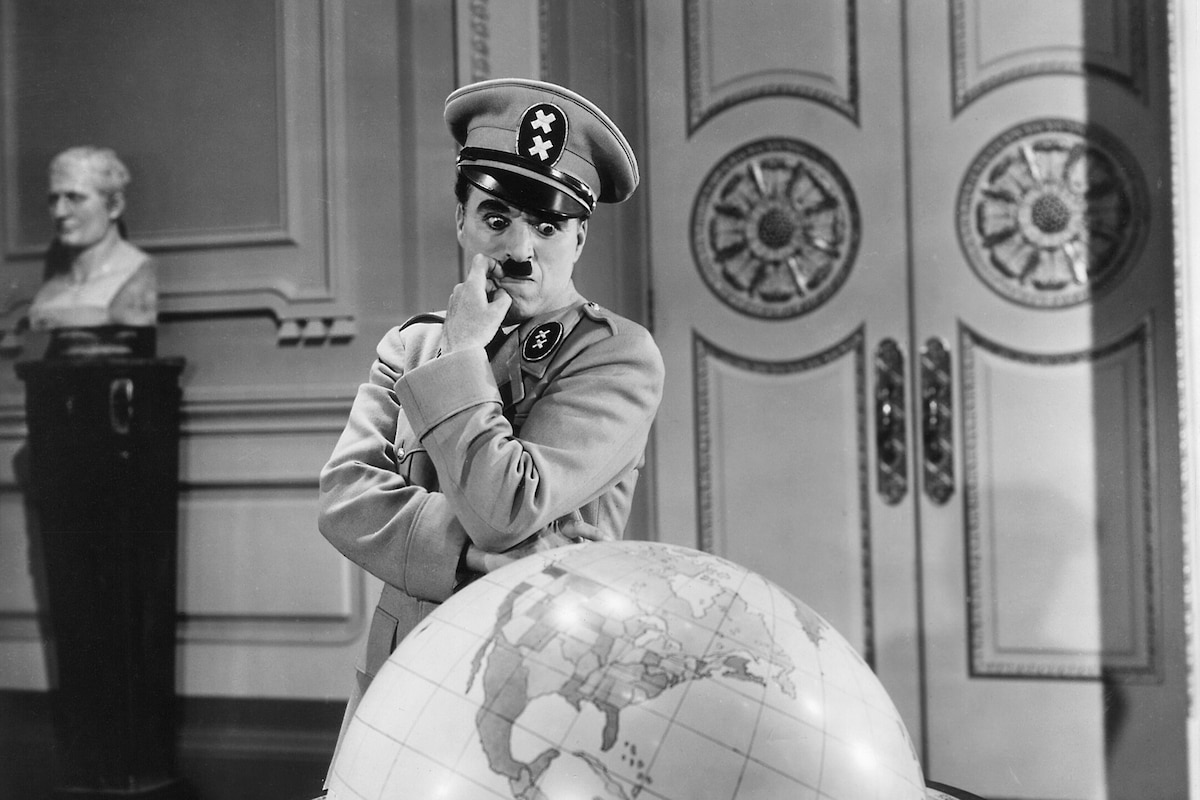
Hynkel's dance with the globe was originally written as a scene in which he cuts up a map of the world to rearrange the countries the way he wants. When this evolved into the globe dance, Chaplin spent six days over a two month period filming the sequence, plus three days of retakes.
Chaplin and Paulette Goddard clashed frequently on the set of The Great Dictator. At this point in their lives, Goddard was beginning to build a career of her own outside Chaplin's films and she resented her small role in the film and the unglamorous hair and costumes required for it. At one point, Chaplin complained that she wasn't using a scrub brush properly and ordered her to clean the entire set with it until she got "the proper swing of the brush." She stormed off the set, and he dismissed the rest of the company until she gave in.
Principal shooting ended in March 1940, with a final budget of $1.5 million. The only scene left to shoot, the barber's climactic speech while impersonating Hynkel, was put off until June. Postproduction work and retakes consumed six months.
As originally written, Chaplin's final speech, in which the barber is still masquerading as Hynkel, was a call for peace through appeasement. As news reports came in from Europe, however, he re-wrote it as a call for peace and liberty for all. Some critics, most notably columnist Ed Sullivan, claimed that the speech was pure Communist propaganda.
Chaplin had also planned shots of people all over the world accepting the message of peace as goose stepping German soldiers broke in a waltz and Japanese bombers dropped toys on Chinese children. He actually started shooting some of these scenes before abandoning the idea. They survive in home movies shot by his son.
Some of Chaplin's associates tried to talk him out of the final speech about peace. One film salesman said the speech would cost him a million dollars at the box office. "Well, I don't care if it's five million," Chaplin replied.
Jack Oakie (Napolini) had been on a diet before filming started. To make him large enough to contrast effectively with Chaplin, the director ordered his cook to fatten Oakie up.
Chaplin and Oakie enjoyed their roles so much, they often stayed in character after shooting finished for the day. They even attended a party thrown by Mary Pickford in full costume.
As the premiere approached, Chaplin had good reason to be concerned about his gamble on political commentary. Gallup polls revealed that 96 per cent of Americans opposed U.S. involvement in the war in Europe, and threatening letters from Nazi sympathizers poured into the studio. At one point he even asked a friend with the Longshoreman's Union in New York if they could have some union members present at the opening to prevent a pro-Nazi demonstration.
by Frank Miller
Behind the Camera
by Frank Miller | March 01, 2007
SIGN UP FOR OUR NEWSLETTERS

CONNECT WITH TCM