As Adolph Hitler was rising to power in Germany, many fans and filmmakers noted Charles Chaplin's resemblance to the Fuehrer. In 1937, British producer-director Alexander Korda suggested that Chaplin create a film built around The Little Tramp's character being mistaken for Hitler.
In 1937 and 1938, Chaplin and friend Konrad Bercovici, a political writer and noted anti-Fascist, worked on story treatments for different projects that might serve as a follow-up to Modern Times (1936). At a party in early 1938, Bercovici suggested a story that fellow guest Melvyn Douglas later said bore strong resemblances to The Great Dictator. A treatment written by Bercovici shortly afterwards included such scenes as the Little Tramp's escaping from a concentration camp in a military uniform and being mistaken for Hitler, Hitler's stripping Goering of his medals and a failed attempt to demonstrate a new parachute. Chaplin said he would have to check with the State Department to see if such a film could be made. Later he told him they had counseled against the idea.
In October 1938, the German Consul, George Gyssling, wrote to Production Code chief Joseph Breen complaining that Chaplin was preparing a satire of Hitler. Breen responded that he had heard nothing of any such picture. At the time, his office had to approve all film scripts before they went into production.
Chaplin attempted to register a script under the title The Dictator in November 1938 only to learn that Paramount Pictures had already registered the title, having bought the rights to a play with that title by Richard Harding Davis. When they refused to part with the title for less than $25,000, Chaplin changed his title to The Great Dictator.
Other titles Chaplin registered at the time were Ptomania, The Two Dictators, Dictamania and Dictator of Ptomania.
When word got out that Chaplin was preparing a comedy to poke fun at Adolph Hitler, executives at United Artists, the studio Chaplin had co-founded and through which he released all of his films, tried to convince him to give up the project on the grounds that the film that could not be released in the lucrative German market and that it would alienate the many people who still sympathized with the Fuehrer.
When Bercovici read the first press reports about Chaplin's plans for The Great Dictator, he sent the star a registered letter asking what was happening, but got no reply. Subsequent attempts to set up meetings were ignored.
At one point, Chaplin planned to cast Ziegfeld Follies comedienne Fannie Brice as the dictator's sex-starved wife. An associate suggested the wife's scenes were cut because of problems with the Production Code Administration.
Chaplin cast his wife, Paulette Goddard, as Hannah, the Jewish orphan. He had previously used her as his leading lady in Modern Times.
Goddard's character, Hannah, was named for Chaplin's mother.
Comic actor Jack Oakie was in a career slump in the late '30s, partly because of his reputation as a heavy drinker. He was desperate to play the Mussolini role and got friends to put in a good word for him with Chaplin. When Chaplin called him to discuss the work, he never let on that he knew how desperate Oakie was. Instead, he took him out to a luxurious dinner where he assured him that he wanted an actor, not an impersonator. When Oakie brought up his reputation as a drinker, Chaplin said it didn't matter. If Oakie got too drunk, the director would just work around him. Oakie was so impressed he stopped drinking altogether until the film was completed.
The Hollywood Reporter announced the start of set construction in June 1939, but Chaplin then delayed the start of production to do further work on the script.
Chaplin's first shooting script for The Great Dictator was 300 pages long, about three times the length of the average Hollywood feature.
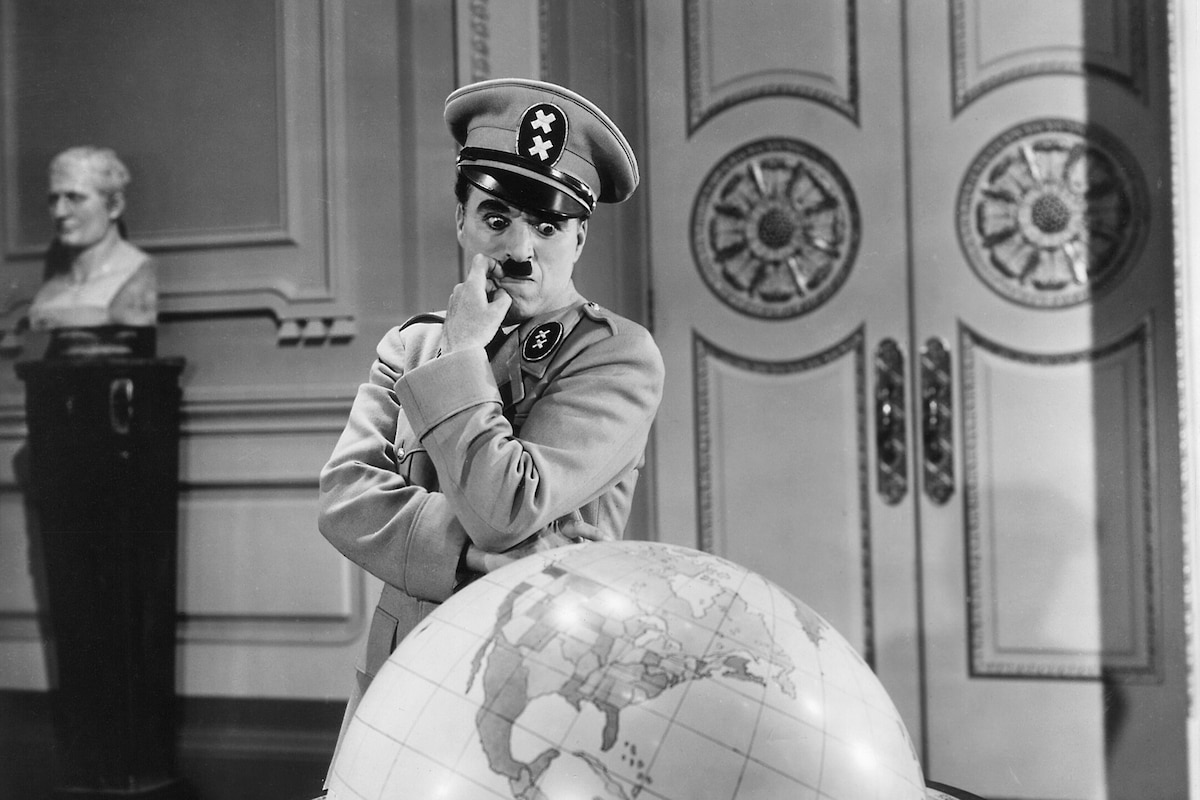
In October 1939, Chaplin finally released the news that he would be playing a Jewish tailor (later changed to a barber) and a character modeled on Hitler.
Along with Chaplin's portrait of Hitler, other characters modeled on contemporary political figures were Napolini (Jack Oakie), inspired by Mussolini; Garbitsch (Henry Daniell), based on Joseph Goebbels; and Herring (Billy Gilbert), modeled on Hermann Goering.
by Frank Miller
The Big Idea
by Frank Miller | March 01, 2007
SIGN UP FOR OUR NEWSLETTERS

CONNECT WITH TCM