Eddie Murphy once did a standup routine that went:
"Black Caesar, the blackest movie ever made. Filmed on the streets of Harlem with an all-black cast. You have never seen a black movie like this. Black Caesar: a Larry Cohen film."
The audience roared.
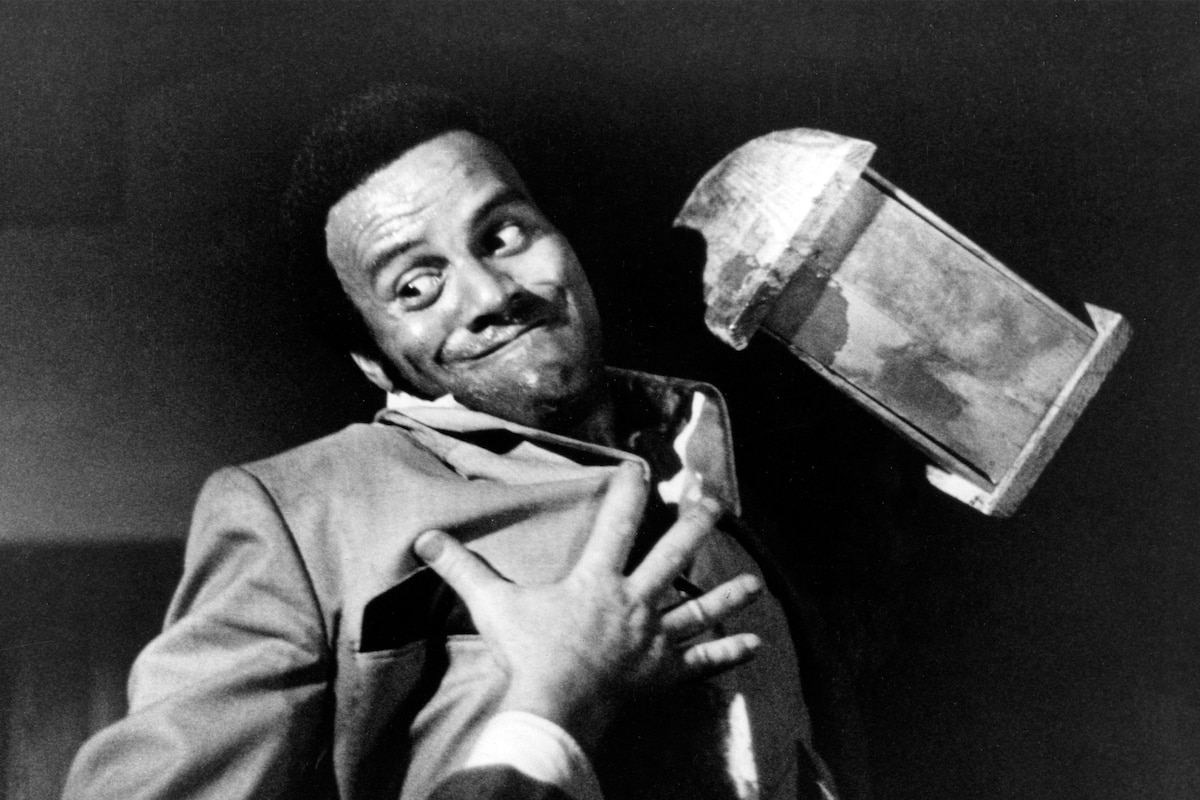
And this is then the question: how does a white Hollywood insider like Larry Cohen make a raw, angry work of black cinema like this? To hear Fred Williamson tell it, he didn't.
First, a few words about Fred Williamson. He spent 10 years as a professional football player, where he earned the nickname The Hammer, for a hammer-like blow he dealt his opponents on the field. Eventually he carried that nickname with him into a new career as an action movie icon, starring in the 1972 thriller Hammer. Williamson became one of the genre's top box office draws, a commercial power he parlayed into establishing himself as an independent filmmaker-writing, producing and directing his own starring vehicles.
Williamson is many things: a karate black belt and former architect, an oversized force of nature, and an inveterate self-promoter. His anecdotes are peppered with self-aggrandizing details-such as that he actually directed the football scenes in Robert Altman's M*A*S*H (1972), or that he convinced Otto Preminger to cast him in 1970's Tell Me That You Love Me, Junie Moon by picking the old man up and threatening to throw him through a wall. He's butted heads famously with his co-workers, all of whom Williamson insists were in the wrong-Jack Arnold, Gordon Parks, Jr., Howard Cosell...
Williamson claims to have invented Black Caesar on his own. "Nobody ever made a black gangster movie with an Edward G. Robinson type character. Suit and tie, hat, a real Edward G. Robinson guy. I had this idea for Black Caesar." On the details, though, Williamson gets vague. In one telling, he pitched the idea to Larry Cohen, who in turn sold it to American International Pictures. In another version, he went straight to AIP's Sam Arkoff, who in turn hired Cohen to write and direct.
Cohen, unsurprisingly, tells a different tale.
But first, a word or two about him.
Larry Cohen is first and foremost a writer. A prolific, gifted writer. From his start in the world of live television drama in the 1950s to the present day, Cohen has scripted popular, profitable thrillers like nobody's business. The sequel to The Magnificent Seven (1966), The Private Files of J. Edgar Hoover (1977), I, the Jury (1982), Spies Like Us (1985), Maniac Cop (1988), Body Snatchers (1993), Phone Booth (2002), and Cellular (2004) all bear Cohen's stamp. And like Fred Williamson, Cohen learned that taking control of the camera is an essential step in career freedom. As a director, Cohen has made numerous cult classics such as the It's Alive trilogy, God Told Me To (1976), Q: The Winged Serpent (1982), and The Stuff (1985). He's worked amicably with Alfred Hitchcock, Walter Mirisch, Joel Schumacher, Lorenzo Semple, Jr., and Bette Davis.
Cohen is known for driving around with countless unsold scripts and story treatments in the trunk of his car-treasures waiting for their moment in the sun. When opportunities present themselves, Cohen is ready with the appropriate scripts close at hand. Take, for example, Phone Booth. In the 1970s, Cohen met with Alfred Hitchcock to develop a thriller set entirely in a phone booth. The project was never realized, the idea moldered in storage nearly two decades until the chance came to pitch it anew. 20th Century Fox bought it, Joel Schumacher filmed it, and happy audiences paid handsomely to see it. Patience has its rewards.
Which returns us to Black Caesar. Sammy Davis, Jr. pined to break free of the Rat Pack, and establish himself on his own, away from Dean Martin et al. Davis' manager asked Cohen to come up with some kind of starring vehicle. A longtime fan of Warner Brothers' classic films noir, Cohen took memories of Little Caesar (1931) and The Public Enemy (1931) and grafted them onto the true-crime life story of Harlem gangster Nicky Barnes.
Problem was, Sammy Davis, Jr. was in hock to the IRS and couldn't come up with the promised $10 grand he owed Cohen, so Cohen kept the script in his car, a movie without a star, waiting for another chance. One day, Sam Arkoff came calling for a blaxploitation idea (possibly at the behest of Fred Williamson) and Cohen called Black Caesar back into service.
In the years hence, these two headstrong filmmakers have each tried to efface the other's contribution to what was, we must assume, a collaboration. For Williamson, it's a matter of pride. "You're talking about something that was close to home to me," he says, "That came from me, that came from my life experience. Larry Cohen couldn't tell me how to relate to the black people and the black public. He had no idea... All the life that I had lived, I flowed into this character. Larry Cohen damn sure couldn't tell me. What the hell does he know about the relationships in black communities, about how black people really act and interact with each other?"
In the jaw-dropping final act, Williamson's character applies blackface to his white nemesis and forces him at gunpoint to sing "Mammy." Generations of degradation and exploitation come to a head in a single moment of intense drama-but the shadows of Cohen's life hang heavy on this scene, whatever Williamson may say. Cohen's grandfather was a vaudevillian minstrel who performed in blackface, back when the Cohens lived in Harlem-then a tony white neighborhood. For all that Williamson sees Black Caesar as a mythic take on his own rags-to-riches, underdog-vs.-prejudice life story, Cohen can just as well claim to be working out unresolved racial tensions of his own past. And let's not forget that the script closely parallels old black-and-white Hollywood classics and the true story of a real Harlem gangster-in other words, Black Caesar has the power it does because its story is resonant and relevant to lots of viewers, white and black alike. It "works."
In the original cut, Williamson's character is beaten to death-not by his white enemies, but a new generation of black street thugs in the ruins of his old ghetto. Test audiences responded so strongly to the film, AIP's Sam Arkoff realized he was sitting on a gold mine (the flick earned $2 million in domestic ticket sales in 1973, which for a low budget film in that era was quite a windfall). Hits like these demand sequels. So, Arkoff ordered Cohen to snip off the last 90 seconds of the film to leave Williamson's character to a dire but still uncertain fate-enough wiggle room for a round two.
The team reunited for a sequel, made so quickly Cohen was writing it as he shot it. "And it sure looks like it," Cohen admits. Hell Up in Harlem was released to theaters within months of its predecessor. Soon after, Williamson felt confident enough to launch his own company, Po' Boy Productions, and Cohen began making auteurist cult classics of his own.
23 years on, Williamson and Cohen reunited, but the tensions between them had not abated. Over time, the market for Williamson's low-budget quickies had dried up, and he had stopped making films. In 1995, he met Quentin Tarantino, whose boundless fandom for blaxploitation films re-energized Williamson. Inspired by Tarantino, Williamson decided to pay homage to the genre by taking the final scene of Black Caesar and expanding it to feature length in a film entitled Original Gangstas (released in 1996). He would reunite the top stars of the cycle-Jim Brown, Pam Grier, himself-in a story that pit their old-school kick-ass ways against an amoral new breed of teenage thugs. And who better to direct the thing than Larry Cohen?
Where Williamson expected Cohen to be the efficient B-movie hack he was back in 1973, Cohen had in the intervening years blossomed into a writer-director-producer-auteur, with an emphasis on "writer." He and Williamson clashed on the script and the production, resulting in an admirable misfire of a movie, a noble failure.
Perhaps it was a fool's errand. In what way could they have ever hoped to top the raw energy and electric power of their first, best collaboration. Black Caesar, the blackest movie you ever saw. A Larry Cohen-Fred Williamson picture.
by David Kalat
Sources:
Brett McCormick, "Fred Williamson: The Hammer Strikes!" Psychotronic Magazine
Darius James, That's Blaxploitation, St. Martin's Griffin
Gerald Martinez et al, What It Is...What It was!, Hyperion Books
Larry Cohen, commentary track on the MGM Black Caesar DVD
Patrick McGilligan,
Stanley Winter, Dark Visions: Conversations with the Masters of the Horror Film, Avon Books
Steve Ramos, "It's Hammer Time Again," City Beat
Steve Ryfle, "The Last Action Hero," Shock Cinema Magazine
Tony Williams, "Larry Cohen," Senses of Cinema
Insider Info (Black Caesar) - BEHIND THE SCENES
February 28, 2007
SIGN UP FOR OUR NEWSLETTERS

CONNECT WITH TCM