"I was out to create a different kind of film-more cynical, darker, more wickedly funny," said Roger Corman.
They say hindsight is 20/20, and for a modern-day P.T. Barnum like cult movie auteur Corman that is understating things. In other words, Corman may be overstating things. The bleakly black comedies he fashioned at the tail end of the 1950s were not quite as ground-breaking as all that-just watch James Whale's The Old Dark House (1932) if you don't believe me. But in the sunny landscape of Father Knows Best 1950s, Corman's bilious satires were a cold splash of water in the face, a kick in the gut, a breath of decidedly unfresh air.
Roger Corman was bushed. Ski Troop Attack (1960) had been a grueling shoot. Recuperating from the experience, he was asked by his distributors at AIP to deliver some horror goods for $50,000 pocket change. Corman needed something quick-n-dirty after that cruel Chicago winter. So he accepted the assignment as a kind of dare: what if he could break his previous record of filming an entire movie in just 6 days?
Whatever he was going to do, then, it would have to be small in scale. As he would later explain in a 1987 interview, this meant approaching the film from a new direction: "You break the tension one way, and it's horror. You break the tension another way, they laugh." Horror and comedy were two sides of the same coin. Inspired by his experiment with black comedy in 1957's Not of This Earth, Corman would focus on mordant wit and social satire.
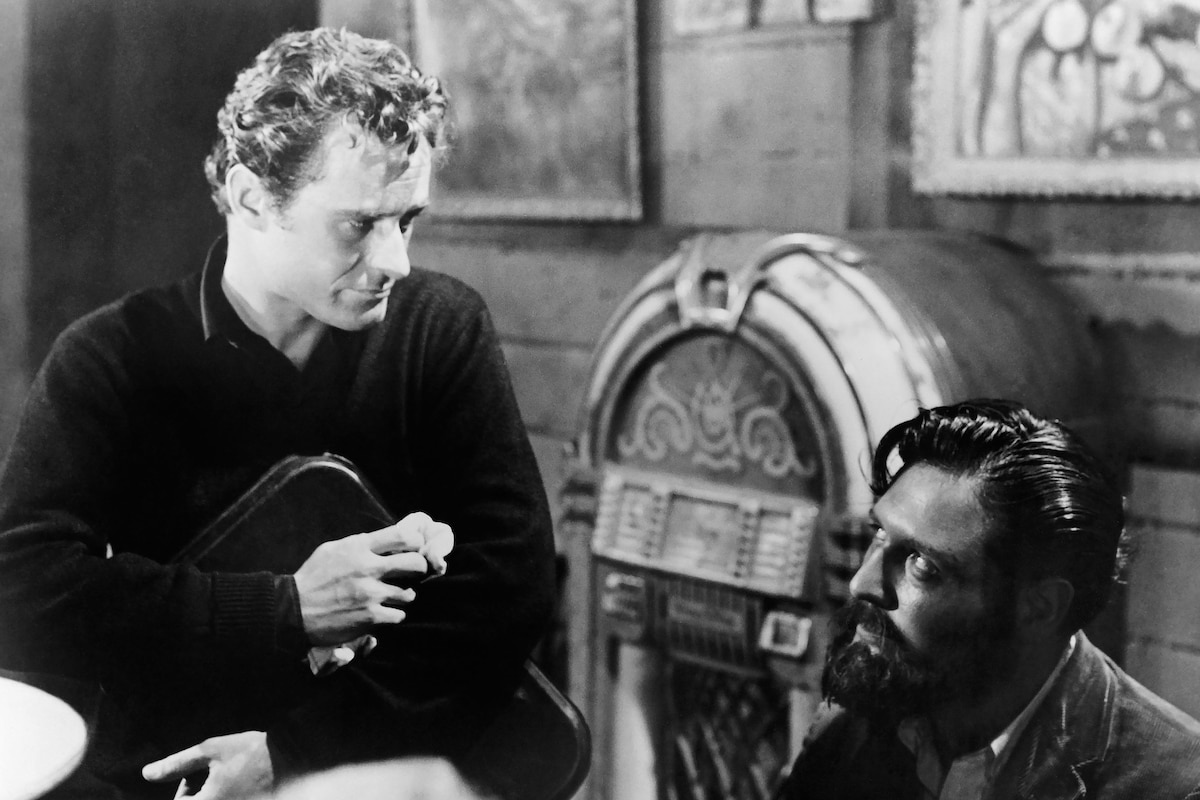
It all started with an all-night coffee bender across Sunset Strip. Corman and writer Chuck Griffith trawled across endless coffee bars, hashing out story ideas. Come the wee hours of the morning and the pair found themselves at Chez Paulette as the staff were closing up. Waitress-cum-wannabe-actress Sally Kellerman took a break from her washing up duties to plunk down in a chair with the two filmmakers, offering up some notions of her own. And thus was A Bucket of Blood born.*
This is the official story, a satisfying mythology repeated by Corman whenever the subject of A Bucket of Blood comes up. It is not, however, the only account.
There are those-such as Corman acolyte Joe Dante-who insist Corman didn't even get the jokes and needed others to explain the humor to him. Chuck Griffith says that when he first suggested making a comedy, Corman said no: "We don't do comedy," Corman allegedly explained, "because you have to be good. We don't have the time or money to be good, so we stick to action." When Griffith finally persuaded Corman to take the chance, he says Corman fretted nervously about how to even direct such a thing, and relied on Griffith (a vaudeville baby) for advice.
Corman and Griffith each tell the tale in a way that effaces the other and inflates their own role; the truth likely sits somewhere in between. Regardless of whether Corman set out to pioneer a new breed of horror comedy or had it thrust upon him by a canny screenwriter, the fact remains that Corman did at least win his bet. A Bucket of Blood came in at a tidy $35,000 and took just five days-a new record, and with time and money still in hand for yet a second film!
Corman got wind that the Chaplin Studio nearby had some sets still standing from a previous production that were ready to be torn down. Corman quickly rented the sets for two days (the amount of time he still had left on A Bucket of Blood 's ledger) and tasked Griffith with cooking up a script that could be done using just those settings. The result was The Little Shop of Horrors, made for a measly $27,500 and beating Blood's record handily. A third black comedy, Creature from the Haunted Sea completed the triptych in 1960.
"Taken together," boasted Corman, "these remarkably modest black and white films-with their loose, raw energy-were a major departure in my career."
* -- Chuck Griffith tells much the same story about a coffee-bender that ended at Chez Paulette and the birth of a screenplay, but he says the film in question was The Little Shop of Horrors.
by David Kalat
Sources:
Alan Frank, The Films of Roger Corman, BT Batsford Ltd, London.
Beverly Gray, Roger Corman, Thunder's Mouth Press, New York.
Ed Naha, The Films of Roger Corman: Brilliance on a Budget, Arco Publishing Inc., New York.
John Charles, "A Bucket of Blood," Video Watchdog, Number 68, 2001, Cincinnati, OH.
John Charles, "The Death Artist," Video Watchdog Number 37, 1997, Cincinnati, OH.
Roger Corman, How I Made a Hundred Movies in Hollywood and Never Lost a Dime, Dell Publishing, New York.
Insider Info (A Bucket of Blood) - BEHIND THE SCENES
by David Kalat | February 28, 2007
SIGN UP FOR OUR NEWSLETTERS

CONNECT WITH TCM