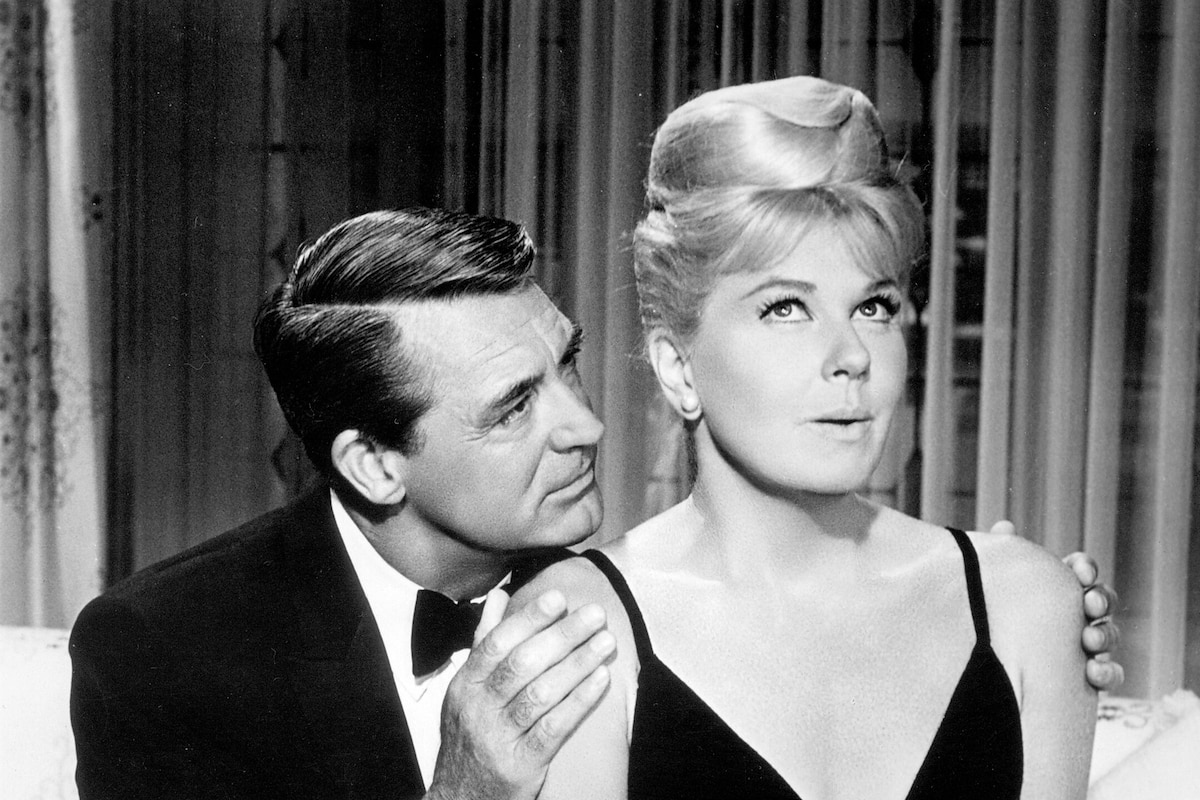
That Touch of Mink was Cary Grant's 69th movie in a career that stretched back to 1932. Although he was in his late 50s when he filmed it, Grant was still suave, handsome and an expert farceur. But he must have sensed it was time for a change. He made one more picture in which he was the dashing leading man, Charade (1963), opposite Audrey Hepburn. After that, he appeared as a grizzled old beachcomber in Father Goose (1964), then as a British gentleman who plays Cupid for the young romantic leads in Walk Don't Run (1966), his last film before retiring from the screen.
Doris Day's string of box office hits continued though with somewhat diminishing returns over the next six years in ten more films. After With Six You Get Eggroll (1968), the actress retired from the big screen. Her hit TV sitcom, The Doris Day Show, ran from 1968 to 1973, changing formats and storylines almost every season. In recent years she has devoted herself to animal care and rights.
Doris Day's screen characters in this period had a tendency to share similarities in names. Her name in That Touch of Mink is Cathy Timberlake, and in her previous release, Lover Come Back (1961), it was Carol Templeton. Between 1960 and 1962 she played characters named Kate, Kit and Kitty, and her names in her two 1959 releases were Jan and Jane.
Gig Young was born Byron Barr, and started his career under that name but took the name Gig Young after the character he played in the Barbara Stanwyck film The Gay Sisters (1942). Young was often troubled by disappointments in his career and by alcoholism, which got him fired from both Mel Brooks' Blazing Saddles (1974) and as the voice of Charlie on the TV series Charlie's Angels. He was Oscar®-nominated three times for Best Supporting Actor and won on the last go-round for They Shoot Horses, Don't They? (1969). But further success eluded him, and plagued by depression, he committed suicide in 1978 after fatally shooting his wife. According to George Ells in his biography Final Gig: The Man Behind the Murder, Young liked his role in That Touch of Mink and turned in a hilarious portrait, despite his desire to play the kind of leading parts that made Cary Grant a star, rather than the supporting roles to which he was most often relegated.
Grant and Young had a private detail in common they both underwent LSD therapy in the early 60s when it was still a tool of the psychiatric profession and not yet widespread as a recreational drug.
Director Delbert Mann started his career in television drama and parlayed one of his early TV projects into a major film debut, his production of Marty (1955), which he had directed on the air two years earlier. It earned Mann (as well as the picture, lead actor Ernest Borgnine and screenwriter Paddy Chayevsky) an Academy Award and ushered in a new era of small, intimate "slice-of-life" dramas. Mann continued to do sterling work in TV dramas, directing the occasional feature film throughout the decade, most notably guiding David Niven and Wendy Hiller to Oscar®s in Separate Tables (1958). In the 1960s he did two Doris Day comedies, That Touch of Mink and Lover Come Back (1961), and other big budget productions before returning to more intimate dramas and television, where he worked almost exclusively for nearly 30 years, until his last project in 1994.
Cinematographer Russell Metty began his long and distinguished career in the mid-1930s, eventually working with such directors as John Huston, Stanley Kubrick and Orson Welles. Some of his most famous work was for director Douglas Sirk, for whom he created the rich and often surreal color cinematography for such lavish melodramas as Magnificent Obsession (1954), All That Heaven Allows (1955), Written on the Wind (1956) and Imitation of Life (1959). He won an Academy Award for his work on Kubrick's Spartacus (1960).
That Touch of Mink was John Astin's second screen appearance after his debut in West Side Story (1961). Despite his many screen appearances, he is probably best known as the bizarre family patriarch in the TV series The Addams Family. He was once married to actress Patty Duke; their two sons, Sean and Mackenzie Astin, are both actors.
Dick Sargent (billed here as Richard) makes a brief appearance in the role of a frustrated newlywed who commiserates with Grant at the Bermuda resort. He became most famous a decade later as the "second Darrin" in the hit TV show Bewitched. Coincidentally, the future star of that show, Elizabeth Montgomery, was at the time of this picture's release married to Gig Young.
John Fiedler, who plays the mousy honeymooner Mr. Smith in That Touch of Mink, had a long career as a character actor and, thanks to his distinctive voice, as a voiceover artist, providing the voice of Winnie the Pooh's friend Piglet many times between 1964 and 2005.
One scene in That Touch of Mink features real-life New York Yankee baseball players Mickey Mantle, Roger Maris and Yogi Berra. The previous season, Mantle and Maris competed to see who could beat Babe Ruth's home-run record. Maris was the one who broke the single-season record.
Famous Quotes from THAT TOUCH OF MINK
CATHY (Doris Day): You're a sneaky, crude, offensive man. Of course, that's just how I feel. I'm sure there are hundreds of girls in this city who admire those qualities.
ROGER (Gig Young): With your money, you can run down half the girls in New York and still be solvent.
CONNIE (Audrey Meadows): When a girl reaches my age and still isn't married, you either philosophize or get arrested.
CONNIE: She's gonna spend the rest of her life saying "I'm not that kind of girl." I'm only afraid that someday before she can finish saying it, she will be.
PHILIP (Cary Grant): You're the type of woman who brings out the worst in a man his conscience.
PHILIP: Try Bergdorf-Goodman. I hear they're showing a new line of sacrificial evening gowns.
CATHY: Do you like the way I walk?
PHILIP: Poetry in motion.
CATHY: I learned when I was a baby, been walking for years.
CATHY: I fell out of Mr. Shayne's suite. See that I'm returned!
PHILIP: Al's Motel. Sounds like a place where you bring your own light bulbs.
Compiled by Rob Nixon
SOURCES:
Evenings With Cary Grant: Recollections in His Own Words and by Those Who Knew Him Best by Nancy Nelson
Cary Grant: A Biography by Marc Eliot
Doris Day - Her Own Story by A.E. Hotchner
Final Gig: The Man Behind the Murder by George Eells
Trivia & Fun Facts About THAT TOUCH OF MINK
by Rob Nixon | February 28, 2007
SIGN UP FOR OUR NEWSLETTERS

CONNECT WITH TCM