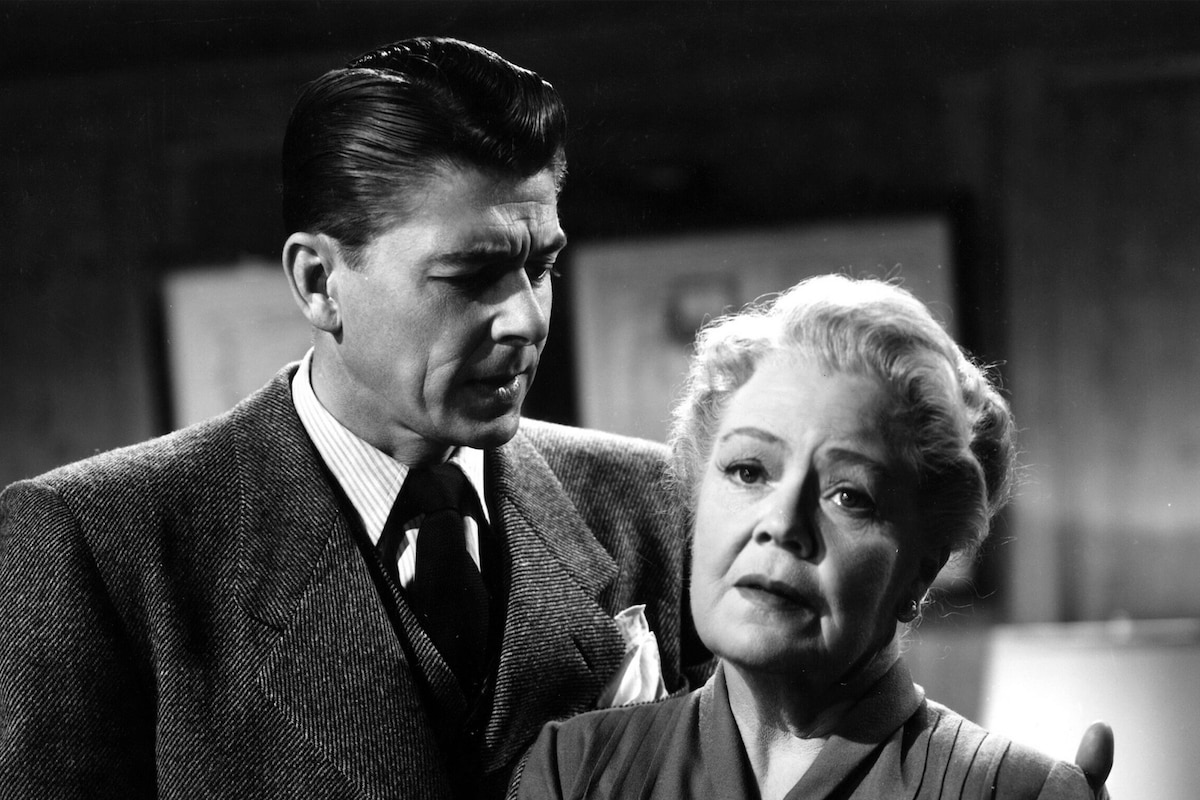
In the Hollywood of 1950, when Louisa was made, actresses were considered "over the hill" at 30. Spring Byington turned that notion on its ear when, at the age of 63, she starred as a widowed grandmother who has a love triangle with two men. Written by Stanley Roberts from his original story, Louisa has widowed Louisa Norton (By-ington), living with her son, architect Hal (Ronald Reagan), his wife Meg (Ruth Hussey) and their kids Cathy (Piper Laurie in her first film role) and Chris (Jimmy Hunt). After causing trouble for the family when she gets into a spat with the local grocer Henry Hammond (Edmund Gwenn), Louisa apologizes to Hammond, having realized that her behavior was caused by her loneliness. Hammond, a widower, admits to also being lone-ly, and the two start up a secret romance.
The family gets in an uproar when Cathy spots her grandmother holding hands with Hammond in the movie theater, and when confronted by Hal, admits that Hammond has proposed marriage. Upset at the news, Hal is sent home from work by his boss, Mr. Burnside (Charles Coburn), and Hammond is invited to dinner that night, where he again proposes. During dinner, Burnside shows up and is captivated by Louisa and a rivalry begins. The jealous Burnside hires a detective and presents evidence that Hammond is really a bigamist. Also in the cast was former Little Rascals star Scotty Beckett as Cathy's boyfriend, Jimmy.
Unhappy with the types of roles being offered, Ronald Reagan had just ended his long-term contract with Warner Bros. when his agent, Lou Wasserman, negotiated a five-year, five-picture contract with Universal. Louisa was his first film with the stu-dio, and he enjoyed being reunited with Coburn, with whom he had worked on Kings Row (1942). The film was shot on the Universal lot in Burbank from February 2 - March 15, 1950.
Louisa was released on May 31, 1950 with the curmudgeonly The New York Times film critic Bosley Crowther highly praising it writing, "Who says that Hollywood movies are made solely for the teen-age crowd? Who says that love only happens to the youthful and the glamorous on the screen? Louisa [is] a jovial little picture about a gloriously giddy romance between a pleasantly plump grandmother and a beamingly 60ish swain." Crowther applauded writer Stanley Roberts for creating a film about older people who have been widowed, but rather than sitting at home decide to look for anoth-er mate. Crowther deemed Byington "darling [...] her radiance at the discovery of a new love should be more remedial than medicine in raising the spirits of people her age."
Louisa would be nominated for an Academy Award for Best Sound Recording and Spring Byington was nominated for a Golden Globe for Best Actress - Comedy or Musical for her performance. Byington and Charles Coburn made several films together, beginning with The Story of Alexander Graham Bell (1939), often playing a mar-ried couple, and the chemistry continued into television with her hit television show December Bride. Later, both Byington and Coburn would say publicly that of all the films they had made, Louisa was their favorite.
By Lorraine LoBianco
Loiusa
by Lorraine LoBianco | July 01, 2020
SIGN UP FOR OUR NEWSLETTERS

CONNECT WITH TCM