The literal translation of "Yi Yi" from Chinese to English is "one one." The Chinese character for the word "one" resembles a dash. When placed in vertical alignment it resembles the Chinese character for "two." When the title appears onscreen, one can see these characters that look like the two cloudy, wavy bars of an "equals" sign, which to a Western eye might even look a bit like an "approximately equal to" or "almost equal to" sign. Below that, the title reads A ONE AND A TWO ... Below that, the title reads "YI YI".
Just as Taiwanese director Edward Yang presents the viewer with the title in three parts, he will also carefully weave together the unfolding drama of three generations of a middle-class family, as seen through three different perspectives that alternate between a father, a son and a daughter. The story is centered around three pivotal moments, beginning with a marriage and ending with a funeral, and in between is life itself, simple on one level, yet extremely complicated on another. The same can be said for Wang's filmmaking style, with its steady, stable, calm camera angles that also make rich use of topography, composition and reflections.
During the almost three hours of its running time, Yi Yi (2000) provides a very honest portrayal of Taipei, a city well known to the director. Selected inhabitants look back at their many dreams and regrets in the waning years of the 20th Century, still very much alive and ready to create drama in the present, while also looking forward to the new possibilities that might unfold in the coming century.
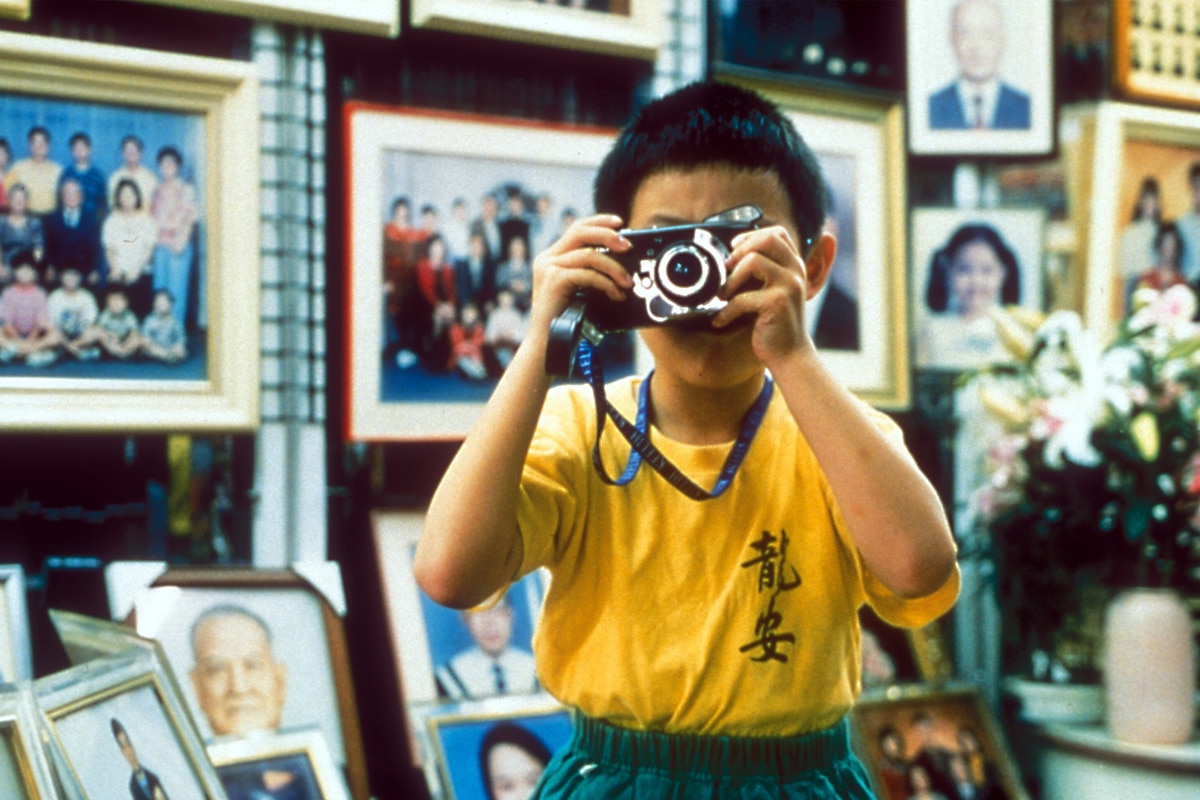
NJ (Wu Nienjen) is an electronics executive with a wife (Elaine Jin), a mother-in-law, a teenage daughter (Kelly Lee) and an 8-year-old son (Jonathan Chang). We also get to know their long-time neighbors. When NJ unexpectedly comes face-to-face with Sherry, his first love, whom he almost married 30 years ago, old drama turns into a new mid-life crisis. (Sherry is played by Ke Suyun, also the lead actress in Wang's first movie.) Meanwhile, the daughter has her own identity crises to deal with. Life also hands its fair share of trials and tribulations to the younger brother - a curious child who uses a camera to take pictures of small things that can't be seen by the lens alone, as well as the backs of people's heads to show them that which they cannot otherwise see. There are ways in which the same might be said for Edward Yang's approach to his characters, whom we come to know in ways that feel so intricately and emotionally articulated that viewers can rightfully feel like they are seeing not just the front and back of their heads but peaking inside of them as well.
Halfway through Yi Yi, there is a particularly iconic moment that occurs when the son Yang Yang drops a water balloon on his teacher. As Yang Yang runs down the school hallway looking for an escape, he ducks into a darkened room that turns out to be an audio-visual class about weather. He crouches down to the floor and squeezes himself among the other students as a voice-over talks about the creation of beautiful clouds and the quiet rhythms of nature. Suddenly the door opens again, but instead of a furious teacher, a young girl walks in. Her skirt gets stuck in the doorframe, giving Yang Yang an accidental peak at her panties as the voiceover continues talking about positive and negative charges.
As the door is closed behind her, the room goes dark again for a moment, but now Yang Yang can see the girl and the projected image behind her, melding together as the voiceover continues about how "in one flashing moment, the two violently reunite." Thunder. Lightning. And within those flashes of light, we see Yang Yang transformed by desires he didn't even know existed before as he gazes at the profile of the girl while hearing about how "a bolt of lightning created the first amino acid, the origin of life that was the beginning of everything." In a film bracketed by marriage and death, it feels perfectly fitting to have a moment that evokes the genesis of all life right in the middle of it all. And, it also serves as a ready reminder for why Edward Yang belongs in the pantheon of leading filmmakers of the Taiwanese New Wave and Taiwanese cinema in general.
Yi Yi is Edward Yang's seventh and final film. It won him the award for Best Director at the 2000 Cannes Film Festival, where it was also nominated for the Palme d'Or. It is epic yet understated and so meticulously well-crafted that every single scene seems to effortlessly live on its own. Film critic Nigel Andrews sums it up nicely when he stated that describing Yi Yi "as a three-hour Taiwanese family drama is like calling Citizen Kane a film about a newspaper."
By Pablo Kjolseth
Yi Yi
by Pablo Kjolseth | June 22, 2020
SIGN UP FOR OUR NEWSLETTERS

CONNECT WITH TCM