With the recent work of writer-director-producer Ryan Murphy and others, revisionist histories of Classic Hollywood have again become a popular trend in current movies and television.
This trend is not a novelty. A particularly long cycle of films about Hollywood and pop-culture icons came in vogue in the late 1970s and early '80s with films like Sidney J. Furie's Gable and Lombard (1976) and Frank Perry's Mommie Dearest (1981). Nicolas Roeg's dark comedy Insignificance (1985), brought a strong finish to this cycle.
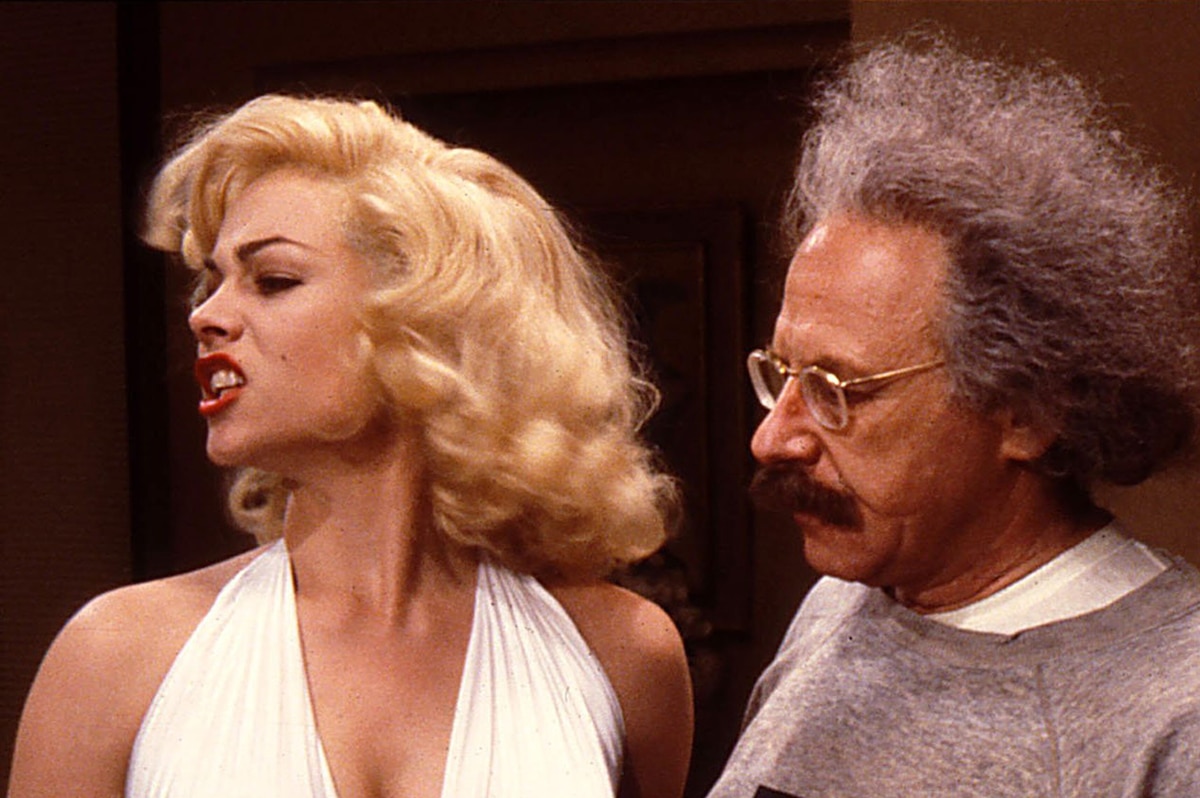
The film tells of a fictional encounter between 1950s icons Marilyn Monroe (Theresa Russell), Joe DiMaggio (Gary Busey), Albert Einstein (Michael Emil) and Joseph McCarthy (Tony Curtis), which changed all four of their lives. Though it is obvious that these are the four figures being portrayed, the film never specifically names them and instead refers to them as simply the actress, the ballplayer, the professor and the senator.
As American as these characters and the story are, the production was entirely done in Great Britain. English writer Terry Johnson wrote the screenplay, which was based on his stage play of the same name. When Johnson read a biography of Marilyn Monroe, he learned that amongst the possessions found at the time of her death, was an autographed photo of Albert Einstein. This sparked Johnson's idea to create a play about the meeting of these two icons.
Much of Johnson's work deals with Hollywood and pop culture figures, including Hitchcock Blonde about the famed director and debuting in 2003 and a stage adaptation of Mike Nichols' classic, The Graduate (1967). Despite such an obvious interest in Hollywood, Insignificance has unfortunately been Johnson's only credit as a feature film screenwriter. Johnson remains devoted to the London stage as a writer and director, with only the occasional television adaptation of usually his own work.
Johnson wrote Insignificance as a vehicle for his then girlfriend, actress Judy Davis, who originated the role on the London stage. While Johnson hoped to have Davis reprise her role on screen, director Nicolas Roeg gave the plumb role to his own wife, Theresa Russell. Russell had first been offered the role by the film's producer, Alexander Stuart, but turned it down. She said that portraying Monroe "seemed so daunting" that she didn't think she could ever do her justice. Even years after the film was made, Russell remains uncertain that her performance is something other than caricature. It was only after her husband was confirmed as the film's director that Russell reluctantly took the role.
Roeg deliberately cast Tony Curtis as the Senator because of his previous experience working with Monroe on Some Like It Hot (1959). He also thought that casting a classic Hollywood star would add another level of irony to this story about the dark side of fame. In addition to casting choices, Johnson and Roeg also had differences regarding the script. Johnson originally wanted to stick to the contents of his play and, if anything, make it shorter to fit a typical movie running time. However, Roeg thought it necessary to create more backstory for the characters. He even had Russell recreate Marilyn Monroe's notorious Playboy photographs.
Insignificance was both a critical and commercial success, eventually becoming Britain's entry in the 1985 Cannes Film Festival.
By Jack Fields
Insignificance
by Jack Fields | June 21, 2020
SIGN UP FOR OUR NEWSLETTERS

CONNECT WITH TCM