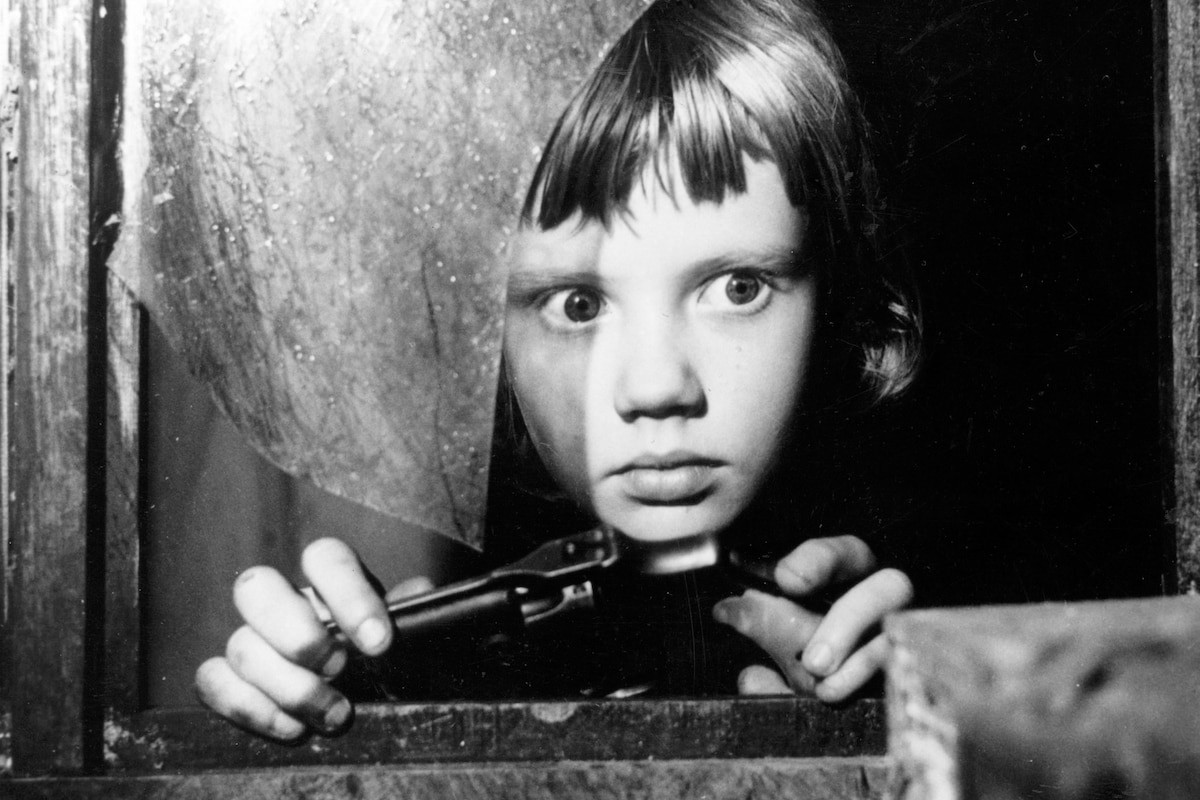
Twelve-year-old Hayley Mills started her rise to top child star of the 1960s with her surprisingly complex performance as a tomboy who witnesses a murder and then bonds with the killer (Horst Buchholz). The film led to her five-year contract with Walt Disney and the title role in his new film version of Polyanna (1960). Even without that bit of history, Tiger Bay (1959) still stands as a powerful thriller and an important transitional film between the classic British cinema of the 1940s and 1950s and the British New Wave of the 1960s.
Buchholz is Bronislaw, a Polish sailor who returns to Wales in search of his girlfriend (Yvonne Mitchell). Learning she's moved, he asks the young Gillie (Mills), whom he sees playing in the street, for directions to the new address. She takes him there, then spies on him as he confronts the woman. When his girlfriend pulls a gun on him, Bronislaw takes it and shoots her in a jealous rage. Gillie hides and grabs the gun for herself when he stashes it near her before fleeing the scene. When the murder is discovered, Gillie lies to the police so that she can keep the gun. Bronislaw tracks her down, but instead of eliminating the sole witness to the murder, he befriends her creating an interesting dynamic and unlikely alliance.
In Noel Calef's original short story, "Rodolphe et le Revolver," the child witness was a boy. When director J. Lee Thompson visited Mills' father, John Mills, to discuss his role as the police superintendent, he noticed the tomboyish girl wearing a boy's haircut and was so impressed with her energy and her eyes that he had the role re-written for her. It was her first film appearance since a bit part as an infant in So Well Remembered (1947), which had starred her father. As a result, posters hailed her performance in Tiger Bay as "Hayley Mills' Triumphant Return to Film."
The film takes its name from a district of Cardiff, Wales, where it was mostly shot. Unlike most British films at the time, it featured extensive location shooting, featuring Cardiff, the Newport Transporter Bridge and Bristol's Avonmouth Docks. It also captures the social changes to the area, which was becoming increasingly multicultural and multiracial. With its unsentimental approach to childhood, Tiger Bay has been hailed by later critics as a precursor of the British New Wave of the 1960s, which also featured extensive location work and a focus on social realism.
At the center is Hayley Mills' performance. Unlike the sentimental children of Hollywood films, her character is a tough if lonely little girl, recently transplanted from London after her parents' death. She fights to get the boys in her neighborhood to play with her rather than seeking female friends and takes advantage of adults who presume children are innocent. Mills' performance was aided by the presence of her father in some of her most important scenes and Thompson's sensitive direction. For the scene in which she lies to the police, he simply outlined the plot and let her improvise her lines. It also helped that she developed a crush on Bronislaw, which made her loyalty to him more convincing. In addition to being extremely good looking, her co-star also kidded around with her, occasionally breaking her up with his off-camera antics while she was shooting a scene.
On the film's release, Bosley Crowther of the New York Times raved about Mills' "heart-gripping performance of a child caught by terror, dismay, morbid fascination, affection and stubborn loyalty." She won a BAFTA (British Academy of Film and Television Award) as most promising newcomer and a special prize at the Berlin International Film Festival. When Disney's wife saw the film during a London vacation, she insisted she had found the perfect actress for his upcoming production of Pollyanna, a role for which he had tested hundreds of young girls.
Buchholz also got a career boost out of the film. The young German had been acting since he was a teenager and scored a hit with his first credited feature role, in Julien Duvivier's Marianne of My Youth (1955). By 1957, he was voted Germany's most popular actor, often called the "German James Dean" because of his roles as young rebels. With the global success of Confessions of Felix Krull that year, his move into international markets was inevitable. He made his English-language debut in Tiger Bay before moving on to such classics as The Magnificent Seven (1960), Fanny and One, Two, Three (both 1961).
Director: J. Lee Thompson
Producer: John Hawkesworth, Leslie Parkyn, Julian Wintle
Screenplay: John Hawkesworth & Shelley Smith
Based on the short story "Rodolphe et le Revolver" by Noel Calef
Cinematography: Eric Cross
Score: Laurie Johnson
Cast: John Mills (Superintendent Graham), Horst Buchholz (Bronislaw Korchinsky), Hayley Mills (Gillie), Yvonne Mitchell (Anya), Megs Jenkins (Mrs. Phillips), Anthony Dawson (Barclay), Shari (Christine), Marne Maitland (Dr. Das), Michael Anderson, Jr. (Youth)
By Frank Miller
Tiger Bay
by Frank Miller | June 02, 2020
SIGN UP FOR OUR NEWSLETTERS

CONNECT WITH TCM