Italian director Pietro Germi made over a dozen neorealist films before his dark comedy Divorce: Italian Style (1961), a film so successful that it became the first in a trilogy of comedies. It was followed by Seduced and Abandoned (1964) and the anthology film, The Birds, the Bees and the Italians (1966). Indeed, Divorce Italian Style sparked an entire genre: Commedia all'italiana (Comedy: Italian Style). Produced after the second World War, from the 1950s to early 1970s, Commedia all'italiana satirizes the Italian politics and societal structures of the time, particularly those pertaining to gender.
Hardly didactic and certainly not patronizing, these films balance slapstick comedy conventions with metatheatrical commentary and highly stylized camerawork. And while the themes are clear in these films, there is no prescriptive messaging. Italian film critic Mario Sesto describes the genre as a coin - with one side being comedy and the other tragedy. Clarifying, one of Seduced and Abandoned's screenwriters, Furio Scarpelli, points out that, "we only laugh at things with a dramatic element at their core." Germi's trilogy excavates Italian masculinity in order to unearth the troubling double-standards between men and women when it comes to sex and marriage.
Lending extra diegetic meaning to Germi's first comedy, in Divorce Italian Style Marcello Mastroianni plays Ferdinando Cefalù, a restless and impoverished Sicilian nobleman, who can no longer stand his annoying wife Rosalia (Daniela Rocca). Because divorce was illegal in Italy at the time, Ferdinando plots to off his wife so he can be free to seduce his younger, more attractive cousin, Angela (Stefania Sandrelli). He settles on projecting his behavior onto his wife - framing her for infidelity - in order to justify her murder. The plotline reflects the legal treatment of honor killings at the time; honor was so important to Italian society that this type of murder was seen as justifiable, even acceptable, and punishment for the vengeful cuckold was often lenient. Germi's brilliant satire works as audiences of the film find themselves suspending their own moral righteousness. We become complicit in state sanctioned sexism, laughing at Ferdinando's efforts to kill his wife instead of critiquing the illegality of divorce and the general mistreatment of women.
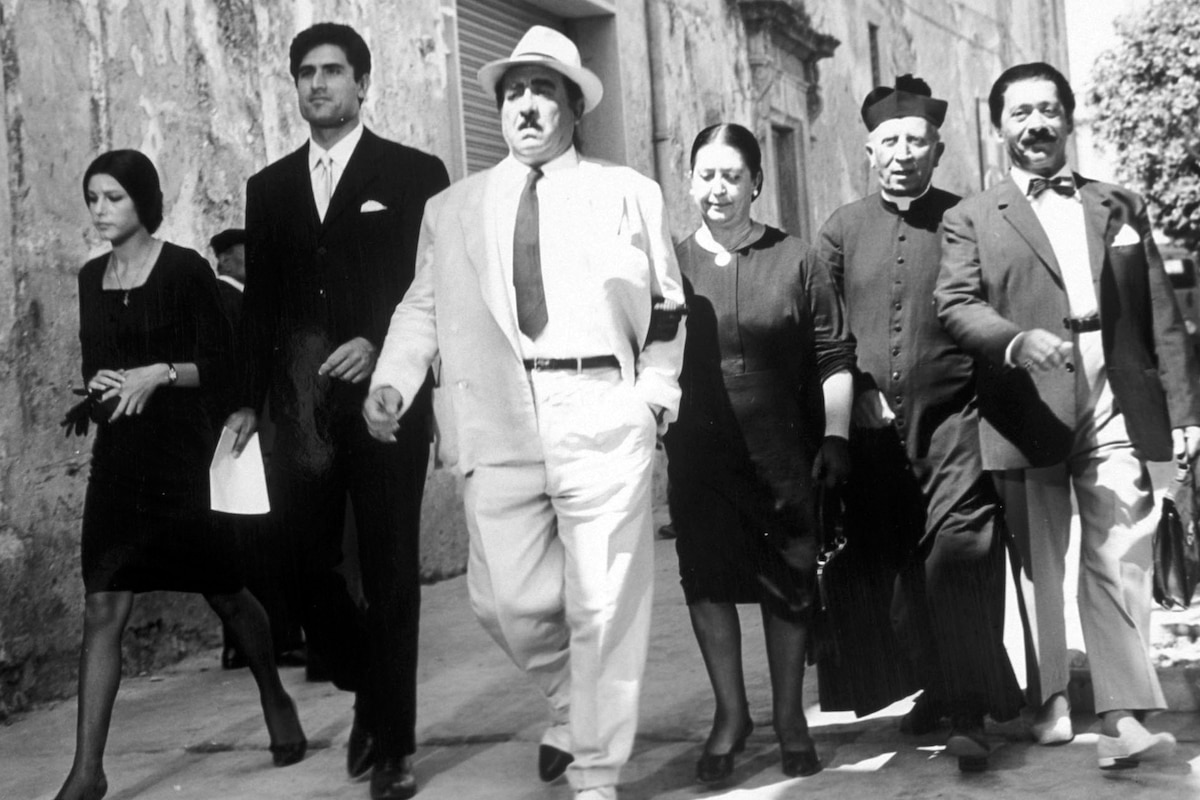
If Divorce Italian Style focuses on a restless and insecure man seeking to avoid middle age matrimony, Seduced and Abandoned, an informal sequel, focuses on a successful older man named Don Vincenzo Ascalone (Saro Urzì). He becomes violently anxious about losing the respect of his gossipy town when one of his daughters, Agnese (Stefania Sandrelli), becomes pregnant by his other daughter's fiance, Peppino (Aldo Puglisi). While it had become fashionable to cast American actors in Italian roles (such as Burt Lancaster in The Leopard (1963) and Dustin Hoffman would star in Germi's 1972 comedy Alfredo, Alfredo), Urzì's portrayal of Vincenzo embodied the kind of familiar Italian patriarch that Germi aimed to lambast. The film is quick to highlight how, in that cultural context, a father's shame can eclipse his daughter's wellbeing. Vincenzo beats and blames Agnese for what he believes is her sexual indiscretion even though the audience knows that she had been raped. Vincenzo forces Peppino into a reparatory marriage with Agnese to save face. At first Peppino agrees, but then he says he does not want to marry Agnese, insisting that he'll only marry a virgin. The irony that Agnese was a virgin when she was raped is emphasized further when Peppino's own mother recalls how his father had pressured her for sex before their marriage. Peppino's father admits that he wouldn't have married her either, arguing, absurdly: "It's a man's right to ask, it's a woman's duty to refuse."
Although Agnese's trauma is never broached, the film does not wholly victimize her. When interviewed about playing Agnese, Stefania Sandrelli said she was grateful for the liberty that Germi gave her in playing a role that represented an "evolution of the female character in Italian society." Moreover, Don Vincenzo, as well as the larger Sicilian patriarchy he represents, is clearly being mocked with forthright candor. Seduced and Abandoned, like Divorce, Italian Style, remains remarkable for its ability to temper a seething critique of gendered hypocrisies with humor and sophisticated parody.
By Rebecca Kumar
Seduced and Abandoned
by Rebecca Kumar | May 28, 2020
SIGN UP FOR OUR NEWSLETTERS

CONNECT WITH TCM