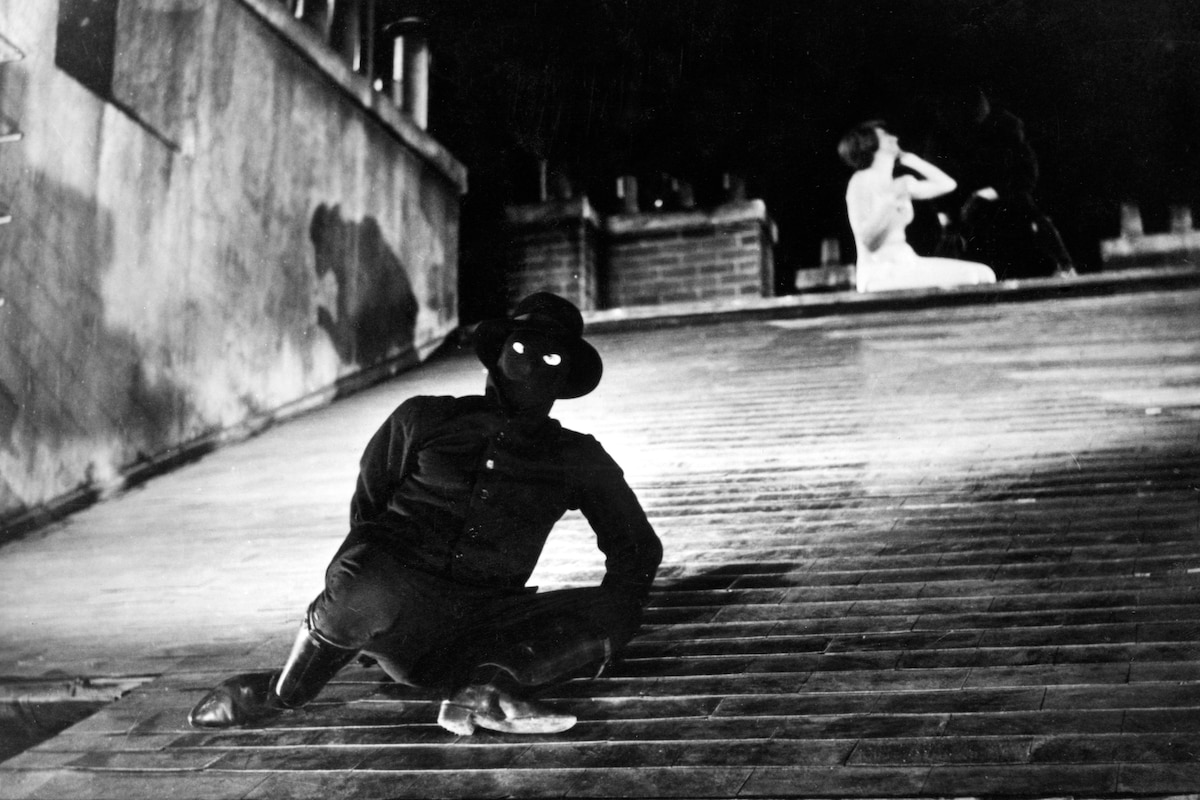
The original 1916 Judex, a 12-chapter crime fantasy serial from the impossibly prolific Louis Feuillade, was an epic tale of revenge perpetrated by a mysterious black-cloaked figure upon a ruthless banker who callously destroys lives in his grasp for power and fortune. The story has echoes of The Count of Monte Cristo and the mysterious Judex is like a proto-Batman with his disguises, secret lair, and fantastic tools and gadgets.
In the early 1960s, Feuillade's grandson Jacques Champreux was approached by a producer who wanted to remake Judex. Champreux suggested Georges Franju, a filmmaker of poetic documentaries and a handful of dreamy features, to helm the project. A founding member of the Cinematheque Française with Henri Langlois, Franju had a passion for silent cinema and especially the films of Louis Feuillade, whom he discovered through the preservation efforts of the Cinemateque. As Champreux remembers it, Franju responded that "I'd rather remake Fantomas," Feuillade's earlier, more anarchic serial adventure built around a murderous master villain. "Franju often said that what interested him was not really Judex but the atmosphere of the era, the poetry of the cinema of that era."
Champreux, who scripted the adaptation with French film historian Francis Lacassin, condensed the five-hour-plus serial into a 90-minute remake that was faithful to the plot while drawing elements and scenes from other Feuillade serials, notably Fantomas (1913-1914) and Les Vampires (1915). It's set in the 1910s, as evidenced by the cars, yet in a way feels timeless, untethered to any specific time or place. The masked vigilante, banker villain, innocent maiden, wicked femme fatale, goofy detective and scamp of a boy sidekick all made the transition but Franju discarded the motivations and much of the exposition and transformed Feuillade's elegant rollercoaster cliffhanger into a kind of dream ballet.
What interested Franju was the evil character, not the hero, recalled actress Francine Bergé in a 2012 interview. In Judex, that character is Diana Monti, aka Marie Verdier, played by Musidora in the original serial. Brigitte Bardot was approached for the key role but she proved too expensive. Franju cast Bergé after seeing the young actress in Les abysses (1963). According to Bergé, he said simply, "I want the tall brunette who seems so evil," and cast her after a brief meeting without even a formal audition. Franju dressed Bergé in a black leotard for her cat burglar sequences, just as Musidora had worn as the master criminal Irma Vep in Les Vampires.
For Jacqueline, the innocent daughter of the ruthless banker, Franju once again cast Edith Scob, who was so haunting as the faceless Christiane in Franju's Eyes Without a Face (1960). It was their fourth collaboration and she casts an otherworldly innocence and purity in her largely silent role. "Edith doesn't inspire me, she inhabits me," said Franju of the actress. And for the title role of Judex, the avenger of the film, Franju cast Channing Pollock, a good-looking American magician who had little acting experience and spoke no French. Pollock was a cabaret star with a sleight of hand act and Franju used those skills to give Judex a strange, surreal and memorable entrance.
"Judex is a purely decorative film and present itself as such," explained Franju decades later. "It isn't meant to frighten. Judex is a film of pure form, a purely aesthetic film." The reviews, while generally positive, often noted the dispassionate direction. Bosley Crowther's review in The New York Times, one of the few negative notices, dismissed it as "an unsubstantial reproduction of an antique." But in France it was embraced as a lovely homage to Feuillade and his era of silent cinema and the film's reputation has only grown with time.
Sources:
"'Judex,' a French Tale of Antique Villainy, Bows at Baroet," Bosley Crowther. The New York Times, April 26, 1966.
Georges Franju, Kate Ince. Manchester University Press, 2005.
"The Secret Heart of Judex," Geoffrey O'Brien. Criterion Collection, 2014
"Franju le visionnaire," documentary directed by Andre S. Labarthe. Originally broadcast as part of Cinema de notre temps, 1998.
"Francine Berge on Judex," video interview. Cinemateque francaise in Paris, 2012.
"Jacque Champreux in Judex," video interview. Eureka, 2007.
IMDb
By Sean Axmaker
Judex (1963)
by Sean Axmaker | May 28, 2020
SIGN UP FOR OUR NEWSLETTERS

CONNECT WITH TCM