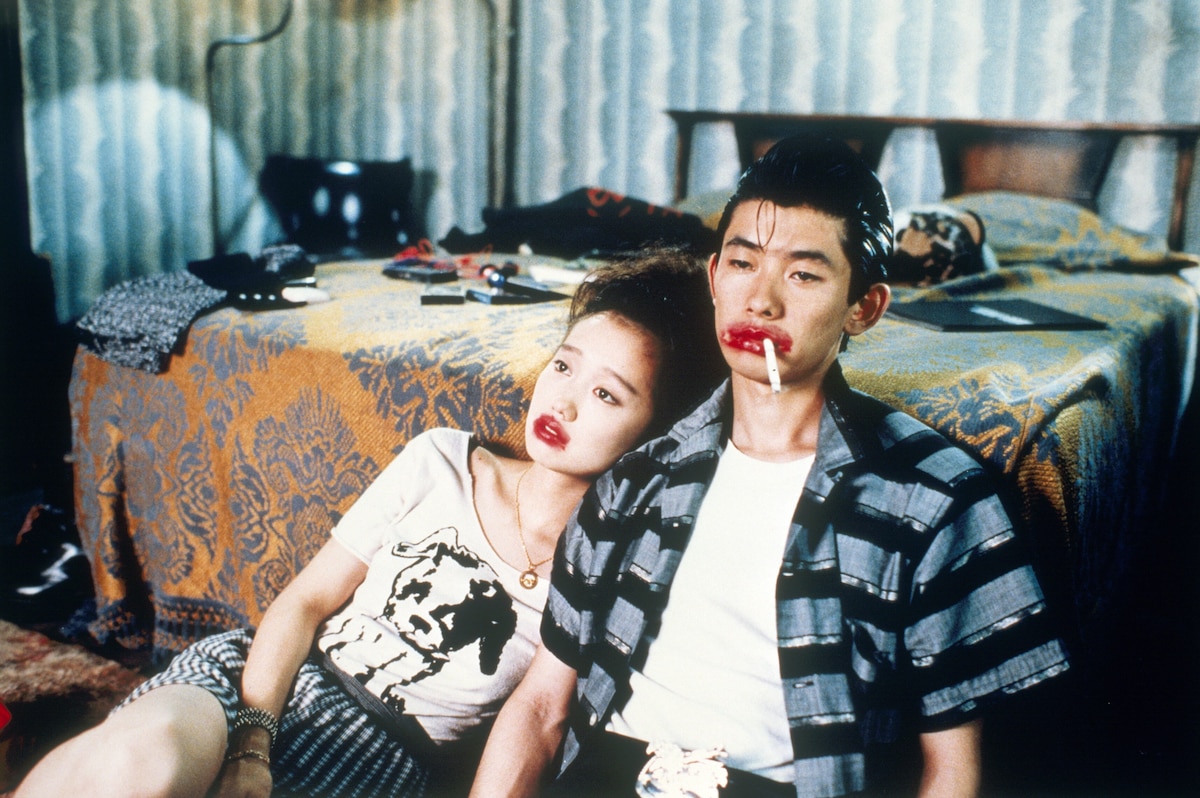
For his fourth feature film, postmodernist writer/director Jim Jarmusch takes us through a night in Memphis, Tennessee in Mystery Train (1989). Three different stories are told: "Far from Yokohama" tells of two Japanese teenagers (Youki Kudoh and Masatoshi Nagase) paying a visit to Elvis; "A Ghost" has a widow (Nicoletta Braschi) returning to Italy with her late husband's coffin in tow; and "Lost in Space" introduces a British Elvis impersonator (Joe Strummer), who goes carousing through the city with his buddies. All three stories have the city of Memphis, a seedy hotel and a gun shot in common.
This format of telling three or more different story lines in the framework of a shared setting or location is often referred to as the anthology film or hyperlink film. This sub-genre was very popular in the studio era with movies like The Story of Three Loves (1953) and Grand Hotel (1932), as the format was perfect for creating star heavy ensemble pieces. By the 1980s, however, the format was mostly used as an artistic choice by auteur filmmakers. The same year as Mystery Train, Woody Allen, Martin Scorsese and Francis Ford Coppola all joined forces for the film New York Stories (1989). A few years later, Quentin Tarantino (a big fan of Jarmusch's) would take the format to the limit with Pulp Fiction (1994).
For his part, Jim Jarmusch chose to portray the shared locations of the Arcade hotel and the city of Memphis as characters in the movie. This is a recurring trend in Jarmusch's work which usually tells stories of people navigating through unfamiliar places and territories. He also tries to depict the bleaker side of places usually given more glamorous treatments on film. The Memphis of this film is not what is sung about in country music. Ironically, Jarmusch had never even been in the state Tennessee prior to writing this story, but upon his arrival in Memphis, he took it upon himself to scout locations. Simply by casually driving through the city's Southside, he found both the Arcade Hotel and the train station featured prominently in the film.
Another recurring practice in Jarmusch's films is his casting method. Jarmusch often reaches out to his favorite musicians, some of whom have never acted in movies, to play central characters. For Mystery Train, Jarmusch wrote the character of Johnny specifically for Joe Strummer. Strummer was the lead vocalist for The Clash, Jarmusch's favorite punk rock band. Legendary blues and rock singer Screamin' Jay Hawkins had only made brief appearances as himself in previous movies when Jarmusch offered him the role of the mysterious night clerk. This admiration for musicians relates to Jarmusch's own musical talents. In addition to writing and directing, Jarusch is a gifted composer who played keyboards and sang for the short-lived band The Del-Byzanteens in the early 1980s.
This was Jarmusch's fourth film and his first with a major studio backer and distributor, Orion Pictures and JVC, their Japanese conglomerate. Unlike his last two films, an increased budget of $2.8 million allowed Jarmusch to film in color and to have more freedom with his casting choices. Because the budget was still a fairly modest one (at least by Hollywood studio standards) and because Jarmusch's minimalist style brought the film in under budget and ahead of schedule, the film's ultimate lack of profit was not a total disappointment.
Though not a box-office smash, Mystery Train was a great success at Cannes and on the festival circuit, eventually receiving attention from some of the Independent Spirit Awards. It marked a new period of prolific filmmaking for Jim Jarmusch and a new age of anthology films.
By Jack Fields
Mystery Train
by Jack Fields | May 26, 2020
SIGN UP FOR OUR NEWSLETTERS

CONNECT WITH TCM