FROM BEYOND
Following the critical and home video success of his debut feature, Re-Animator (1985), writer-director Stuart Gordon took a career turn that would change his life forever. A major force in the Chicago theater scene thanks to Organic Theater Company (which he founded with his wife and frequent repertory player Carolyn Purdy-Gordon), Gordon decided to move to Los Angeles where he teamed up with friend Brian Yuzna to make their first feature together, a startling, gory and outrageous jet-black comedy based on an obscure serialized tale by H.P. Lovecraft. Re-Animator proved to be the most famous film released by Empire Pictures, an indie distributor founded by Charles Band in 1983 focusing on horror and sci-fi projects with very low budgets. Empire had its first commercial success with Ghoulies (1985) and a cable hit with Trancers (1984), but Re-Animator was a major genre revolution that put Gordon, Yuzna and Band's company truly on the map.
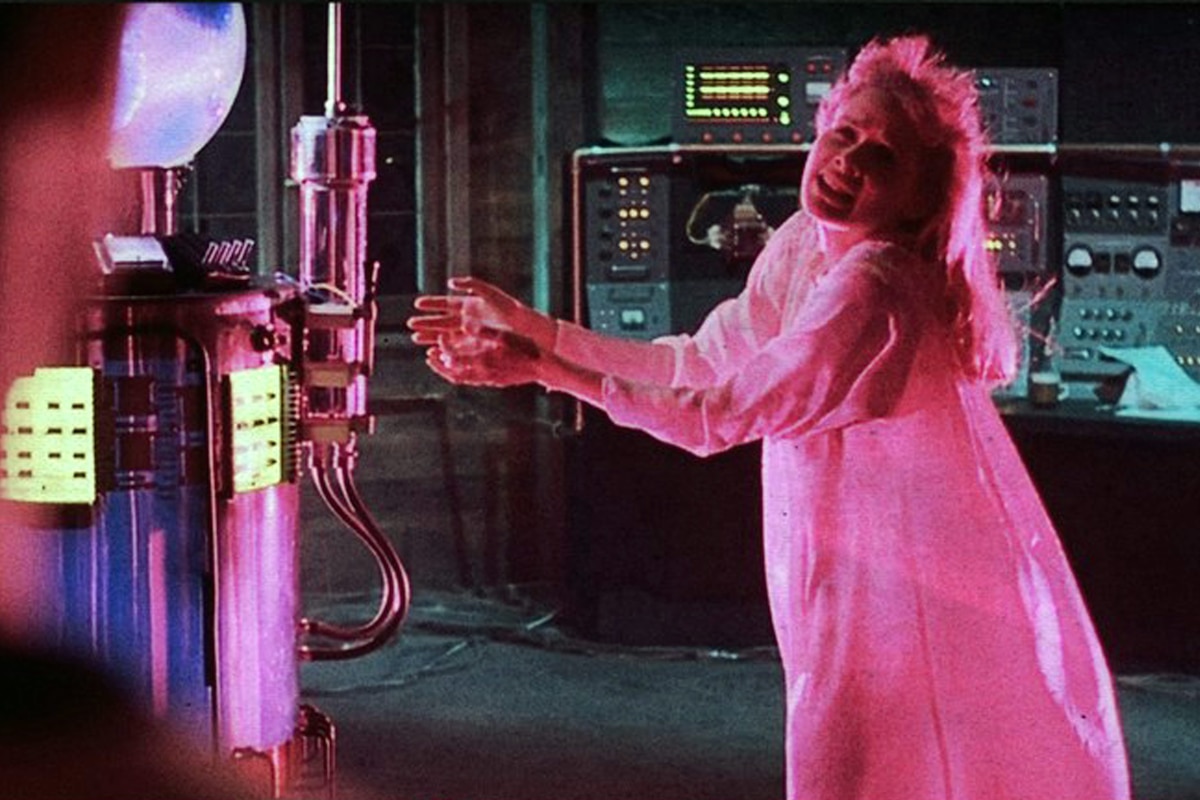
A follow-up film was quickly initiated at Empire with Gordon and Yuzna returning with frequent co-writer Dennis Paoli to pen From Beyond (1986), another Lovecraft adaptation based on a short story first published in 1934 in The Fantasy Fan magazine. Essentially a two-character chamber piece, the tale revolves around a nameless narrator who is horrified to discover that a scientist named Tillinghast has discovered that electronic stimulation of the human pineal gland reveals another dimension floating around us containing horrific creatures. That idea forms the basis of the film, which demotes Tillinghast to an oddball supporting character played by Re-Animator star Jeffrey Combs. Primary villain duties here go to Ted Sorel as Dr. Edward Pretorius, whose experiments with a machine called the Resonator drive his associate mad and into the care of a doctor, Katherine McMichaels (Barbara Crampton, also of Re-Animator fame). The investigating detective, Bubba Brownlee (Ken Foree, star of 1978's Dawn of the Dead), accompanies the doctor and patient back to Pretorius' lab where all hell breaks loose.
A marked break from Gordon's previous film, From Beyond is filled with vibrant, splashy colors and flights of outright fantasy with an array of practical effect grotesqueries from another dimension. Also returning here is composer Richard Band, whose cheeky pilfering of Bernard Herrmann's Psycho (1960) in the prior film is replaced here with his most elaborate symphonic concoction in the grand monster movie tradition. Gordon and company play the material comparatively straight, opting for an air of escalating menace instead of the cavalcade of sick laughs that had made them famous. The film's biggest revelation actually proved to be Crampton, who moves far beyond her damsel in distress role that had made her famous and here delivers a complex, fascinating heroine who explores her more perverse side in the film's twisted final act.
While Re-Animator had gone out to theaters unrated with a notice that viewers under 17 would not be permitted (while a greatly watered-down version was prepared for home video with an R rating and plenty of excised narrative footage restored to compensate), the powers that be decided From Beyond stood a better chance theatrically with an R rating from the outset. That necessitated a considerable number of cuts at the behest of the MPAA, though not as many as they originally demanded from Gordon. The damage to the film was significant and resulted in numerous pacing and continuity issues that harmed the overall effectiveness of the film from start to finish. The fact that splashy gore effects turned up in promotional featurettes and documentaries around the film rubbed salt in the wound for horror fans, and for many years, publications reported that the original unrated cut was impossible to salvage given the editorial process of getting it through the ratings board gauntlet. However, when the rights to the film passed to MGM, the excised footage was recovered with a full restoration of Gordon's cut undertaken to bring it back to its original excessive glory. That full-strength version aired on the now defunct but beloved Monsters HD channel, with later home video releases on DVD and eventually Blu-ray. The film's reputation has also ascended considerably thanks to that turn of events, and it is now regarded as an essential and imaginative entry in the rich heritage of Lovecraft cinema.
By Nathaniel Thompson
From Beyond
by Nathaniel Thompson | April 23, 2020
SIGN UP FOR OUR NEWSLETTERS

CONNECT WITH TCM