During the dark days of the Great Depression, Shirley Temple sang, danced and charmed her way into the hearts of moviegoers around the world. With her 56 perfectly coiled ringlets and her irrepressible, happy-go-lucky attitude, Temple provided light during a dark time. The pint-sized entertainer was so popular she almost single-handedly saved the Fox Film Corporation, which would merge and become 20th Century-Fox in 1935, from going under. Her films were box-office hits and Shirley Temple merchandise, in the form of toys, books and ephemera, made her a familiar face on and off screen.
On the heels of the success of the Temple vehicle Bright Eyes (1934), Fox was looking for new properties to showcase their young star. They found her next project in Annie Fellows Johnston's much beloved children's book The Little Colonel. Published in 1895, it sold over a million copies and Johnston developed the story into a full-fledged series with a dozen more novels. Set in post-Civil War Kentucky, the story follows the adventures of a young girl, the offspring of Confederate and Yankee families, who wins over her cantankerous grandfather. It was just the sort of vehicle custom fit for Temple who excelled at playing precocious young problem solvers. Fox purchased the film rights from Johnston's stepdaughter Mary G. Johnston. Screenwriter William M. Conselman, who would go on to write for six different Shirley Temple films, adapted Johnston's novel to screen.
Director Irving Cummings was assigned to The Little Colonel (1935) but had to drop out to direct retakes for another film. David Butler, who later had great success directing big show business types such as Bob Hope, Doris Day and Will Rogers, was his replacement. Butler had directed Temple in Bright Eyes the year before and collaborated with songwriter turned producer Buddy G. DeSylva, who had been under contract with Fox since 1929. The Little Colonel was billed as "A B.G. De Sylva Production".
Production ran from late November 1934 until early January 1935. The Little Colonel was filmed in black and white with the final scene shot in Technicolor. Lionel Barrymore was cast as Colonel Lloyd and given second billing. By the 1930s, Barrymore had perfected the role of the curmudgeon and did so dutifully for The Little Colonel. It's said that Barrymore flew into a rage when Shirley Temple, who memorized the entire script, fed him a line he had forgotten. Tensions arose on set, but the pair eventually made up. Barrymore had appeared with Temple the previous year in Carolina (1934) and would do so again in Since You Went Away (1944). Other cast members include relative newcomers Evelyn Venable and John Lodge who play Temple's parents. Hattie McDaniel, a few years away from Academy Award-winning performance in Gone With the Wind (1939), portrayed Mom Beck.
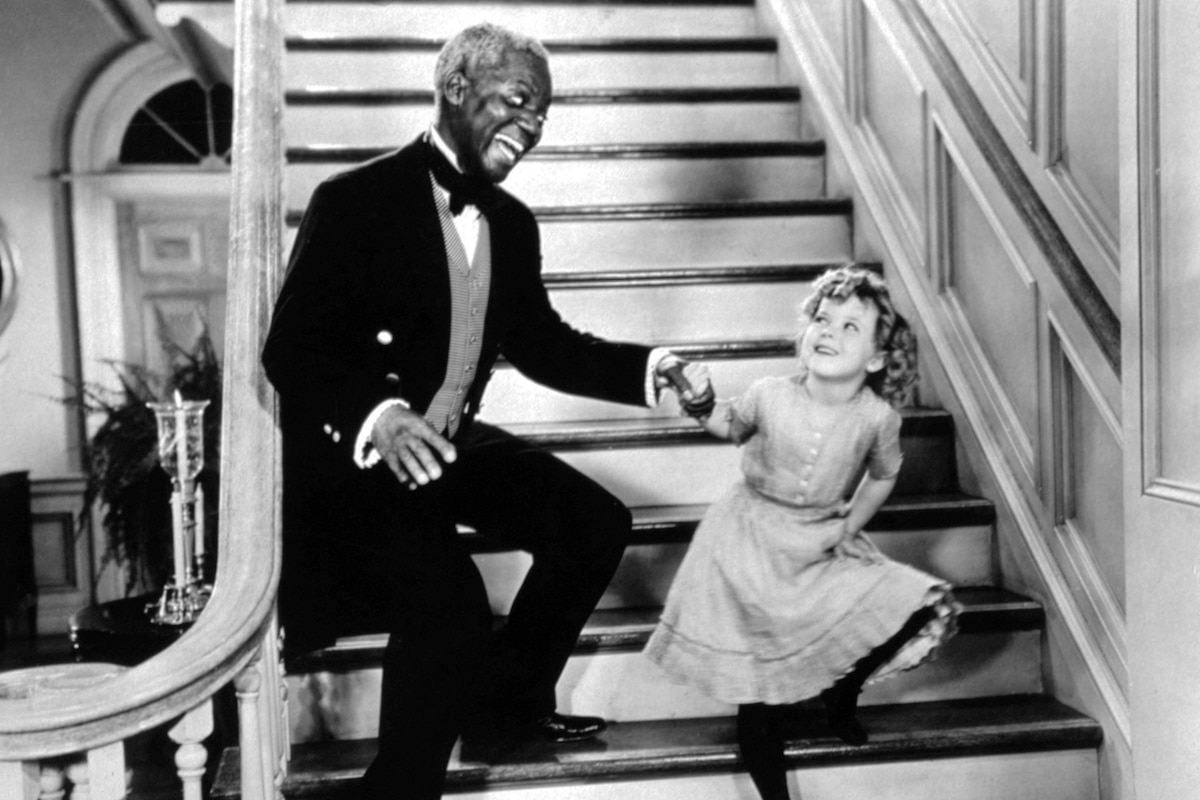
The Little Colonel's claim to fame is the legendary staircase dance sequence, a collaboration between tap-dancing legend Bill Robinson and Shirley Temple. The scene in which Robinson demonstrates how to tap dance up the stairs as part of Temple's bedtime routine, was the first time an interracial dance couple performed together in a Hollywood movie. Film historian Donald Bogle calls it "one of the great 'musical' sequences in the history of American cinema... it's one of those Depression-era sequences with a subtext that hard times (including domestic difficulties) can be endured and triumphed over if black and white work together." Staircase dancing was Robinson's signature style, one he tried but failed to copyright under his name.
In an interview with Larry King, Shirley Temple remembered Robinson as "the special man in my life... special friend and special teacher." During rehearsals, Robinson would squeeze Temple's hand once if they were doing very well, twice if they were doing fairly well and three times if they had to start over. A version of the film screened for Southern audiences was edited to remove any shots of Temple and Robinson holding hands. According to professor and historian Miriam J. Petty, "though he was much beloved by the youngster in real life, and though he appeared in more films with Temple than any other individual, Robinson was never depicted hugging or kissing Temple onscreen, as white male actors like Lionel Barrymore... were."
The Little Colonel premiered on February 22, 1935 at the Rialto Theatre in Louisville, Kentucky. It was made for a modest budget and earned $1.2 million at the box office. It received mixed reviews. Film critic Andre Sennwald of The New York Times wrote "[The Little Colonel] seems to be right up to the standard of Bright Eyes and out to bring out the best in every one who sees it." The Temple-Robinson dynamic proved to be such a hit that the duo appeared together in four more films: The Littlest Rebel (1935), Captain January (1936), Just Around the Corner (1938) and Rebecca of Sunnybrook Farm (1938). The Little Colonel has been released on home video in the original black-and-white version with the final Technicolor sequence and a computer colorized version.
By Raquel Stecher
The Little Colonel
by Raquel Stecher | April 23, 2020
SIGN UP FOR OUR NEWSLETTERS

CONNECT WITH TCM