The Sin of Nora Moran (1933) follows a storyline common in the pre-Code era of Hollywood in which a young woman of meagre means falls in love with a wealthy man of status. Because he stands to lose wealth, power, or position due to their illicit affair or disreputable relationship, she is destined to suffer from the abandonment that inevitably follows. Generally told from the woman's point of view, this subgenre of melodrama was sympathetic to the young female protagonists while depicting the men as weak, cowardly, or cruel. After the enforcement of the Production Code, and its mandate of virtue for leading ladies, girls who dallied with men were reduced to unsympathetic secondary characters pegged as temptresses, homewreckers, or on the road to ruin.
Zita Johann, best known as the object of Imhotep's obsession in The Mummy (1932), stars in the title role. Young Nora seems to be fate's victim from childhood, losing both her birth parents and later her adoptive parents. Though she studies dance to improve herself, the only job available to her is in a small circus as the assistant to Paulino the lion tamer (John Miljan). Paulino's brutal nature is evident in the way he abuses his lions, so it comes as no surprise when he rapes Nora. Escaping to New York City, she finds a job in a night club, where she meets Dick Crawford (Paul Cavanagh), an older gentleman destined for the governor's mansion. Crawford is kind to her and sets her up in a house, but he is fearful of destroying his political career, so he limits their relationship to secret assignations twice a week. When Paulino catches up with her and violence results, Nora realizes that she had been living on borrowed time.
The storyline of The Sin of Nora Moran may be familiar melodrama, but the nonlinear structure is so intricate and the tone so bizarre that the film feels bold and unique. The story begins in the present when Mrs. Crawford finds love letters to her husband from Nora. She takes them to her brother, John Grant, played by Alan Dinehart, who is the district attorney and Dick's political strategist. As Grant begins to tell Nora's story, a flashback reveals that Nora is in prison awaiting execution. From that flashback, another trip back in time from Nora's perspective reveals how she lost two sets of parents. The film cuts from the present to the past and then to the distant past and then back again, unfolding the story in flashbacks within flashbacks and from more than one narrative point of view.
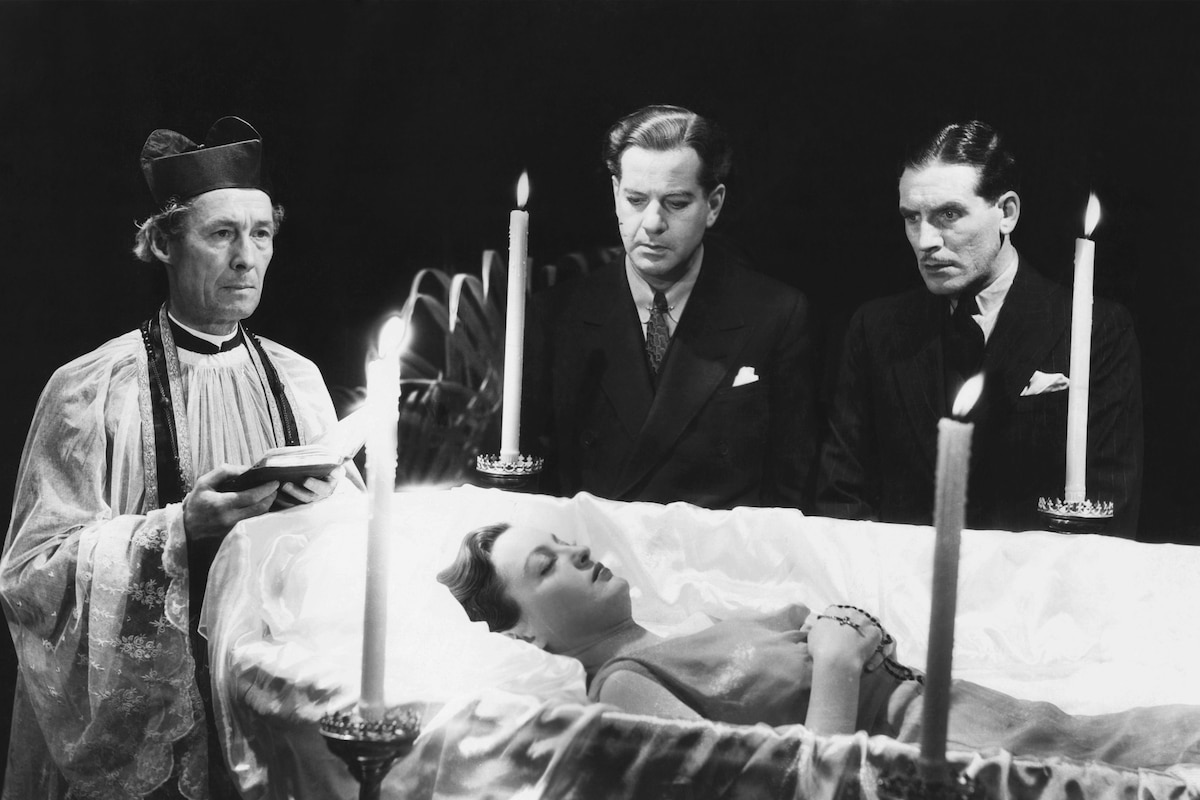
The most unusual sequences are those of Nora in prison awaiting execution. Dream-like scenes show Nora in deep anguish, holding a conversation with Sadie (Ann Brody), an old friend from her circus days who suddenly appears next to her. In a poignant if strange scene, Sadie offers to change her actions in the past, so that Nora's current situation and future outcome will unfold differently. A character attempting to alter a part of the story the audience has already watched and accepted as fact was bold storytelling for 1933. Equally hallucinatory is a scene in which Dick, now the governor who could stay Nora's execution, speaks to her disembodied head, then debates aloud with his conscience. A scene in which Dick and John Grant stand over Nora's coffin may not be real at all. It could be a dark speculation into the future, or Dick's guilt weighing heavily on his soul. The film offers no definitive explanation.
While most of the abandoned women stories are tragedies, The Sin of Nora Moran is undoubtedly one of the darkest. This is partly due to Nora's hard-luck life in which she is orphaned twice, raped, and imprisoned. But, the dream-like scenes that seem to reflect the characters' inner turmoil add to a mood of despair and desperation--two feelings that Depression-era audiences could relate to.
In addition to the unique structure, The Sin of Nora Moran makes use of sophisticated montages to indicate the passage of time. The montages consist of shots taken from stock footage that are cut together in rapid succession but also superimposed or connected by dissolves. For example, when Nora finishes with dancing school, she tries to find a job in the city. A montage of overlapping images of her feet, her worried face, the teeming streets of a big city, and signs that say "Position Filled" indicate her difficulties in finding work and her desperation to take any job. The montage takes only a few seconds of screen time, but the combination of images tells the complete story of her struggles.
The Sin of Nora Moran was produced at Majestic Pictures, a Poverty Row studio active during the 1930s. Phil Goldstone, who directed the film, was a producer at Majestic who strived to create better films than most Poverty Row productions. Goldstone had been a real estate mogul who invested in independent productions and worked hard to persuade theaters to exhibit films made independently of the major studios. At tiny Majestic, Goldstone did not have to answer to producers and studio heads, a situation more conducive to experimenting with storytelling conventions and editing practices. Whether Goldstone is responsible for the haunting, hallucinatory nature of the film is unknown. Apparently, he took over direction from Howard Christy. Whoever was responsible, the film seemed to be ahead of its time. Unfortunately, the unique structure and rapid montages confounded reviewers and audiences, and the film failed at the box office.
Star Zita Johann did not enjoy a long career in Hollywood films, partly of her own choosing, but she was recognized as a powerful stage actress. She used a technique for getting into character that was based on an almost spiritual approach. She called it "theater of the spirit." Before a performance, she sat alone in her dressing room, said a few prayers to tap into her spirituality, pulled herself into the part, and then walked onstage. Her acting methods served her well, giving her performances a burning intensity that earned her the nickname the "White Flame of the American Theater."
Few knew until after her death that Johann had a keen interest in spiritualism, the occult, and reincarnation. According to the actress, her forays into the latter helped her tap into the emotions and spirits of the characters she played. The haunted and haunting quality of her character Nora Moran likely benefitted from her unusual approach to her craft.
Producer: Larry Darmour and Phil Goldstone for Majestic Pictures
Director: Phil Goldstone
Screenplay: Frances Hyland and Willis Maxwell Goodhue, adapted from the story "Burnt Offering" by Willis Maxwell Goodhue
Cinematography: Ira Morgan
Editor: Otis Garrett
Art Direction: Ralph Oberg
Cast: Nora Moran (Zita Johann), John Grant (Alan Dinehart), Dick Crawford (Paul Canvanagh), Paulino (John Miljan), Mrs. Edith Crawford (Claire Du Brey), Nora as a Child (Cora Sue Collins), Sadie (Ann Brody), Mrs. Moran (Aggie Herring), Mr. Moran (Harvey Clark)
1933 Black & White 65 mins.
By Susan Doll
The Sin of Nora Moran
by Susan Doll | April 22, 2020
SIGN UP FOR OUR NEWSLETTERS

CONNECT WITH TCM