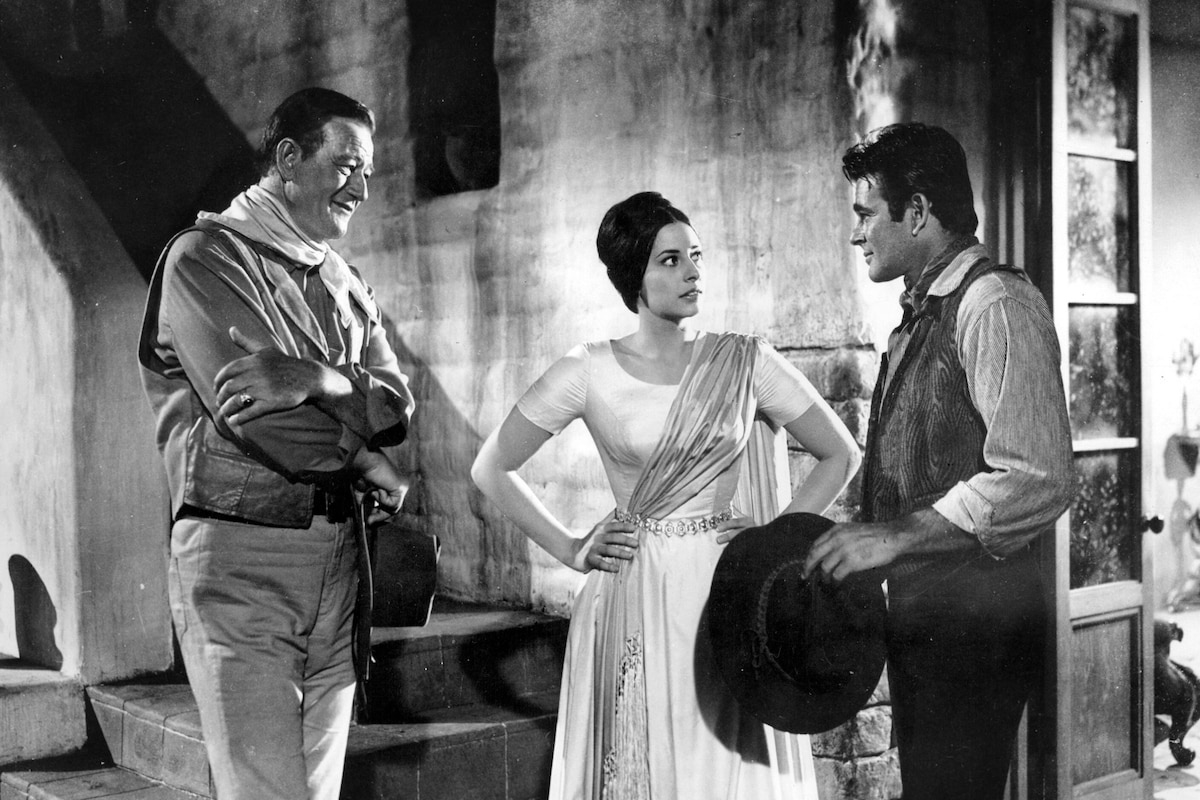
While The Comancheros (1961) was the last film directed by Michael Curtiz, it was arguably more a reflection of the work of John Wayne, who stars as Texas Ranger Jake Cutter but also had a big hand--uncredited--in casting, producing and even directing.
The project began as a 1953 novel by Paul Wellman. George Stevens bought the rights, intending to produce and direct a film version until he was offered the chance by Twentieth Century-Fox to make The Diary of Anne Frank (1959). As part of that deal, he sold the rights to The Comancheros to the studio. Fox producer David Weisbart proceeded to set it up as a reunion vehicle for Vera Cruz (1954) co-stars Gary Cooper and Burt Lancaster, but Weisbart then departed the studio. Soon Cooper and Lancaster were off the picture as well, replaced by John Wayne and Charlton Heston. But after starring in Ben-Hur (1959), Heston wasn't interested in teaming with another star, and he, too, departed this project, replaced by Tom Tryon.
Wayne's enormous stardom--and his new three-picture deal with Fox--gave him the leverage to now steer things. He got Fox to hand the producing reins to his old friend and industry veteran George Sherman, and the directing reins to fellow veteran Michael Curtiz, who was becoming frail and needed the work. Curtiz had directed Wayne in Trouble Along the Way (1953) and even in a bit part in Noah's Ark (1928). Wayne also got his favorite screenwriter, James Edward Grant, onboard to do a rewrite.
When Curtiz received the screenplay, he was on location in Italy shooting Francis of Assisi (1961). He showed the script to actor Stuart Whitman, essentially promising him the role that had already been cast with Tom Tryon. Back in Hollywood, Whitman approached Wayne and convinced him to press Fox to re-cast the role one final time. 1961 would wind up a busy year for Whitman: he acted in four films released that year, one of which, The Mark, would land him a Best Actor Oscar nomination for his performance as a child molester.
In June 1961, The Comancheros finally started shooting in Moab, Utah. The story follows a Texas Ranger (Wayne) who is bringing a gambler (Whitman) to prison, before they find themselves joining forces against outlaws led by Nehemiah Persoff. Whitman and Tom Mankiewicz, a future screenwriter here working as a third assistant director, later reported that Curtiz's health declined noticeably during filming; he usually fell asleep after lunch each day, and he made questionable decisions on the set. Whitman told Wayne biographer Scott Eyman, "Duke could see what was happening, took the reins and took over." When Curtiz injured himself in a fall and was hospitalized, Wayne--who had experience in directing The Alamo (1960)--took over completely. Stunt man Dean Smith said Wayne directed the entire final battle sequence, and Whitman estimated that Wayne directed about half the finished product. Curtiz, meanwhile, learned that he had cancer; he had been diagnosed years earlier but his family and doctor had not informed him. He died in April 1962.
The Comancheros opened on November 1, 1961, and was a sizable hit, earning solid reviews. Look for longtime character actor Guinn "Big Boy" Williams in his final role as Ed McBain. Known mostly for westerns, Williams had his first credit in 1919 and worked with Wayne on several films in the 1920s and '30s: another example of Wayne giving some work to an old friend.
By Jeremy Arnold
SOURCES:
AFI Catalogue of Feature Films
Scott Eyman, John Wayne: The Life and Legend
Alan K. Rode, Michael Curtiz
The Comancheros
by Jeremy Arnold | April 06, 2020
SIGN UP FOR OUR NEWSLETTERS

CONNECT WITH TCM