The film version of Fear Strikes Out was budgeted at $924,000, which included the $50,000 Paramount had paid to obtain the book rights. Just before shooting began, director Robert Mulligan had put the actors through an intense month-long rehearsal process where they all performed the entire script from start to finish like a stage play over and over until they were all completely comfortable in their roles. The only scene that was not carefully rehearsed was Piersall's pivotal breakdown on the ball field. That would come later.
While Anthony Perkins had proven that he was more than capable as an actor, he was not quite as convincing as a ball player. This presented a bit of a problem since he was depicting the life of a Major League athlete. "He couldn't throw a ball," recalled co-star Karl Malden. "They had to hire a real pro, Tommy Holmes, to go out there and teach him how to throw, and he still couldn't do it."
There was also another problem: Perkins was left-handed, while Jim Piersall was right-handed. It was a detail that would be hard to ignore for sharp-eyed moviegoers and baseball fans. Ideas were tossed around about how to handle this problem, including talk of flipping the film and printing it backwards, but the complicated logistics of doing such a thing made the studio drop the idea quickly. In the end, Perkins simply worked twice as hard to learn how to throw with his right arm, often practicing in the driveway in front of the Chateau Marmont.
When shooting began, Robert Mulligan barred the real Jim Piersall from visiting the set because he didn't want any of the cast members - especially Perkins - to be influenced by him. Piersall, however, was interested in what they were doing with his story and phoned the set to see how things were going almost every day.
Producer Alan Pakula also kept his distance from the set once the film started shooting because he wanted to give director Mulligan plenty of space to do his job. Pakula wanted to be collaborative without being intrusive. He would meet daily with Mulligan - once early in the morning before shooting began, and once at the end of the day - but that was all. "Alan was never on the set during shooting," said Mulligan. "It was his choice and not something I demanded...From time to time he'd drop by to walk a new set with me or welcome a new actor to the movie...Once the camera was ready to roll, he'd wish me luck and leave. His visits were always calm and positive."
Even though Paramount was positioning Anthony Perkins as a major leading man, Perkins made it clear that he was first and foremost an actor and wasn't interested in a lot of publicity. His intensity made him somewhat aloof from the crew, and his obvious lack of baseball skills made the ultra-serious actor the butt of many jokes. Before long the mood on the set became tense and antagonistic between Perkins and the crew. "Tony became more and more difficult as the film went on," recalled co-star Norma Moore. "By the time we were in the last third or fourth of the shoot, the crew was antagonized by him. They made snide remarks about him, and he just distanced himself."
The whispers about his relationship with actor Tab Hunter, who reportedly frequented the set, didn't help matters. Hunter had recently been outed as a homosexual by Confidential magazine, and Paramount was reportedly uncomfortable with the association between their star and Hunter.
To do damage control and help promote the film, Paramount sent Perkins and his co-star Norma Moore out on several public dates. The two would sometimes even double date in public with Tab Hunter.
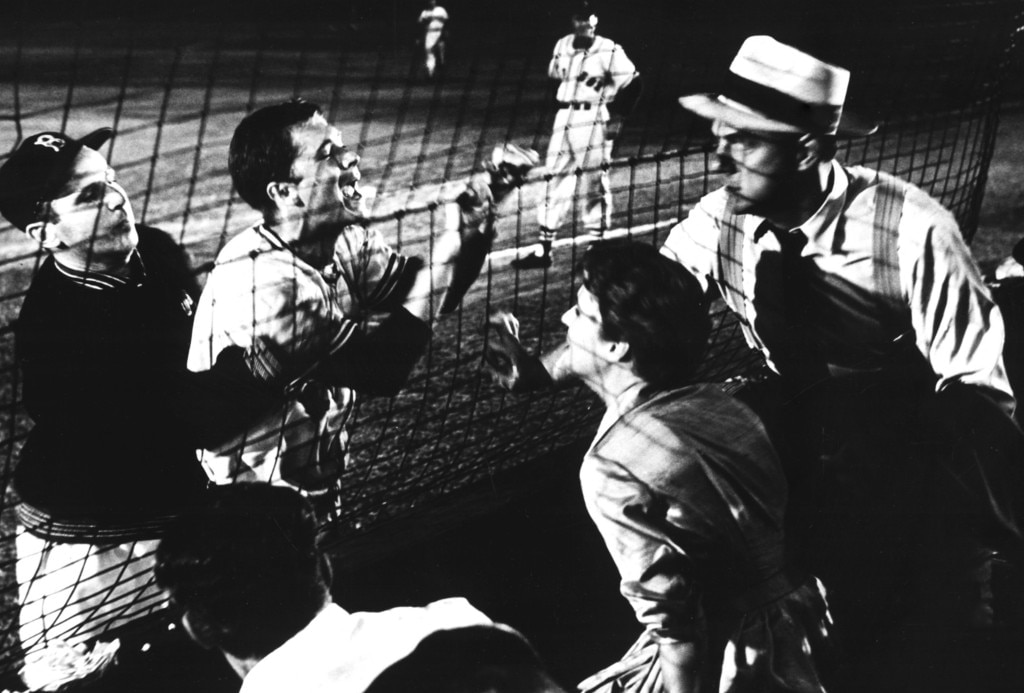
Anthony Perkins knew that his big nervous breakdown scene was coming, and he was very apprehensive about it. It hadn't been rehearsed in any detail, and tensions were so high on the set between him and the crew that many thought Perkins was close to breaking down himself. He and director Mulligan knew that the scene would be somewhat improvised and spontaneous, but neither was sure exactly what Perkins would do when the scene needed to be shot.
When Mulligan felt that the time was right to shoot the breakdown, he gave Perkins 24 hours notice for him to prepare. To do a scene in which he was required to rant and rave and be very physical was a challenge for Perkins, who by nature was quiet and introspective. Co-star Karl Malden recalled, "He was afraid of what he had to do, run and physically climb that fence. So he just had to let himself go and what happened, happened. It rubbed him out." The scene turned out to be one of the most powerful in the film, and most certainly in Perkins' career. "Though he didn't know the first thing about the game and had to be taught how to throw a ball from the outfield," said Malden, "he ended up turning in a stunning performance."
Fear Strikes Out was released in early 1957 and was well received by audiences and critics alike. As a result of the film's success, Alan Pakula and Robert Mulligan decided to form a partnership and continue their working relationship. "During Fear Strikes Out," said Mulligan, "we found that we enjoyed working together. We trusted one another. We liked one another. We had become friends...Alan brought up the idea and we shook hands on the spot. No lawyers. No agents. Just our word." The two would collaborate on six more films together including the classic To Kill a Mockingbird (1962) before going on to successful solo careers.
by Andrea Passafiume
Behind the Camera
by Andrea Passafiume | February 15, 2007
SIGN UP FOR OUR NEWSLETTERS

CONNECT WITH TCM