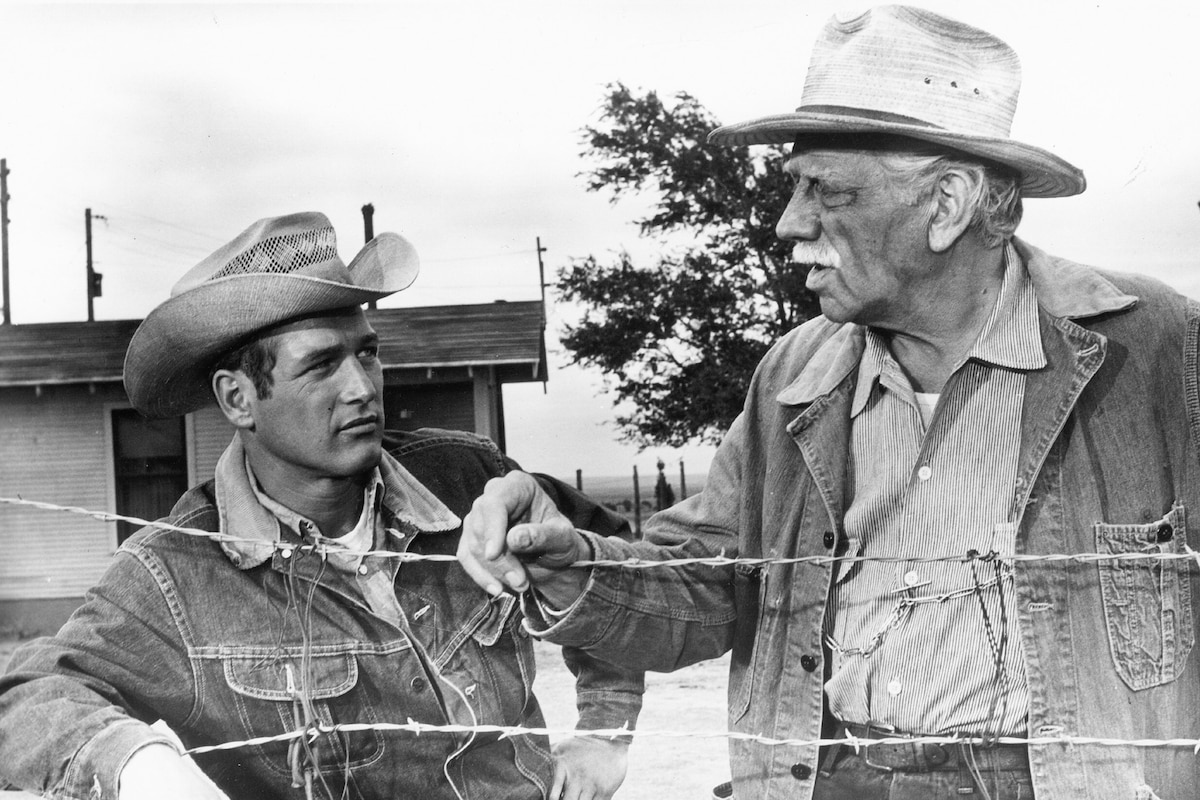
While on location in Texas, Newman dove into his role by living like the other hands on the ranch where they were filming-sharing meals, sleeping in the bunkhouse, working until his hands became callused. He studied their mannerisms and the way they walked and put it into the character of Hud.
Newman's commitment to the character spilled over into off-camera moments. One such incident involved the rare opportunity for him and Patricia Neal to hang out poolside at their motel. Neal found herself opening up emotionally about her daughter Olivia, who had died suddenly just months earlier of measles encephalitis. After her long outpouring, Newman stared at her for a long moment, then simply uttered "tough" and walked away. She was taken aback by his reaction. It was early in production, and they had not yet done a major scene together, so she hadn't really gotten to know him well or to understand his methods. Later on in the shoot, however, she realized he was already very much in character as Hud.
Despite this potentially rocky start, Neal said in her autobiography that she and Newman "worked together beautifully."
Neal was particularly proud of one unscripted moment that made it into the film. While talking to Newman's character about her failed marriage, a huge horsefly flew onto the set. Just as she says she's "done with that cold-blooded bastard," she zaps the fly with a dish towel. Ritt loved it and printed the take. Her favorite scene-telling Lon he'll "just have to ask someone else" what life is all about-was cut from the final print.
Newman got his first taste of how the female public reacted to him while shooting Hud on location. "Women were literally trying to climb through the transoms at the motel where I stayed." Although he found it flattering at first, he came to believe the reaction was largely to the characters he played rather than the real person behind them.
Douglas was delighted with Ritt's suggestion that the actor spend three weeks rehearsing with the rest of the cast to delve more deeply into the role and get a sense of continuity before shooting started, a reflection of the director's theatre background. "No one in the movie industry had suggested such a practice to me since I had worked with Ernst Lubitsch [in the 1930s]," Douglas said. Rehearsals consisted of a week of reading and discussing the script, followed by working within a taped-off ground plan of the set, just as a cast would in the theater. Ritt rehearsed them again for a day or two after they arrived on location in Texas, so that by the time the crew was ready to begin shooting, the actors "were engrossed in what Stanislavsky might have called the 'inner lives' of our characters."
Douglas said the atmosphere was amiable and professional but not a laughter-filled set, thanks largely to the inward nature of the cast. He described Newman as "shy, almost withdrawn" and said Neal was an "internal" person dealing with difficulty in her own life (including a stormy marriage to writer Roald Dahl and the recent death of her seven-year-old daughter). He described Brandon De Wilde as "moody, often to the point of being sullen" and frequently distracted in a manner typical of many young people.
Douglas enjoyed the people he met-not the wealthy cattlemen and landowners who were far too reactionary for his very liberal sensibilities but the ordinary ranch hands, who didn't mind that he imitated them to get a sense of character. He went out drinking with them many nights, and when the picture was finished, one of them presented him with a handmade belt with Douglas's initials on it in silver.
Largely because of the recent tragedy in their lives, Neal felt she couldn't leave her husband and surviving children at their home in England for the two months it would take to shoot the picture. Ritt offered to let her take a break to go home between the Texas locations and the Hollywood studio portion of the shoot.
Neal loved working with Ritt, feeling that for the first time since working with Elia Kazan on A Face in the Crowd (1957) she could do anything a director asked of her. Ritt was mutually happy with the working relationship and told her, "The minute I saw you handling those pots and pans, I could tell you were a woman who knew her way around a kitchen."
To shoot the film, Ritt hired master cinematographer James Wong Howe, whose career stretched back to the silent era. The two would eventually make four films together, Wong Howe's favorite work in the 1960s, but Hud was the one he considered the best.
All the exteriors and all the interiors except the inside of the Bannons' house were shot on location in Texas. The house interiors were done in a studio in Hollywood.
Background photography had already been completed when Wong Howe began his work on Hud. Ritt told him he wasn't happy with what had already been shot because it was very flat, with blank skies and no trees. The director suggested double-printing the clouds to fill in the sky, but arriving in Texas, Wong Howe was struck by the harsh beauty of the location and insisted on filtering out the clouds, instead of the other way around.
Wong Howe was ultimately very happy with the final look of Hud. There was one shot he was particularly proud of, in which Newman and De Wilde stood in the backyard with light coming from the porch. "I used incandescent lights," he later explained. "I took condensers out for the interior arcs to flood them out more and get sharper shadows."
by Rob Nixon
Behind the Camera
by Rob Nixon | February 15, 2007
SIGN UP FOR OUR NEWSLETTERS

CONNECT WITH TCM