The Man Who Never Was is an intriguing title, and it fits the historically based movie quite literally. One of its key characters is a nonexistent agent created by a British naval officer as a ploy to fake out the German military in early 1943, when World War II was at its height. Allied forces were set for a major invasion of Sicily to open up Mediterranean shipping routes, and it was essential to keep Germany from discovering and forestalling the invasion. How could this diversion be accomplished?
The answer was Operation Mincemeat, a scheme devised by Ewen Montagu, an officer in British naval intelligence who later wrote the 1953 book that inspired this Ronald Neame movie. Under the plan, officials would print a set of bogus documents indicating that the Allies were actually preparing to invade nearby Sardinia and Greece, throwing the Germans off the Sicilian scent. The big problem with this idea was that the Germans would surely question the authenticity of any papers that came too conveniently into their hands. But they might fall for the ruse if they believed the documents had come under their eyes entirely by accident. Working with a small team of assistants, Montagu arranged for an elaborate subterfuge whereby a drowned man would be washed ashore - on a Spanish coastline where Germans would be pretty sure to find the body - with the papers hidden in his clothing.
That made sense on paper, but even in wartime, the British couldn't deliberately drown someone for the sake of deceiving the enemy. So now the challenge was to find the corpse of a suitably young man who had recently died from a lung disease, producing symptoms that would look like drowning when the Germans conducted an autopsy. Even when the right sort of corpse was found, permission to use it might be hard to obtain: "Every body belongs to somebody," says the officer in charge of the search, "and it isn't a thing people want messed about."
A suitable cadaver was finally located and the necessary permission was obtained from the father of the deceased on the condition that his name remain a secret, a commitment upheld by Nigel Balchin's screenplay, which refers to him only by his pseudonym. The movie ends with a poignant onscreen text: "Military security and respect for a solemn promise have made it necessary to disguise the identity of some of the characters...but in all other essentials this is the true story of 'Major William Martin'."
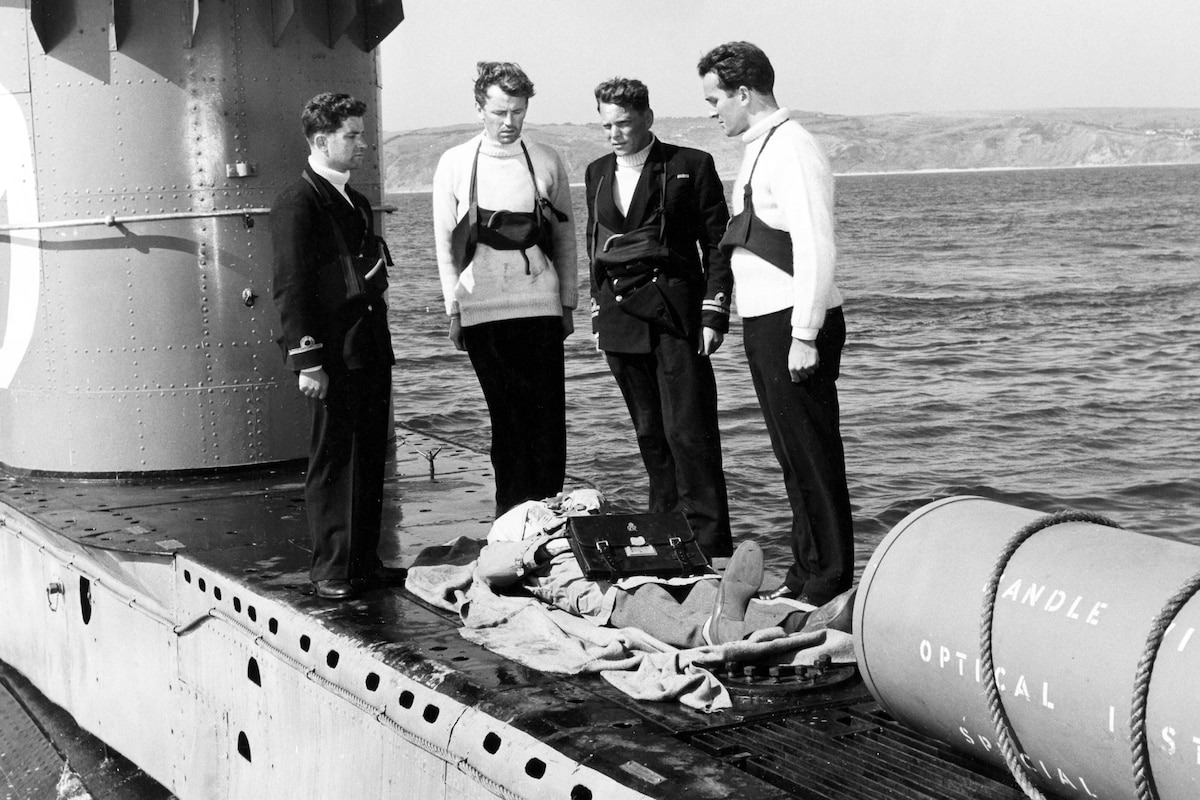
Much of The Man Who Never Was details the formulation of the plan, the many steps taken to create a convincing false identity for the supposedly drowned emissary and the key moment when the phony papers and their grim messenger are released into the sea from a submarine. The story takes a turn when German intelligence operatives examine the papers and conclude that they may not be genuine. Masquerading as Patrick O'Reilly, a dapper Irish gent, a German agent goes to London and looks for evidence of fakery by checking out places mentioned in the personal papers planted on Martin's body; his visit to a bank almost blows Martin's carefully constructed cover, but an alert bank manager and a call to Scotland Yard save the day.
Other important subplots involve Montagu's secretary, Pam, and her friend Lucy, who fabricate a love letter placed into Martin's wallet. In one of the film's most suspenseful episodes, O'Reilly confronts Lucy with questions about her alleged fiancé, about whom she knows next to nothing. Her grief over the death of her actual fiancé, a fighter pilot just killed in action, transforms her answer - that her fiancé doesn't exist - from a potentially disastrous revelation into a sign of deep emotional anguish. Moments like this make The Man Who Never Was an effective melodrama, but it's also a fine espionage yarn, and centering the plot on a nonexistent agent gives it a passing resemblance to Alfred Hitchcock's 1959 classic North by Northwest (1959).
The Man Who Never Was is a war movie without much in the way of war scenes, but director Neame keeps the story moving at a brisk pace, giving it enough bite and surprise to keep it involving from start to finish. Clifton Webb plays mildly against type as Lieutenant Commander Montagu, making a strong enough impression to remain a vivid presence even during the long stretch when the German agent dominates the story. Gloria Grahame and Josephine Griffin are excellent as Lucy and Pam, respectively, and Grahame delivers a stunning moment when a phone call at work informs her that her fiancé has been killed. Winston Churchill doesn't appear on the screen, but his voice is heard, impersonated by none other than the great comedian Peter Sellers in a non-comic performance that couldn't be more convincing.
Director: Ronald Neame
Producer: André Hakim
Screenplay: Nigel Balchin; Ewen Montagu (book)
Cinematographer: Oswald Morris
Film Editing: Peter Taylor
Art Direction: John Hawkesworth
Music: Alan Rawsthorne
Cast: Clifton Webb (Ewen Montagu), Gloria Grahame (Lucy Sherwood), Robert Flemyng (George Acres), Josephine Griffin (Pam),Stephen Body (Patrick O'Reilly), Laurence Naismith (Admiral Cross), Geoffrey Keen (General Nye), Moultrie Kelsall (father), Cyril Cusack (taxi driver), André Morell (Sir Bernard Spilsbury), Michael Hordern (General Cockburn), Allan Cuthbertson (vice-admiral), Joan Hickson (landlady), Terence Longden (Larry), Gibb McLaughlin (club porter)
Color-103m.
by David Sterritt
The Man Who Never Was
by David Sterritt | March 21, 2020
SIGN UP FOR OUR NEWSLETTERS

CONNECT WITH TCM