"Two people... with too much of everything that money could buy... trying to love.
They're Rich, They're Beautiful, and They Think They're in Love" read the posters for Jennifer On My Mind (1971), a film that reflected the times in which it was made, yet nearly forgotten today. The 1960s had ended, but the drug culture continued. Roger L. Simon's novel, Heir (which was also the film's original working title) was supposedly based on the real-life events that occurred in 1966 when Robert Friede, a 25-year-old socialite and heir to the Annenberg publishing fortune had been involved in the drug overdose death of 19-year-old Celeste Crenshaw, whose body was found in Friede's car.
Simon's novel was purchased for $50,000 by producer Bernard Schwartz, president of Joseph M. Schenck Productions, who held a press conference promoting the project, saying, "I want to make Heir the way it is - a real story about two youngsters born into money but who grow up without family affections and go on drugs. It is a story of today." To adapt his "story of today" for the screen, Schwarz originally hired writer Roger O. Hirson to adapt the screenplay, but Schwartz scored a coup by getting Erich Segal, then red-hot off of the blockbuster success of his novel and film adaptation of that novel Love Story (1970). United Artists got the distribution rights and a budget was preliminarily set at $2 million.
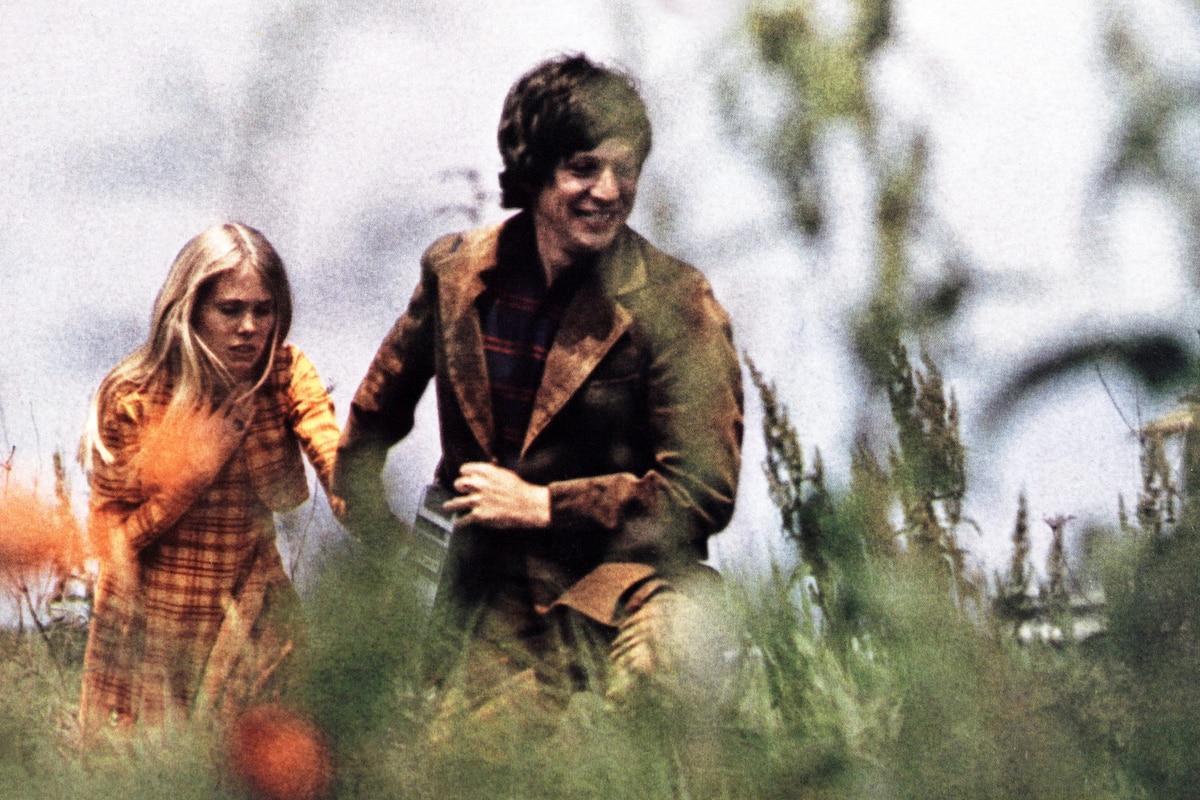
In the film, wealthy young Marcus Rottner (Michael Brandon), the grandson of a racketeer must deal with the heroin overdose of the girl he was in love with, fellow trust fund baby Jennifer De Silva (Tippy Walker). Moving back and forth between flashbacks, Marcus serves as narrator as he talks into his tape recorder about his relationship with Jenny: how they met in Venice, Italy a few months before, visiting her at her home in Oyster Bay, New York and her eventual accidental overdose. The appearance of his sister Selma (Renée Taylor), after being stood up by her brother for a lunch date, forces Marcus to act quickly to hide Jenny's body. The result comes serendipitously when some hippies run him off the road in a hearse and the car carrying Jenny's body is destroyed in flames.
Shot between late May and early August of 1970, Jennifer On My Mind was directed by Noel Black, with Erich Segal making a cameo appearance in the film in the role of a gondolier in Venice, where many of the film's locations were shot, along with New York City and New Jersey. Jennifer On My Mind was the first film for both Barry Bostwick (later to gain fame in The Rocky Horror Picture Show, 1975) and Jeff Conaway (best remembered for his roles in Grease, 1978 and the television show Taxi). Perhaps the most notable thing about Jennifer On My Mind is the appearance of an actor on the cusp of stardom, Robert De Niro. He only appears in one brief scene as Mardigian, a gypsy taxi driver, complete with a bandana and beard. Jennifer On My Mind was one of three films De Niro made in 1971, and all turned out to be disappointments. The following year, DeNiro would meet director Martin Scorsese and his career took off. Also in the cast were Steve Vinovich, Lou Gilbert, Chuck McCann and future Newhart star and director Peter Bonerz. Kim Hunter was listed in the film's credits for a short time because she had completed her scenes as Jenny's mother, but the preview in San Francisco was so bad that the producers decided to delete all of her scenes.
The cuts didn't help. Jennifer On My Mind debuted in New York City with an "R" rating on November 10, 1971 and appeared in only a few theaters for a very short time before United Artists pulled it from distribution entirely. Roger Greenspun, in his review for The New York Times wrote, "Noel Black Pretty Poison directed the film, and Erich Segal wrote it (after a novel by Roger Simon), and in the contest between Black's black humor and Segal's languorous humors both sides lose. In form, and indeed in content, Jennifer on My Mind resembles nothing so much as a satyr play to Love Story, if one were needed. But I am not sure the effect was intended, and with its hackneyed invention and incredible dialogue (and more incredible interior monologues), the film belongs to that desperate class of comedy that is almost never funny except when it doesn't mean to be. [...] In an odd way, Jennifer on My Mind is about aspirations rather than relations, and on that level it very nearly evades its absurdities to come round almost to the point of admiration."
SOURCES:
AFI|Catalog.
Screen: Cruel illusion:' Jennifer on my mind' at number of houses. (1971, November 11).Retrieved from https://www.nytimes.com/1971/11/11/archives/screen-cruel-illusion-jennifer-on-my-mind-at-number-of-houses.html
By Lorraine LoBianco
Jennifer on My Mind
by Lorraine LoBianco | March 21, 2020
SIGN UP FOR OUR NEWSLETTERS

CONNECT WITH TCM