In 2015, the Film Society of Lincoln Center programmed a retrospective, "Action and Anarchy: The Films of Seijun Suzuki," bringing much-needed attention to the work of this Japanese cinema master. Although not as well known internationally as that country's triumvirate of great directors Ozu, Kurosawa and Mizoguchi, Suzuki has been highly respected and influential globally, inspiring such directors as Jim Jarmusch and Quentin Tarantino.
In the mid-1950s, Suzuki (1923-2017) was one of several young directors who joined the long-established Nikkatsu studio. Over the course of the next 10 years, he cranked out dozens of low-budget crime and action pictures, developing his increasingly inventive visual style with little interference until one film, Branded to Kill (1967), was judged by the studio to be incomprehensible and badly botched. The picture was shelved for several years and got its director fired. Nevertheless, despite a decreased output in the years that followed, Suzuki has been seen as one of the leading lights of Noberu Bagu, the cinematic New Wave that arose in Japan roughly around the same time as similar landmark movements in France and England.
Some have seen Branded to Kill and the break with Nikkatsu as the emergence of Suzuki as an independent filmmaker who increasingly explored the boundaries of film, but this work from a few years earlier already shows a confident stylist transforming routine B movie assignments into what The New York Times critic Manohla Dargis called "Japanese cinema in all its frenzied, voluptuous excess."
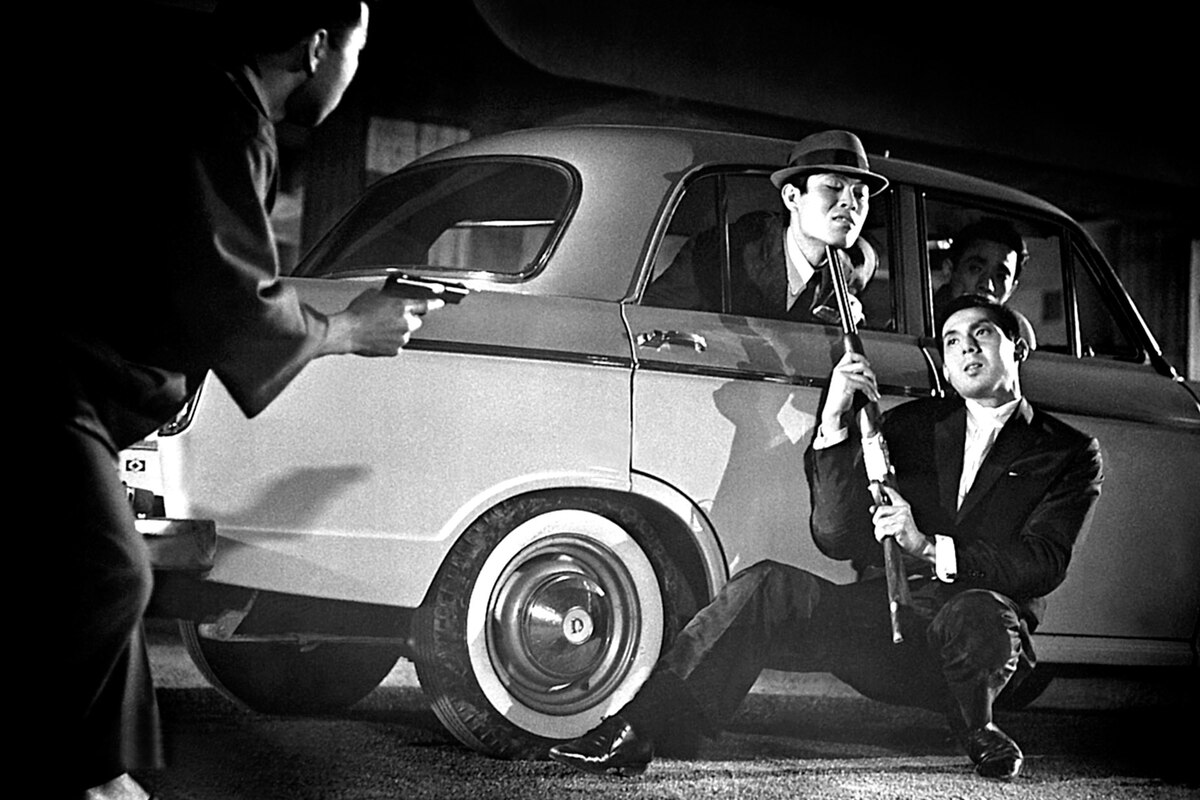
Youth of the Beast stars one of Suzuki's most iconic actors (eight films together), the baby-faced, chipmunk-cheeked Jô Shishido, also the lead in Branded to Kill. Here he plays a thug who starts a war between rival crime gangs for reasons that are gradually revealed in the course of the story - a simple enough noir set-up turned on its head with hallucinatory shots, a mix of melodrama and comedy and a sense of the irrational and abstract, as Suzuki and company blow through the workaday crime plot (from a novel by Haruhiko Ôyabu). What stands out here is, according to Howard Hampton's 2005 Criterion Collection essay, "the sense of a director hitting his stride, full of devil-may-care assurance and try-anything imagination, coupled with an uneasy, palpable boredom with the stale trappings...of the cops'n'yakuza form. "
This is the first Suzuki film to begin in black and white and turn suddenly to the cranked-up pop-art colors for which he's known.
Youth of the Beast was almost completely ignored by Japanese critics when it was released and did not make it to the U.S. until 30 years later. Even then, it went virtually unnoticed until a new generation of enthusiasts began to discover it in the 21st century. In 2012, the Hong Kong action director John Woo (Hard Boiled, 1992; Face/Off, 1997) announced he would remake the film as Day of the Beast. The project has yet to be produced, most likely because of the demise of Woo's production company with producer Terence Chang.
Ôyabu's writing was for a time a staple of Japanese crime films, adapted into the Toshiro Mifune vehicle The Last Gunfight (1960); Cruel Gun Story (1964), another Shishido picture; and Suzuki's Detective Bureau 2-3: Go to Hell Bastards! (1963). This was not the only film version of Ôyabu's work to be slapped with a "beastly" title: City of Beasts (1970), The Beast Shall Die (1974), The Beast to Die (1980).
Director: Seijun Suzuki
Producer: Keinosuke Kubo
Screenplay: Ichirô Ikeda, Tadaaki Yamazaki, based on a novel by Haruhiko Ôyabu
Cinematography: Kazue Nagatsuka
Editing: Akira Suzuki
Production Design: Yoshinaga Yoko'o
Music: Hajime Okumura
Cast: Jô Shishido ("Jo" Mizuno), Misako Watanabe (Kumiko Takeshita), Tamio Kawachi (Hideo Nomoto), Minako Katsuki (Sawako Miura)
By Rob Nixon
Youth of the Beast
by Rob Nixon | March 19, 2020
SIGN UP FOR OUR NEWSLETTERS

CONNECT WITH TCM