To appreciate this film fully, we have to start with its creator, Takeshi Kitano, the Japanese director, author, comedian, TV host and actor known best in his home country by his stage name Beat Takeshi. He is often seen as the successor to Japan's most internationally famous director, Akira Kurosawa.
Kitano slipped into filmmaking almost accidentally when he took over for the ailing director of a movie he was acting in, and he has kept up a busy directing career alongside all his other work since 1989. His earliest films, almost exclusively centered on yakuza (gangster) characters, had some degree of popularity in his home country, but he wasn't taken seriously as a director until the unexpected global critical success of Fireworks/Hana-Bi. The film garnered accolades from film societies and academies, critics and festivals throughout the world, capped with a Golden Lion, the top award at the prestigious Venice Film Festival.
The story has the violence and tension characteristic of the yakuza genre, but Kitano imbues it with a serenity and tender humanity, along with a formal and narrative minimalism, that render the work, in the eyes of many reviewers and audiences, unclassifiable and hard to describe. There is little dialogue in the film and long pauses between lines. American critic Roger Ebert, rating the film highly in 1998, said Fireworks "lacks all of the narrative cushions and hand-holding that we have come to expect" and called it "a demonstration of what a story such as this is really about, fundamentally, after you cut out the background noise."
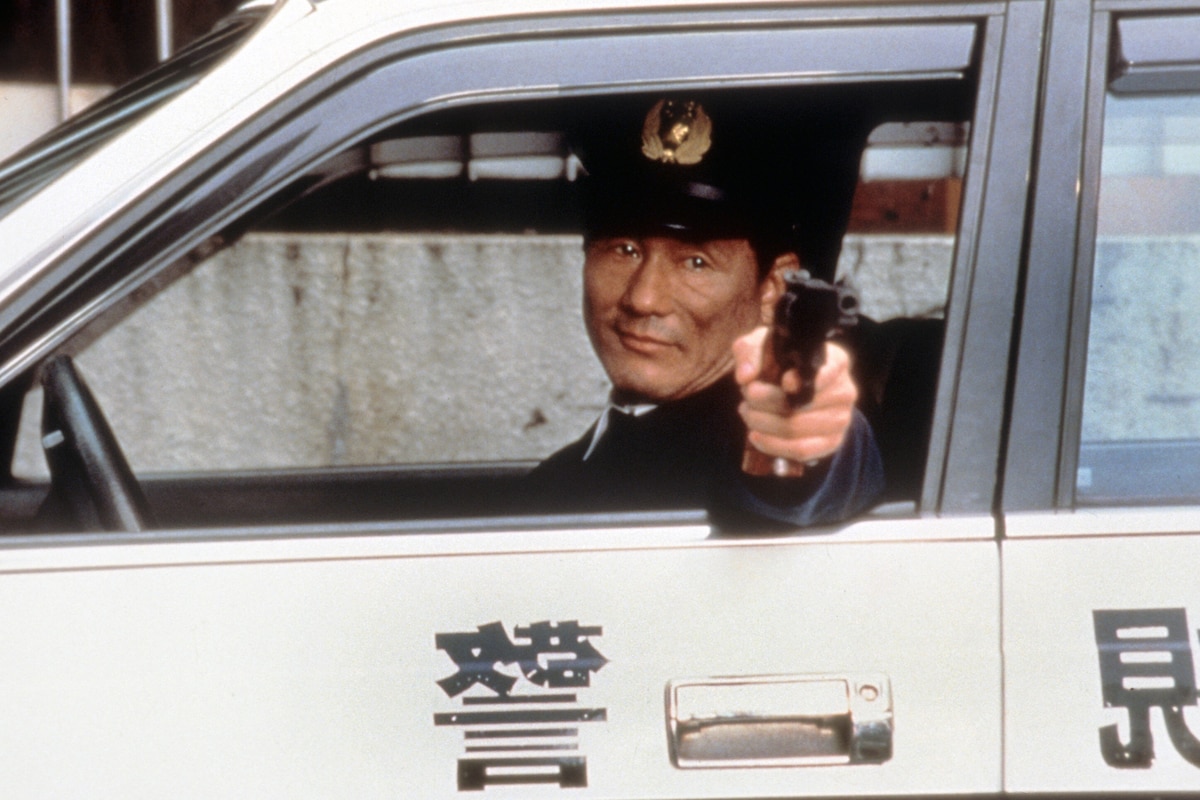
Kitano himself, using his stage name, stars as Nishi, a violent cop forced into retirement by an accident that caused the death of one colleague and severe injuries to two others. Unemployed, he spends most of his time caring for his leukemia-stricken wife and borrowing money from the yakuza to stay afloat. An act of kindness requiring a daring robbery by Nishi sets into motion an ultimately violent and tragic chain of events.
Many critics and theorists - and Kitano himself - have noted a stylistic and thematic shift in his directing work, marked by a brutal motorcycle accident in 1994 that left him seriously injured and disfigured. Film scholar Adam Bingham, in a 2015 book-length study significantly titled Contemporary Japanese Cinema Since Hana-Bi, notes how the film and its year of release signaled an international resurgence of Japanese cinema and a domestic commercial upswing following the end of the country's traditional studio system. As Bingham points out, however, citing several other theorists and critics, the influence of the film goes beyond the commercial, displaying "questions and anxieties about identity and selfhood, both personal and national," a formal preoccupation with games and puzzles and abrupt switches in tone and narrative that interrupt and disrupt the story's trajectory.
One such sudden shift occurs right at the beginning of the film when a credit montage of surrealistic paintings over soft, lyrical music gives way to a brief sequence with both violent and comical overtones that remains unexplained until later in the movie, one of several examples of non-linear storytelling Kitano employs.
The paintings in the film are by Kitano himself. Like the cop character in the story who takes up painting after being partially paralyzed in the line of duty, Kitano took up art while recovering from his near-fatal motorcycle injuries.
The score is by the award-winning composer Joe Hisaishi, who is most closely associated with Japan's master of animation Hayao Miyazaki; the two having worked together on 11 features, among them Spirited Away (2001) and The Wind Rises (2013), as well as several shorts. Hisaishi scored seven of Kitano's films. The almost cheerful and romantic music he wrote for the climax of the picture is, once again, halted abruptly by Nishi's actions, leaving the last shots of the film in silence followed by the tranquil sounds of the sea.
Director: Takeshi Kitano
Producers: Masayuki Mori, Yasushi Tsuge, Takio Yoshida
Screenplay: Takeshi Kitano
Cinematography: Hideo Yamamoto
Editing: Takeshi Kitano, Yoshinori Ohta
Art Direction: Norihiro Isoda
Music: Joe Hisaishi
Cast: Beat Takeshi (Nishi), Kayoko Kishimoto (Nishi's wife), Ren Osugi (Horibe), Susumu Terajima (Nakamura), Tetsu Watanabe (Scrap Yard Owner)
By Rob Nixon
Fireworks
by Rob Nixon | March 19, 2020
SIGN UP FOR OUR NEWSLETTERS

CONNECT WITH TCM