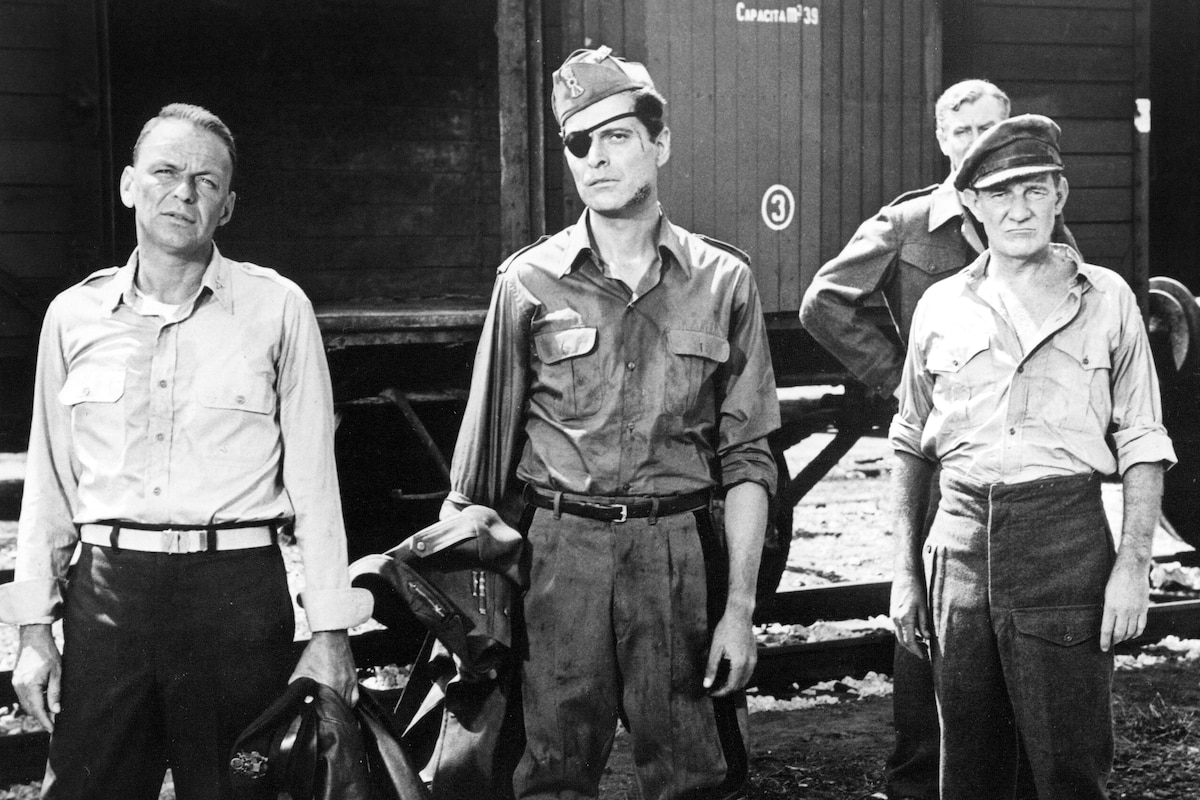
"The most dangerous film ever made," asserted producer Saul David of Von Ryan's Express (1965), a World War II action movie filmed largely in the Italian Alps. Unlike other combat films of the era, this was not an all-star film but a vehicle for Frank Sinatra as a fighter pilot who crash-lands in Italy. He is taken to a POW camp where he clashes with the ranking British officer (Trevor Howard) over whether to organize an escape and how to deal with their captors. Eventually the action shifts to an extended sequence on a train that is taken over by the Allies; it hurtles through mountainous Nazi territory with breathtaking drops and with a German troop train hot on its tail.
In an article published at the time of the film's release, director Mark Robson detailed his meticulous prep work and the challenges of the production. "Our 'set' was half of Italy," he wrote, "from beyond Rome and across the Alps, following the course of a 16-boxcar freight train which was our major 'prop' in the story of the escape of 600 American and British prisoners of war from Nazi-controlled Italy." Robson spent three months preparing by simulating every move with a toy train and tracks. "I used a strong flashlight to represent the sun in planning what the lighting would be at all times of day on a northbound train."
Despite the planning, Robson was surprised to learn on location that the train cars he had to work with had slanted roofs, not flat-tops, which forced him to reimagine the hand to hand combat planned for atop the moving cars. He was also at the mercy of the Italian railway system, sharing the tracks with regular trains. "When I would get word that a fast freight or a passenger express train was coming our way, just when I was halfway through a sequence, I had to think fast how to get the action I wanted in the same matching light before I would have to pull the train into a side track."
After Italy, the company moved to El Chorro, Spain, "for scenes on a narrow railroad trestle in the mountains, with a 3000-foot drop to a gorge below." Trevor Howard came close to losing his life on this location. "As Howard led a group of men on foot across that trestle," Robson recalled, "two rotten ties gave way beneath him. Luckily, the thick cartridge belt he wore caught on a projection, and the two other actors -- Edward Mulhare and Sergio Fantoni -- pulled him to safety."
After the location work, the film shot for a month on a Twentieth Century-Fox soundstage, including scenes of actors rolling out from under a moving train, between wheels which had a ten-foot clearance between them. To achieve the strafing of the train by aerial rockets, miniatures were used in combination with a real train. Most of the action was filmed without sound, with about 70% of the entire film's dialogue added via post-production looping sections.
The picture was based on a novel by David Westheimer, who got the idea from his own experience as a prisoner of war in Italy. Frank Sinatra read it and wanted to star in a film version but he learned that Fox already owned the rights. Fox had recently lost a lot of money with Cleopatra (1963) and needed a hit. The studio was now back under the control of president Darryl Zanuck, who had left in 1956 in order to be an independent producer. Zanuck installed his son, Richard, as head of production, and Richard approved a deal for Sinatra that paid the star $250,000 plus fifteen percent of the gross.
Sinatra received superstar treatment. He clashed with director Robson, demanding that his scenes be shot consecutively. Author James Kaplan wrote that once on location, this proved difficult and expensive to achieve, which Robson explained to his star. "I know all that," Sinatra replied in front of cast and crew. "I didn't tell you how to schedule the picture. I just told you what I wanted, and you told me, in front of witnesses, that you could do it. That was the deal. So now do it! You hear?"
Sinatra was flown daily to the Italian Alps set on a chartered helicopter supplied by Fox, while everyone else made an hours-long drive. Actor James Brolin, appearing in one of his earliest movies, later told Trevor Howard's biographer Michael Munn of driving with Howard to the location in an old Citroen. "We'd be on the set from 8:00 and by about 10:30 nobody's shot anything. Then the helicopter arrives. Out steps Frank Sinatra. Everybody's ready for him in front of the cameras. The director calls 'Action! Camera!' and then you hear 'Cut! Print!' and he's back in the helicopter and off home, and we're still standing there. I think Trevor was a bit put out by all this favored treatment, which is understandable."
But the result was a solid performance by Sinatra that drew enthusiastic reviews, as did the crisp, well-paced film overall, which was a major commercial hit. "Sinatra at his best as an actor," said the Hollywood Citizen-News. "Fast, suspenseful and exciting," declared Variety. "The best of its kind since The Great Escape (1963)," said The Hollywood Reporter. "The action sequences on the train are thrillingly handled. The logistics of these scenes are enormous. Yet the picture slips along as slick as a highball express."
SOURCES:
James Kaplan, Sinatra: The Chairman
Timothy Knight, Sinatra: Hollywood His Way
Michael Munn, Trevor Howard: The Man and His Films
Mark Robson, "Filming the Unexpected." Los Angeles Herald-Examiner, July 18, 1965
By Jeremy Arnold
Von Ryan's Express
by Jeremy Arnold | March 13, 2020
SIGN UP FOR OUR NEWSLETTERS

CONNECT WITH TCM