Malcolm X (1992)
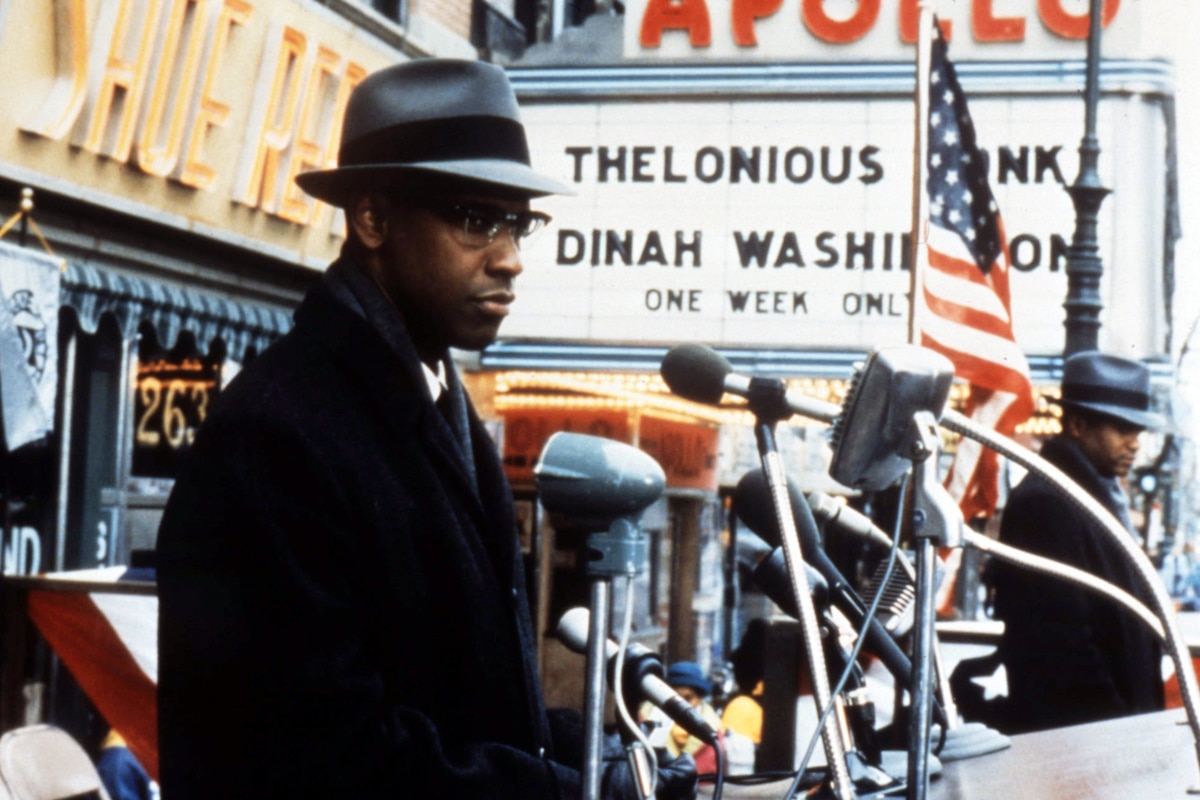
Producer Marvin Worth acquired the rights to The Autobiography of Malcolm X in 1967. It took 25 years before Spike Lee directed the first film adaptation to wide acclaim in 1992. It is a kaleidoscopic biography of the controversial and hugely influential black civil rights leader, anchored by a passionate lead performance by Denzel Washington, who was nominated for Best Actor at the Academy Awards.
Worth had met Malcolm X when he was a kid, telling The New York Times that he first saw him on 52nd Street in NYC in the 1940s, when Malcolm was nicknamed "Detroit Red" selling weed at jazz clubs. Worth remembered that Malcolm was "16 or 17 but looked older. He was very witty, a funny guy, and he had this extraordinary charisma." Worth licensed The Autobiography from Alex Haley (who collaborated on the book) and Malcolm X's widow Betty Shabazz.
Soon after getting the rights, he hired James Baldwin to write the script. Baldwin later wrote in Esquire that, "This was a difficult assignment, since I had known Malcolm, after all, crossed swords with him, worked with him, and held him in that great esteem which is not easily distinguishable, if it is distinguishable at all, from love." Baldwin was writing the screenplay when Martin Luther King Jr. was murdered. He eventually completed the script with assistance from Arnold Perl (who was a victim of the blacklist in the 1950s).
Over the years, scripts were also written by David Mamet, Calder Willingham, David Bradley and Charles Fuller. Spike Lee read all of these during the research process and told Cineaste Magazine that "the Baldwin/Perl script was the best. James Baldwin was a great writer and he really captured Harlem and that whole period. He was a friend of Malcolm's." The recreation of Harlem in the 1940s is a spectacular feat, from the eye-popping zoot suit designs of Ruth Carter to the remarkable detail of Wynn Thomas' production design, from the nightclubs to the barber shop.
Spike Lee re-wrote the Baldwin/Perl screenplay, making enough changes that the estate of James Baldwin asked for his name to be removed from the credits (Spike Lee and Arnold Perl are the credited writers). The major revisions Lee made were to the third act, since more information had come out about Malcolm X's assassination. Spike Lee also wanted to "tie the film into today. I did not want this film just to be a historical document." So he opened the film by laying audio of one of Malcom's speeches over footage of the Rodney King beating. And he ends with a speech from Nelson Mandela, and footage of black schoolchildren from Harlem to Soweto saying, "I am Malcolm X."
The film, even at three-and-a-half hours, cannot come close to covering every event in Malcolm X's remarkable life, so it focuses on major phases - his time as a small-time criminal in Harlem, his imprisonment and conversion to Islam, his rise to the top of the ranks of the Nation of Islam, and his subsequent falling out with that organization's leader Elijah Muhammad. It's like four movies in one, held together by Lee's visual bravado and the haunting score by Terence Blanchard, which undergirds the whole epic edifice.
The production was ambitious and difficult, even securing permission from Saudi Arabia to shoot in Mecca, the first American film to be allowed to do so. The film was budgeted at $28 million and came in at $33 million, a $5 million overage not unusual for a film of that size, but it caused the Completion Bond Co. to take financial control of the movie from Warner Bros., who then refused to approve any more expenditures. Lee was only able to complete the film due to donations from black celebrities like Oprah Winfrey, Michael Jordan, Magic Johnson, Prince, Bill Cosby and Peggy Cooper Cafritz. Warner Bros. could have floated the cash to get the film to the finish line, but instead allowed the Completion Bond Co. to freeze production. Spike Lee was understandably incensed, telling Cineaste, "Racism is part of the fabric of American society, so why should the film industry be exempt? I mean, how is it that Dan Aykroyd, a first-time director, can get $45 million to do Nothing But Trouble? $45 million! They're willing to give more money to these white boys right out of film school than they are to accomplished black directors. In terms of controversy, films go over budget all the time, so why am I on the front page?"
But the production team persevered and completed a modern classic that was later selected for the National Film Registry by the Library of Congress. With a fiery, committed performance by Denzel Washington at its heart, Malcolm X is a complex, thought-provoking, and wildly entertaining portrait of an American original.
By R. Emmet Sweeney
Malcolm X
by R. Emmet Sweeney | March 13, 2020
SIGN UP FOR OUR NEWSLETTERS

CONNECT WITH TCM