Filmmaker Satyajit Ray burst upon the international film scene in 1955 with his poignant, powerful debut feature Pather Panchali, a poetic and powerful portrait of life in rural India. For the next few years, his next films explored life in India's past or in the provinces until The Big City (1963), his tenth feature. Titled Mahanagar in India, it observes the collision of traditional culture with the contemporary world, specifically the economic desperation of urban life in 1950s Calcutta as the banks collapsed.
It was Ray's first film set in the contemporary world of modern urban life but he had been struggling to bring his screenplay, adapted from the short story "Abataranika" by Narendranath Mitra, to the screen since 1955. The film follows the journey of Arati, a wife and mother who steps out of her traditional role as homemaker to take a job to help out the family income. When her husband Subrata loses his job in the bank failures, she becomes the family's sole breadwinner. Ray, who was raised by a widowed single mother who worked outside the home to support them both, was deeply committed to the project and to the theme. But he had difficulty in securing financing for the film, which was more ambitious than his gentle debut feature, and he needed an actress who could carry the leading role. He overcame both challenges by 1963.
For the role of Arati, Ray turned to young actress Madhabi Mukherjee, who had appeared in films by some of India's leading filmmakers. This was her first leading role. "I was stunned," she wrote in her autobiography, after reading the script. "This was the first woman-centered screenplay I had encountered. I was not going to play second fiddle to the main male character as in all plays and films I had acted in or was familiar with." Mukherjee remembered Ray as a compassionate man and a generous director. On the first day of shooting, she discovered that she had a sty in her eye. "Don't worry," Ray said. He framed the shots so her afflicted eye was hidden from the camera until it healed. Mukherjee went on to star in two more Ray films, Charulata (1964) and The Coward (1965), and became a major star of the Bengali film industry in a career that continued through the 2000s.
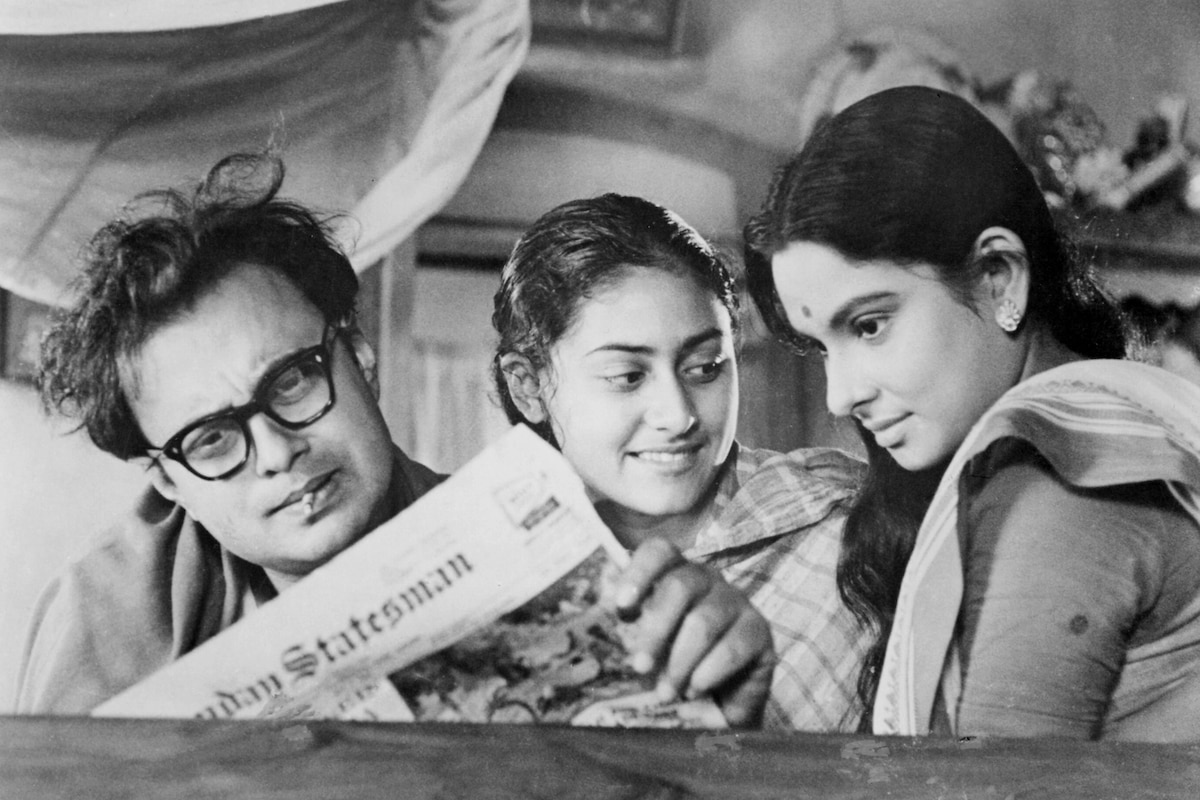
The Big City is also a portrait of life in Calcutta as modern economics collides with traditional social roles. Three generations live in the overcrowded apartment of Arati and her husband Subrata. To convey the culture of an extended family living together in a lower-middle-class existence, Ray crammed them into a set he described as "the smallest rooms ever built," and filled the soundtrack with the ever-present radios of the neighbors bleeding through the walls, reminding us of the close quarters of this urban life. And where Subrata's retired father voices criticisms of Arati's empowerment, Subrata's teenage sister Bani is inspired by the newfound independence in sister-in-law Arati. Ray cast unknown 15-year-old actress Jaya Bhaduri in the role of Bani. The young woman later changed her name to Jaya Bachchan, went on to become a major star of 1970s cinema, and served four terms in the India Parliament.
Ray situates them within a socially and racially diverse Calcutta and takes on racial prejudice as well as sexism through the character Edith, a young Anglo-Indian woman who embraces Western culture, from fashion to the newfound freedoms of women, but is shunned by her coworkers until Arati befriends her. This touchy theme resulted in a scandal when the film was accused of prejudice against the Anglo-Indian community by an MP who had not even seen the film. Indira Gandhi, then the minster in charge of cinema and broadcasting, was called to investigate the charge and found no substance to the charge, clearing the way for exhibition.
The Big City was widely praised at home and abroad. Ray won the Silver Bear for Best Director at the Berlin Film Festival and the film was India's official entry for the foreign language film category of the 36th Academy Awards, though it was not among the five nominees. And when the film was screened at a film festival in Dhaka (now Bangladesh), a near-riot broke out when thousands of people lined up for the three scheduled screenings, far more than the venue could accommodate. The festival organizers scheduled ten additional screenings at the last minute and the film ran consecutively for twenty-four hours to meet the demand.
Sources:
The Cinema of Satyajit Ray, Darius Cooper. Cambridge University Press, 2000.
My Life, My Love: An Autobiography, Madhabi Mukherjee. Palo Alto: The Stanford Theatre Foundation, 1999.
"Big City: A Woman's Place," Chandak Sengoopta. The Criterion Collection, 2013.
Our Films, Their Films, Satyajit Ray. Hyperion, 1994.
Satyajit Ray: The Inner Eye, Andrew Robinson. University of California Press, 1989.
Madhabi Mukherjee on The Big City, video interview produced by Abbey Lustgarten. The Criterion Collection, 2013.
IMDb
By Sean Axmaker
The Big City (1963)
by Sean Axmaker | March 13, 2020
SIGN UP FOR OUR NEWSLETTERS

CONNECT WITH TCM