"Here's That Man Again in a Gay New Misadventure!" and "Lock Up Your Dollars and Doughnuts...here's that man again! He's the cheekiest man in town!" were some of the slogans advertising The Promoter (1952), originally titled The Card. The "cheeky" promoter of the American title was one of Britain's biggest stars in the post-war years, Alec Guinness, who had become a modern-day Lon Chaney due to his ability to lose himself in a character, and the characters were many and varied. Unlike many of the films Guinness would make for Ealing Studios, The Promoter only required one character for Guinness to play, and while he does so admirably, it does not use his talents to best effect.
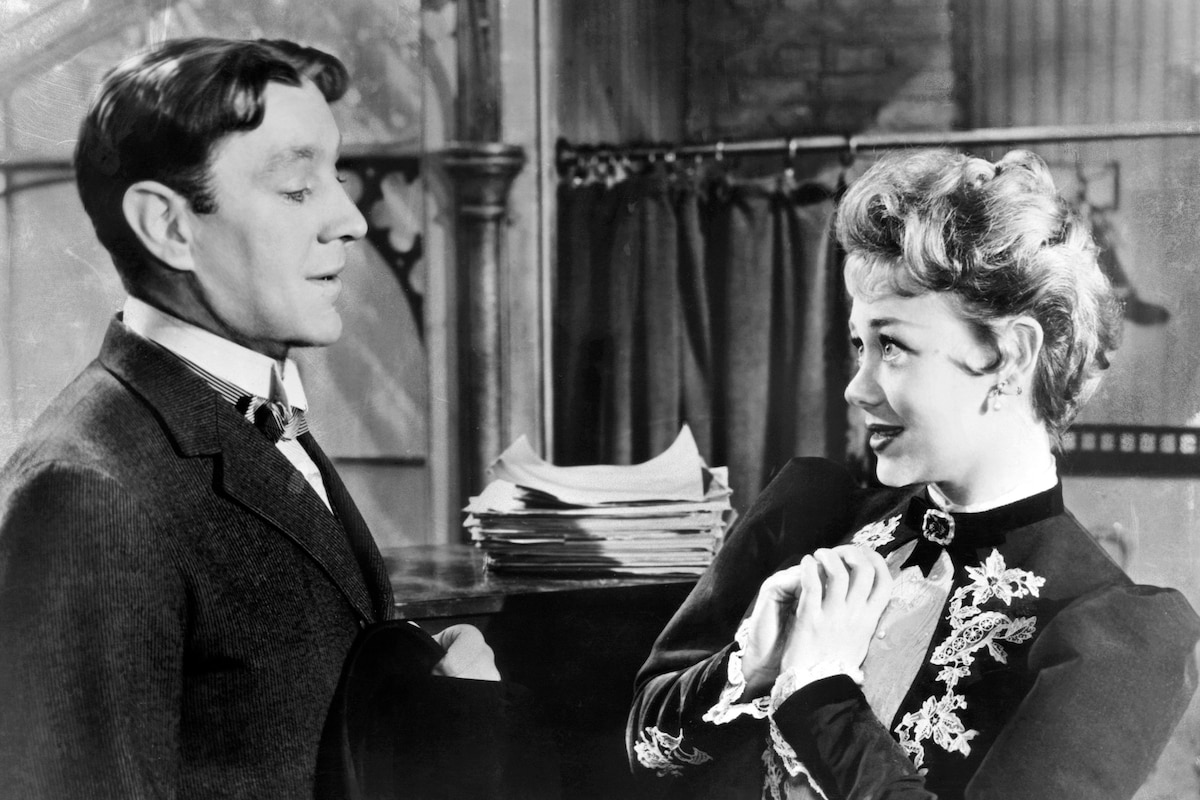
In this film, based on Arnold Bennett's 1911 novel, Guinness plays Edward Henry Machin, known as Denry, a poor washerwoman's son who is obsessed with getting ahead in life. As a young man, he is not above changing his grades in order to get into a school for the sons of wealthy men. At 16, he works as a junior clerk to a town solicitor and manages to sneak into a ball attended by the beautiful Countess of Chell (Valerie Hobson) where he wins a bet by asking her to dance. This solidifies his reputation of being "the card" of the original British title. With the help of the Countess' patronage, Denry career-hops from rent collector to loan shark to town councilor to mayor as he climbs the ladder of upward mobility. Along the way, he falls in love with an equally ambitious dancing teacher (Glynis Johns) but ends up marrying her younger friend (played by a teenaged Petula Clark) when he realizes that she is the one he really loves. Also in the cast were Joan Hickson (who would become familiar to American audiences as TV's Miss Marple) and Wilfrid Hyde-White, best remembered for his role of Col. Pickering in My Fair Lady (1964).
The majority of The Promoter was shot at both the Pinewood Studios in Iver Heath, and the D&P Studios in Denham, Buckinghamshire, England, with location work done at Llandudno, Conwy, Wales and Stoke-on-Trent, Staffordshire, England. Guinness had worked with Ronald Neame when he was David Lean's assistant director on Great Expectations (1946) but it was his first and only film with Petula Clark. It would be Guinness who delivered Petula Clark's first on-screen kiss, but she would later remember that the experience was less than exciting, "When we kissed, I don't think the earth moved for either of us." There would be equal dissatisfaction with the role, as Guinness would recant in a 1985 television interview in which he complained that his build up as the "Man of a Thousand Faces" didn't apply to all of his films of the period, particularly The Promoter because it did not require any more strenuous makeup or transformation than a toupee. Later in his life, Guinness would dismiss his early comedic roles, preferring to be remembered for the more important ones like in The Bridge on the River Kwai (1957) which allowed him to be a serious actor.
When the film was released in the United States in October 1952, debuting in New York at the Fine Arts Theater, Bosley Crowther of The New York Times praised both Guinness and Johns but criticized the film, writing that "Neither of these young folk is roguish. They're just fast at embracing the main chance. And the whole amusement and delight in the picture is watching how neatly they perform. [...] And there lies the weakness of this picture. As a sketch of two characters, it is grand, even though the depths of the two characters are never revealed or even probed. Mr. Guinness' scamp is a cross-view of innocent-appearing treacheries--a seeming Milquetoast with monstrous cunning, on whom it is impossible to put your thumb. And Miss Johns' self-propelling young lady is a bundle of feminine guile, but she too is full of contradictions and apparent cross-purposes. [...]But the script [...] just ambles along very gently from one situation to the next, permitting Mr. Guinness primarily to round out his faintly shocking sketch. [...] The Promoter, while vastly amusing in spots, is not a first-rate Guinness show." Although the screenplay may not have won any awards, The Promoter was nominated Best Sound Recording at the 1953 Academy Awards, losing to another British company, London Film Productions for Breaking the Sound Barrier (1952).
By Lorraine LoBianco
SOURCES:
150 Finest Films of the Fifties. (n.d.)
1953. (n.d.). Retrieved from https://www.oscars.org/oscars/ceremonies/1953
Nina Metz, Nina Metz. (2014, July 16). The lighter side of Alec Guinness.
THE SCREEN IN REVIEW; Alec Guinness and Glynis Johns Play a Crafty Pair in 'ThePromoter' at Fine Arts. (1952, October 29). Retrieved from https://www.nytimes.com/1952/10/29/archives/the-screen-in-review-alec-guinness-and-glynis-johns-play-a-crafty.html
The Promoter
by Lorraine LoBianco | March 02, 2020
SIGN UP FOR OUR NEWSLETTERS

CONNECT WITH TCM